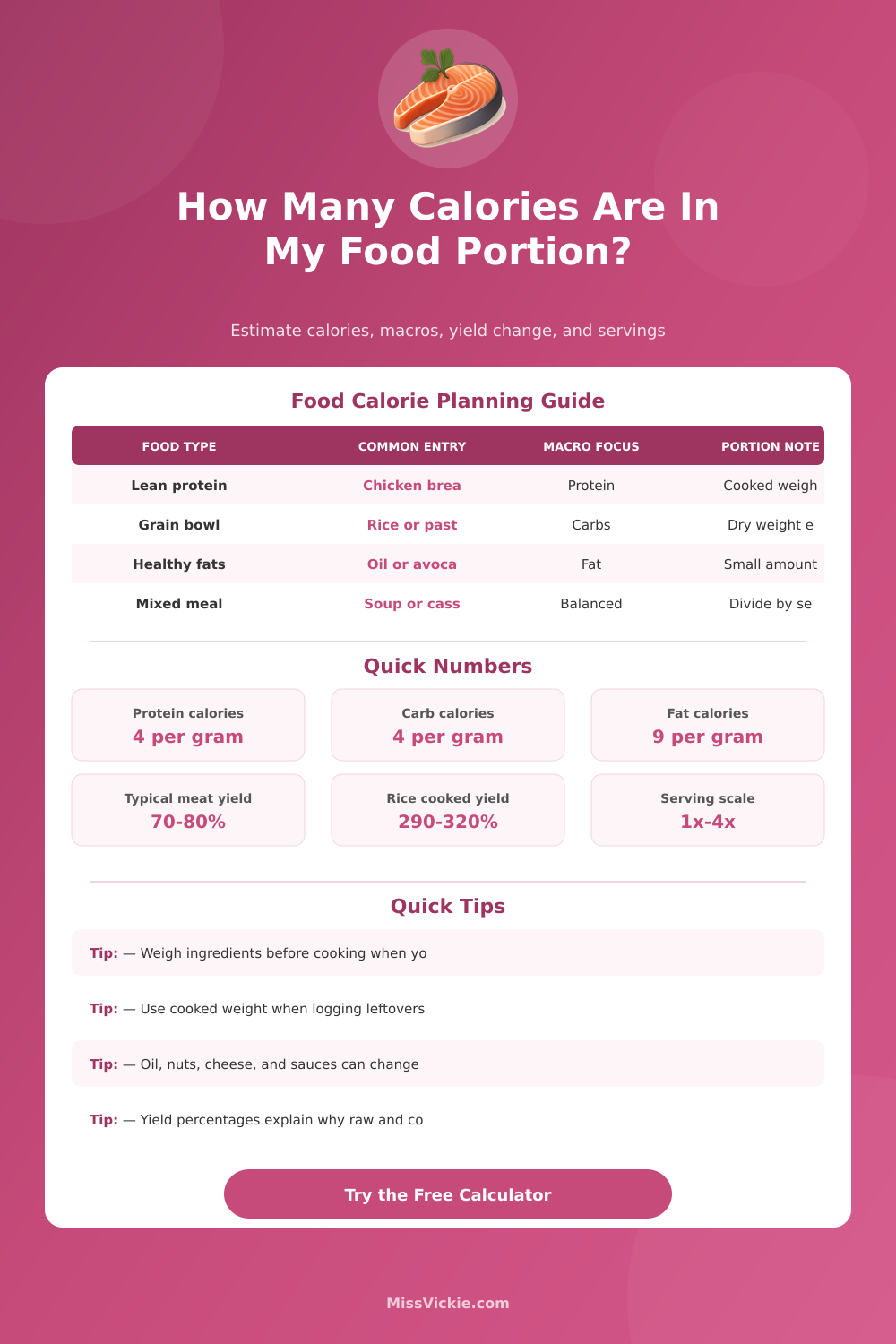
Ingredient weight, yield, portions, and macro calories
Food Calorie Calculator
Estimate calories for a single ingredient or a whole meal by choosing a food category, entering raw or cooked weight, applying cooking yield, splitting into servings, and scaling the portion you plan to eat.
Use a USDA-style average as a starting point, then override the macros if your nutrition label is different. Calories are estimated from protein and carbs at 4 calories per gram and fat at 9 calories per gram.
Lean Proteins
120-210 cal
Chicken breast, turkey, shrimp, and lean fish usually deliver high protein for a moderate calorie load per 100 g.
Grains and Starches
85-370 cal
Dry grains are calorie dense before cooking because water absorption changes the weight dramatically.
Vegetables and Fruit
20-95 cal
Produce tends to be water rich, so volume can look large while calories stay modest.
Fats and Sauces
160-884 cal
Oil, nuts, cheese, and dressing can move totals quickly even when the measured spoonful looks small.
Approximate values per 100 g edible portion. Use nutrition labels for packaged foods when exact tracking matters.
| Ingredient | Calories | Protein | Carbs | Fat | Typical Yield |
|---|---|---|---|---|---|
| Chicken breast, skinless raw | 113 | 22.5 g | 0 g | 2.6 g | 75% |
| Ground beef, 90% lean raw | 176 | 20.0 g | 0 g | 10.0 g | 72% |
| Salmon fillet raw | 208 | 20.4 g | 0 g | 13.4 g | 82% |
| Egg, whole raw | 143 | 12.6 g | 0.7 g | 9.5 g | 96% |
| Firm tofu | 144 | 17.3 g | 2.8 g | 8.7 g | 92% |
| Greek yogurt, plain nonfat | 59 | 10.3 g | 3.6 g | 0.4 g | 100% |
Dry grains and pasta gain weight during cooking. The yield column helps convert dry batch planning into cooked portions.
| Ingredient | Calories | Protein | Carbs | Fat | Typical Yield |
|---|---|---|---|---|---|
| White rice, dry | 365 | 7.1 g | 80.0 g | 0.7 g | 300% |
| Brown rice, dry | 370 | 7.9 g | 77.2 g | 2.9 g | 285% |
| Pasta, dry enriched | 371 | 13.0 g | 75.0 g | 1.5 g | 240% |
| Potato, raw | 77 | 2.0 g | 17.5 g | 0.1 g | 92% |
| Rolled oats, dry | 389 | 16.9 g | 66.3 g | 6.9 g | 250% |
| Quinoa, dry | 368 | 14.1 g | 64.2 g | 6.1 g | 290% |
Produce values vary with ripeness, peeling, trimming, and cooking moisture loss, so treat these as practical kitchen estimates.
| Ingredient | Calories | Protein | Carbs | Fat | Fiber |
|---|---|---|---|---|---|
| Broccoli, raw | 34 | 2.8 g | 6.6 g | 0.4 g | 2.6 g |
| Carrot, raw | 41 | 0.9 g | 9.6 g | 0.2 g | 2.8 g |
| Apple with skin | 52 | 0.3 g | 13.8 g | 0.2 g | 2.4 g |
| Banana | 89 | 1.1 g | 22.8 g | 0.3 g | 2.6 g |
| Spinach, raw | 23 | 2.9 g | 3.6 g | 0.4 g | 2.2 g |
| Avocado | 160 | 2.0 g | 8.5 g | 14.7 g | 6.7 g |
Small high-fat servings can be hard to eyeball. Measuring spoons or a gram scale are especially helpful here.
| Ingredient | Calories | Protein | Carbs | Fat | Cup Weight |
|---|---|---|---|---|---|
| Olive oil | 884 | 0 g | 0 g | 100.0 g | 216 g |
| Peanut butter | 588 | 25.1 g | 20.0 g | 50.4 g | 258 g |
| Cheddar cheese | 403 | 24.9 g | 1.3 g | 33.1 g | 113 g |
| Black beans, cooked | 132 | 8.9 g | 23.7 g | 0.5 g | 172 g |
| Tomato sauce | 29 | 1.5 g | 6.3 g | 0.2 g | 245 g |
| Chicken noodle soup | 48 | 3.2 g | 6.4 g | 1.2 g | 240 g |
When you cook a meal, you may want to know how many calorie are in that meal. Many individual will weigh the chicken or rice that they will use in the meal while they are being cooked. However, the weight of the chicken and rice will change while they is being cooked.
The chicken will lose weight due to the loss of moisture by the chicken while it is being cooked. The rice will gain weight because the rice absorbing water while it is being cooked. The weight of the food will change, but the nutrients in the food will remain the same.
Should You Use Raw or Cooked Weight to Count Calories?
Thus, if the weight of the food is not account for, the calorie calculations for the meal will not be accurate. Therefore, it is important to account for the change in the weight of the food. When logging the calories from your cooked meals, you have a choice between logging the raw weight of the food or logging the cooked weight of the food.
For instance, the raw weight of the food is the weight of the ingredient prior to water being added to the ingredients. The cooked weight of the food is the weight of the food after it is cooked. Each type of weight must be chosen and chosen alone when logging meals in order to ensure that the calorie calculation are accurate.
The yield percentage is the tool that will tell the calculator the percentage of the foods weight that will be gained or lost during the cooking process. For instance, meat will often lose weight during the cooking process. Meat may weigh seventy to eighty percent of the original weight of the raw meat.
Foods like grain will gain weight during the cooking process. These grains may weigh three times the original raw weight. The yield percentage will not change the nutrient in the food being prepared, but the percentage will change the weight of the food being cooked in order to calculate the calories.
Thus, the percentage can change to reflect the amount of cooked food that will be produced from the ingredients. Another consideration in the meal preparation process is the portion size. The portion size is the amount of food that an individual will eat from the batch of food that is prepared.
The portion size may have to be changed once the batch of food is divided into serving. A portion multiplier will help to adjust the portion size without having to reweigh the food. Thus, the portion multiplier will ensure that the math is still even and accurate for the meal.
The calories in a meal are obtained from three different macronutrient, protein, carbohydrates, and fat. Each gram of protein and each gram of carbohydrates contain four calorie, but each gram of fat contain nine calories. To calculate the calories in a meal, you multiply the number of grams of each macronutrient by the number of calories per gram for each macronutrient.
This will give the total number of calories in the food. However, this value is only an estimation of the true number of calories in the food. Reference tables can be used to determine the calories, fat, carbohydrates, and protein in food item.
You can use these tables to determine the nutritional values of the ingredients in a meal. Many individuals dont know the nutritional value of all foods and ingredients. Thus, you could use the reference tables for this information.
However, if the specific brand of food has different nutritional values than those in the tables, you can enter the nutritional information for that food into the calculator. It is important to remember certain calorie-dense foods. Foods like oil, dressings, cheese, nuts, and nut butter have a high number of calories but a small volume.
Therefore, when you eat foods that are high in calories, they will have a more greater impact upon your daily calorie count than vegetables will. Thus, you must enter the amount of oil or dressing into the calculator to calculate the true number of calories that will be obtained from the prepared meal. Cooked weight will include the weight of the water that is contained within the food.
If a batch of food is cooked and weighed, the weight can be divided by the number of servings to determine the weight of each serving. However, this will calculate the weight of the water in each portion of food in addition to the weight of the food. Since water does not contain nutrient, the weight of water will not impact the number of calories that the food contains.
Therefore, the raw total of the food should be kept in mind. Batch cooking allows cooks to scale the meals to change the number of servings. For instance, if an individual wishes to prepare food for six individuals instead of four, the batch can be scaled to prepare enough food for six individuals.
The math will remain the same because the nutrients in the food per gram will not change if more of the food is prepared. In order to prepare meals, the ingredients should be weighed at the beginning of the cooking process. This is better than attempting to find the portions of the ingredients once the food has been mixed together.
By weighing the ingredients at the beginning of the cooking process, it is possible to determine exactly how much of each ingredient was used in the preparation of the food. The yield of the food can be used to divide the food into the appropriate portions. Additionally, if each recipe is prepared in the same way, the ingredients can be weighted at the beginning of the cooking process to ensure that the calories from each recipe will remain accurate.