MissVickie pie dough planner
Pie Crust Flour Fat Water Salt Calculator
Dial your dough by pan geometry, top-crust design, flaky versus mealy texture, and hydration shifts from weather and filling moisture before you cut in fat.
Preset buttons load realistic crust scenarios and auto-calculate flour, fat, water, and salt so you can compare how top style and dough texture change a batch.
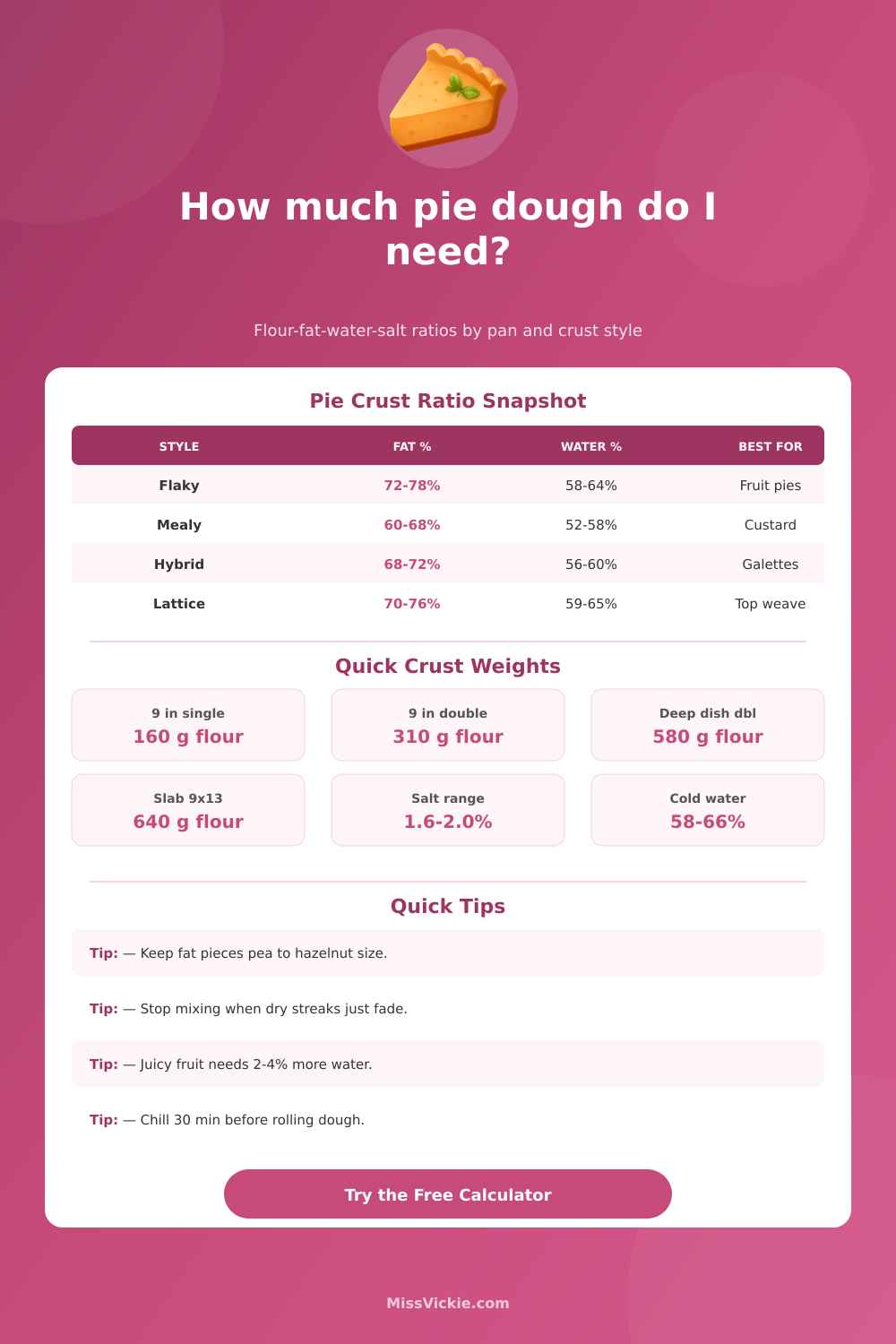
Flour is fixed at 100%. Fat usually runs from 60% to 78% depending on mealy versus flaky goals, and water usually lands near 52% to 66% including weather and filling moisture adjustments.
Salt is commonly 1.6% to 2.0% of flour. Sugar stays optional for browning and tenderness in dessert crusts.
Use this side-by-side matrix to pick a dough strategy before you mix. It helps separate crisp layering goals from tender, short-bite shells.
Flaky profile
Larger fat pieces and higher fat percent create visible layers, best for juicy fruit pies and lattice tops.
Mealy profile
Finer fat dispersion makes a tighter crumb that resists soggy bottoms under custard and cream fillings.
Butter emphasis
Strong dairy flavor and steam lift, but temperature control is stricter to avoid greasy smearing while rolling.
Shortening emphasis
Wider plastic range and cleaner handling in warm kitchens, helpful for decorative edges and cutout tops.
These tables use practical bakery ranges so you can sanity-check computed totals when scaling from a single 9 inch pie up to slab or holiday production.
| Dough Goal | Fat % of Flour | Water % of Flour | Salt % | Typical Use |
|---|---|---|---|---|
| Flaky layers | 72-78% | 58-64% | 1.6-1.9% | Apple, berry, lattice fruit pies |
| Mealy shell | 60-68% | 52-58% | 1.7-2.0% | Pumpkin, chess, pecan, quiche |
| Hybrid crust | 68-72% | 56-60% | 1.7-1.9% | All-purpose dessert shell |
| Decorative top work | 66-72% | 54-58% | 1.7-2.0% | Braids, cutouts, woven tops |
| Pan and Coverage | Flour for Bottom | Flour for Double | Flour for Lattice | Notes |
|---|---|---|---|---|
| 9 inch standard plate | 160 g | 310 g | 270 g | Most home recipes target this baseline. |
| 9 inch deep dish | 300 g | 580 g | 510 g | Higher sidewalls need extra dough for shrink safety. |
| 10 inch tart ring | 215 g | 420 g | 360 g | Lower walls but larger floor area than 9 inch. |
| 9 by 13 slab pan | 340 g | 640 g | 560 g | Good for crowd slices and bar-style servings. |
| Hand pies, 10 pieces | 300 g | 560 g | n/a | Assumes top and bottom rounds with reroll scraps. |
| Flour Type | Protein Range | Water Absorption | Texture Effect | Hydration Adjustment |
|---|---|---|---|---|
| Pastry flour | 8-9% | Low | Very tender bite | -2% water vs AP |
| All-purpose flour | 10-11.7% | Medium | Balanced structure | Baseline |
| Bread flour | 12-13% | High | Stronger chew risk | +3% water vs AP |
| Whole wheat blend 25% | 11-13% | Higher bran uptake | Nuttier, denser crumb | +4% water vs AP |
| Gluten-free 1 to 1 | n/a | Variable | Short and fragile | +5% water then rest |
| Fat Type | Approx Fat Content | Water Content | Handling Window | Best Application |
|---|---|---|---|---|
| Unsalted butter | 80-82% | 16-18% | Cool and firm | Flavor-forward fruit pies |
| Vegetable shortening | 100% | 0% | Wide plastic range | Clean edges and decorations |
| Leaf lard | 99-100% | 0-1% | Softens quickly | Ultra-flaky savory pies |
| Butter-shortening blend | 90-92% | 8-10% | Moderate flexibility | Balanced flavor and handling |
| Refined coconut oil | 100% | 0% | Very temperature-sensitive | Dairy-free crust options |
Typical flour for one bottom crust.
Common flour amount for bottom plus full top.
Practical center point for layered fruit crusts.
Useful center point for custard shells.
Most all-purpose flour pie doughs live here.
Often enough to prevent sticky dough.
Helps dough come together in winter air.
Reliable midpoint for both sweet and savory crust.
A pie crust could fail if a person too rigid follows the recipe written for the crust. Most recipes doesnt account for the specific condition of the kitchens in which the crust is being made. For example, kitchens has different humidity rate.
The type of flour that is used could also change how the pie crust behave. By treating a pie crust as something that can be made according to a flexible ratio, a person can maintain control over the texture of the crust that is made. The texture of a pie crust depend on the ratio of the fat to the water in the crust.
How to Make a Good Pie Crust
The fat will provide tenderness to the crust, while the water act as glue to hold the ingredient of the crust together. If a person use too much water, the dough will contain too much gluten and the crust will have the texture of bread. If a person use too little water, the dough will crack and shatter.
A person can choose to make either a flaky crust or a mealy crust. The type of crust that should be made depend on the type of pie filling that will be used. Flaky crusts contains large chunk of fat that melt within the pie to create air pocket.
Flaky crusts are best used for fruit pie. Mealy crusts are made by cutting the fat into the flour until the fat appear as cornmeal. The mealy crust will create a tight seal to prevent the pies liquid filling from soaking into the crust.
These type of crusts are used for custard or cream filling. The type of fat that is used will change the behavior of the dough. Butter will create a high level of flavor for the crust; however, butter has a low melting point, which could make the pie grease if the kitchens temperature is too high.
Other fat, like shortening and lard, are more forgiving of different temperature. Professionals in the kitchen often use a blend of butter and shortening. The type of fat affect the amount of water that should be used in the crust.
Dough made with butter will require a different amount of water than dough made with shortening. Flour is a variable in the recipe for pie crust. The different type of flour contain different amount of protein.
Pastry flour contains less protein than the other type of flour, producing a more tender crust. Flour that contains more protein, like bread flour, will create a crust that can better support the weight of heavy filling. Humidity can also affect the type of flour that is used.
Flour is hygroscopic, meaning it absorb moisture from the air. In areas with high humidity, the flour will absorb moisture from the air; in this case, the amount of water added to the dough will need to be reduce. The way in which a person handle the dough will also impact the texture of the crust.
The fat need to be kept cold and the gluten need to be relaxed. If a person overwork the dough, the protein within the crust will become tough. A crust that contains tough protein will have a tough texture.
Once the dry streak within the dough disappear, a person should stop mixing the dough. Mixing the dough for too long will turn the pie crust into a biscuit. After mixing the dough, a person should let the dough rest in the refrigerator for thirty minute.
The dough need to rest to allow the flour to hydrate and the gluten to relax. In order to prevent the crust from shrinking when baked, the dough need to be rested. A person should calculate the amount of dough that will be needed based on the size of the pan in which the crust will be baked.
If a person does not calculate the amount of dough that is needed, the dough may end up being too small for the pie pan. By calculating the amount of flour and fat that is needed for a specific size pan, a person will ensure that there will be enough dough to cover the pan without creating scrap of dough that are not utilized for baking the pie. If a person understand the ratio of the fat, water, and flour that will create the perfect dough for a pie crust, a person will be able to successfuly create a pie crust.