🧁 MissVickie meringue engineering
Sugar to Egg White Ratio for Meringue Calculator
Dial sugar weight to your exact egg white load with style-specific logic for French, Swiss, and Italian meringue, including humidity shifts, source behavior, stiffness target, and bake or dehydrate strategy.
These presets are built for real outcomes: crisp shells, chewy centers, torch-ready toppings, buttercream base, and low-risk service batches in changing weather.
Start with total egg white mass, apply method baseline ratio, then adjust for humidity, intended stiffness, sugar particle behavior, and egg source foam strength.
Output gives total sugar target, staged additions, and a process plan tuned for baking or dehydrating so your foam holds shape and dries as expected.
Full Breakdown
French meringue
Fastest setup and best for rustic texture. Works well when baked low and slow, but needs cleaner bowls and slightly higher sugar in humid weather.
Swiss meringue
Whites and sugar are warmed together so crystals dissolve before whipping. Useful when you want glossy structure and predictable piping lines.
Italian meringue
Hot syrup stabilizes the foam during mixing. Excellent for buttercream bases and torched toppings where hold matters more than brittle crunch.
| Method | Typical Sugar Ratio (g:g) | Sugar Addition Pattern | Heat Marker | Best Uses |
|---|---|---|---|---|
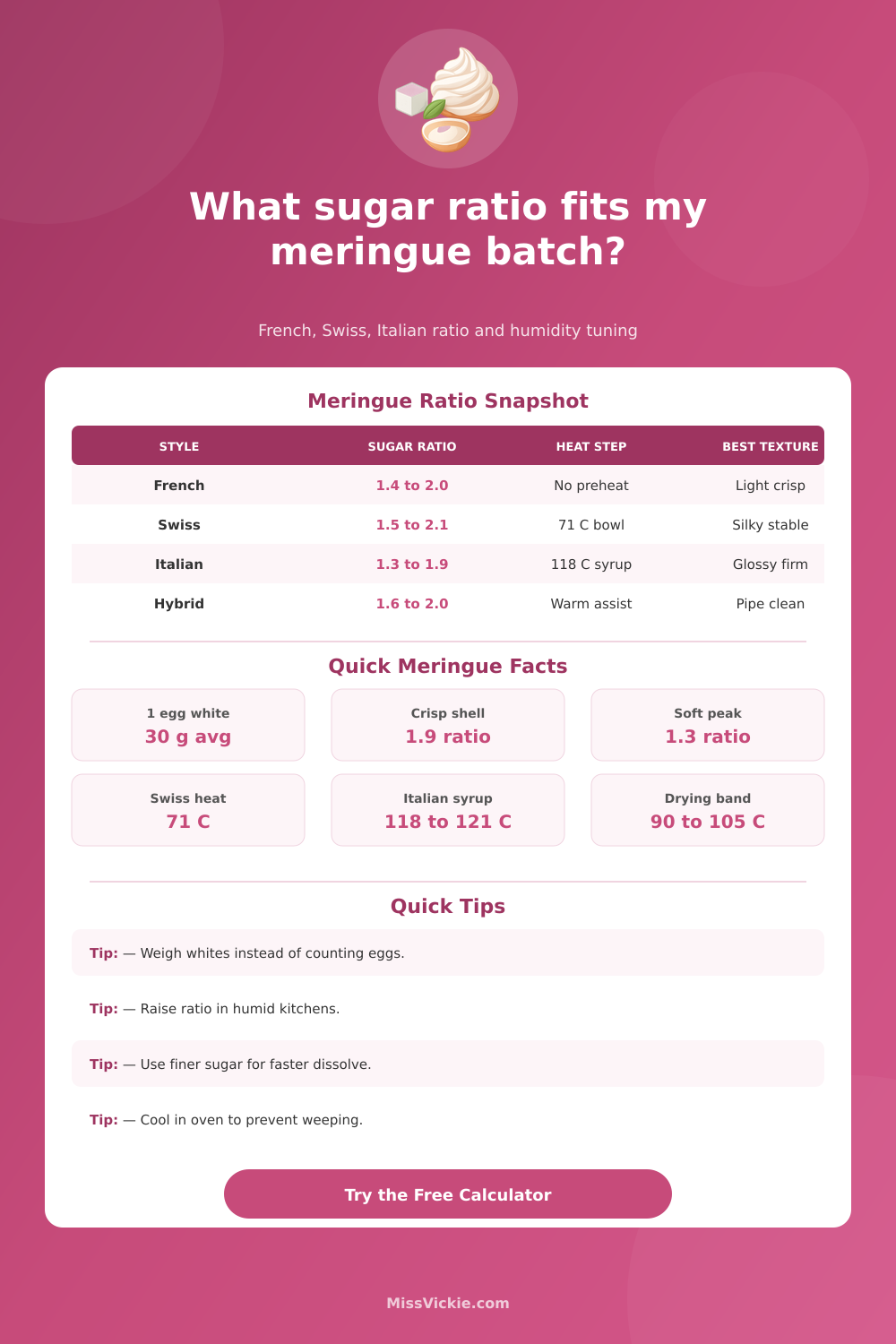
| French | 1.4 to 2.0 | Gradual rain while whipping | No direct pre-cook | Kisses, shells, baked nests |
| Swiss | 1.5 to 2.1 | All sugar dissolved in warm bowl | 71 C bowl target | Piping, buttercream base, swirls |
| Italian | 1.3 to 1.9 | Hot syrup stream into soft peaks | 118 to 121 C syrup | Toppings, mousse, high stability |
| Egg White Source | Working Assumption | Foam Strength | Model Adjustment | Notes |
|---|---|---|---|---|
| Fresh separated large eggs | 30 g white per egg | High | Baseline | Best all-around texture and lift |
| Aged whites (24 to 36h chilled) | Slight moisture loss | Medium high | -0.03 ratio shift | Can whip quicker with fine bubbles |
| Carton pasteurized whites | Variable protein state | Medium | +0.06 ratio shift | Often needs extra whip time |
| Powdered white reconstituted | 10 g powder + 90 g water | Medium high | +0.02 ratio shift | Good for consistency in production |
| Relative Humidity | Typical Effect | Sugar Ratio Shift | Dry Time Shift | Action |
|---|---|---|---|---|
| Under 35% | Fast crusting | -0.03 | -10% | Watch for over-drying |
| 35 to 55% | Balanced drying | 0.00 | 0% | Use style baseline |
| 56 to 70% | Sticky surface risk | +0.08 | +12% | Increase sugar and hold longer |
| Above 70% | Weeping and soft shell risk | +0.15 | +20% | Prefer Swiss or Italian method |
| Bake or Dehydrate Profile | Temp Band | Time Band | Door Position | Expected Result |
|---|---|---|---|---|
| Low dry classic | 90 to 95 C | 95 to 130 min | Closed, final crack-open cool | Crisp shell and pale color |
| Standard shell bake | 100 to 105 C | 75 to 105 min | Closed | Balanced crisp and chew |
| Hot set short | 115 to 120 C | 35 to 55 min | Brief vent halfway | Faster set with more crack risk |
| Dehydrator hold | 57 to 65 C | 180 to 300 min | Airflow constant | Dry uniform minis and decor |
Meringue is a food product that contain air and sugar, but proteins from the egg whites hold the components of meringue together. Meringue will fail if the ratio of sugar to egg whites are not correct, or if the meringue is exposed to to much moisture from the air. In order to create meringue successfuly, the interaction between the sugar and egg whites must be understood; the sugar will hold the structure of the meringue and prevent it from collapsing.
The weight of the egg whites is the most important measurement when creating meringue because the weight of an egg can change. Although many recipes will ask for a certain numbers of egg whites to be used, counting the number of egg whites isnt nearly as accurate as weighing the amount of egg whites that will be used in the recipe. By weighing the egg whites, you can make the amount of sugar match perfectly to the weight of the egg whites.
How to Make Meringue
The calculator include with these recipes makes it possible to match the amount of sugar to the weight of the egg whites for a perfect meringue. There are different methods for making meringue. Each of these methods use different temperatures to help make the egg whites become soft and fluffy.
French meringue is made by whipping the raw egg whites and adding the sugar to the mixture. Because French meringue has not been heated in any way, it is considered to be unstable. Swiss meringue is made by heating the egg whites and the sugar together.
The heat of the mixture will dissolve the sugar crystals allowing for the Swiss meringue to become dense and stable. Finally, Italian meringue is made by pouring boiling sugar syrup into the whipping egg whites. The boiling sugar syrup will cook the egg whites into a very stable and glossily meringue.
Depending off the source of the egg whites, they may behave differently when whipping. Egg whites that have just been separated from the egg yolks will behave differently than egg whites that have sat for some period of time. Additionally, pasteurization of carton egg whites may alter the behavior of the egg whites when whipping them.
Because these factors may impact the volume of the egg whites, the ratio of the sugar to the egg whites may have to be adjusted. Because meringue contains sugar, and because sugar is a hygroscopic substance, humidity in the air may impact the meringue. A hygroscopic substance will pull moisture from the air into the substance.
Thus, high humidity in the kitchen where the meringue is being prepared may cause the meringue to become sticky; the meringue may weep syrup. Additionally, if the meringue becomes sticky, increasing the amount of sugar may fix the problem; more sugar will create a more rigid structure for the meringue to maintain stability against the moisture in the air. Meringue can have a soft peak or an extra stiff peak.
A soft peak will form a low peak which is suitable for mousse recipes. Extra stiff peaks will create a high and firm peak which is necessary for piping recipe ingredients. In order to achieve the proper peak, the ratio of sugar in the recipe should of been sufficient for the weight of the air bubbles in the egg whites.
The last stage of making meringue is the drying process which is not the same as baking the meringue. If the temperature is too high during the drying process, the sugar in the meringue will caramelize which will cause the meringue shell to crack. If the temperature is too low, the center of the meringue will remain gummy.
A low temperature of ninety to one hundred degrees Celsius should be used to dry the meringue. After the meringue has been dried, dont open the oven door; the rush of cool air may cause the meringue shells to crack. Allow the meringue to remain in the oven to dry which will allow the meringue shells to fully stabilize.