🍁 Maple yield, not guesswork
Sap to Syrup Ratio Calculator
Estimate finished syrup from sap Brix, set a finishing target, and turn boil-off rate into a realistic batch time.
Maple sap Brix can swing by season, so this model keeps sugar mass constant, estimates finished volume, and converts boil-off rate into process time.
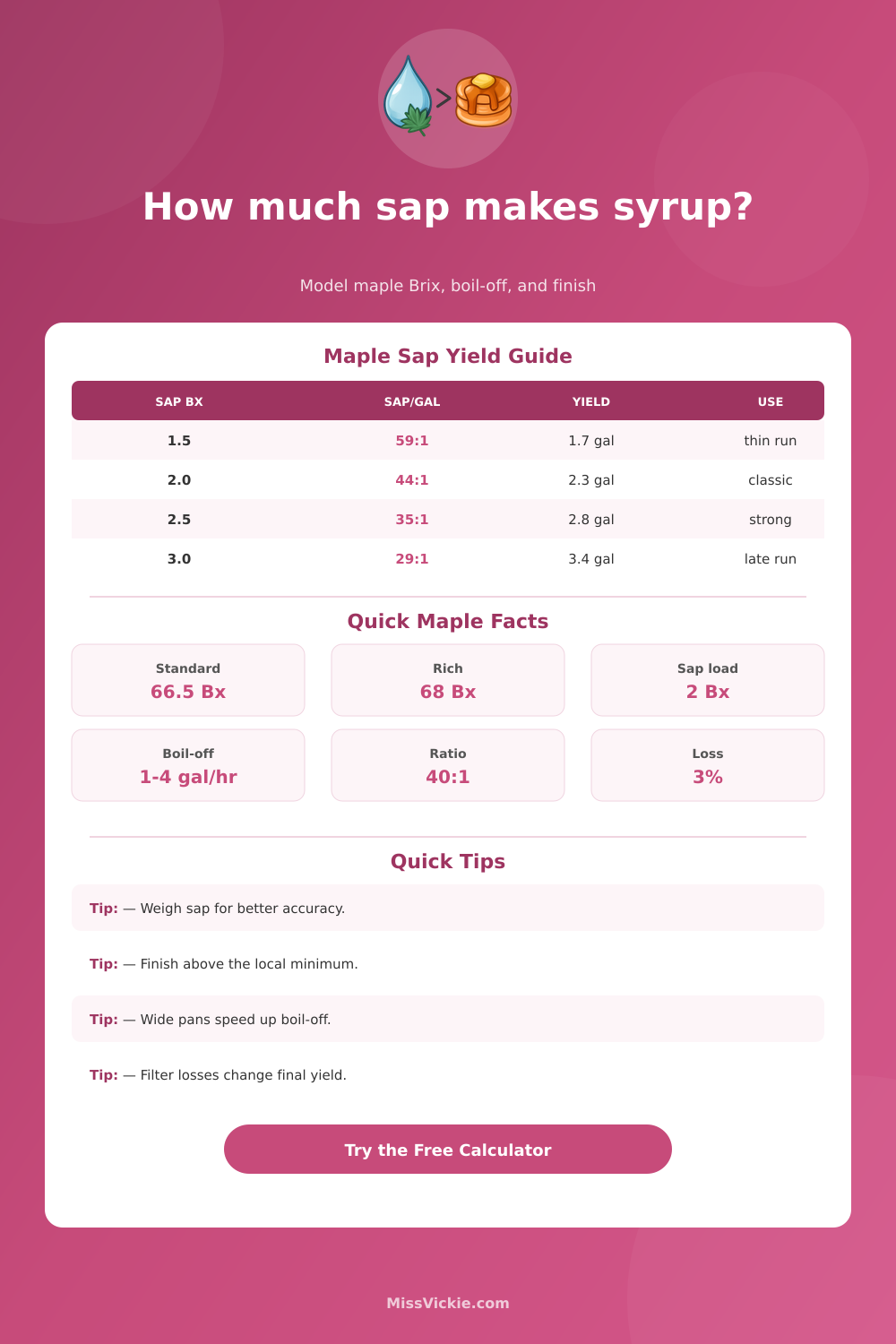
| Sap Brix | Sap per 1 gal syrup | Yield from 100 gal | Notes |
|---|---|---|---|
| 1.5 Bx | 59 gal | 1.7 gal | Thin early run |
| 2.0 Bx | 44 gal | 2.3 gal | Classic sap |
| 2.5 Bx | 35 gal | 2.8 gal | Strong sap |
| 3.0 Bx | 29 gal | 3.4 gal | Late-season sap |
| Target | Density | Texture | Best Use |
|---|---|---|---|
| 65.0 Bx | 1.31 SG | Soft | Thinner pour |
| 66.5 Bx | 1.33 SG | Standard | Maple norm |
| 67.0 Bx | 1.34 SG | Firm | Hot fill |
| 68.0 Bx | 1.35 SG | Rich | Dessert use |
Maple syrup production involve boiling the sap produced by maple trees to remove the water from the sap and leave behind syrup containing a high concentrations of sugar. The start of the process involve a large quantity of sap containing a relatively low concentration of sugar. The end of the process involve a small quantity of syrup containing a relatively high concentration of sugar.
The high concentration of sugar at the end of the process is the result of the boiling of the sap and the evaporation of the water from the sap. The quantity of syrup that is produced will depend on the amount of sugar that is contained within the initial quantity of sap that is boiled. The concentration of sugar within the sap isnt a constant value.
How Maple Syrup Is Made
The concentration of sugar change with the temperature and the time of year when the sap is produced. Early in the season, the sugar concentration within the sap is low. Late in the season, when the sap is produced, the sugar concentration within the sap is high.
The sugar concentration within sap can be measured using a Brix scale. Because the sugar concentration within sap changes, the ratio of the amount of sap that is boiled to the amount of syrup that is produced will change. While the ratio of maple sap to maple syrup is often forty-to-one during the boiling process, the actual ratio of these two quantities will change depending upon the Brix level of the maple sap that is use in the production of maple syrup.
A calculator can be used in the planning of the production of maple syrup. The calculator can take into account the amount of sugar present in the maple sap at the beginning of the boiling process. You can calculate this amount of sugar by inputting the Brix level of the maple sap into the calculator.
Thin maple sap, which is typically produced during the early part of the season, will require more time to boil than thick maple sap that is produced during the later part of the season. The concentration of sugar within the sap can help to make a plan for the amount of fuel that will be needed and the amount of time that will be required for boiling the sap. When maple syrup is boiled, the amount of sugar within the boiling syrup can be adjusted to reach a specific Brix level for the finished product.
The Brix level of the finished syrup will determine the texture of the maple syrup and the length of time that it will remain fresh. If the Brix level of the maple syrup is lowered, the maple syrup will be easier to pour from one container to another. If the Brix level is raised, the syrup will be thicker.
There is a specific Brix level that must be reached for the maple syrup to remain shelf-stable. If the boiling process is stopped too soon, the resulting maple syrup may spoil too quick. If the process of boiling the syrup is continued for too long, the syrup may become too thick to pour from container to container.
The equipment that is used in the boiling process will impact the rate at which the water from the sap evaporates into the air. The faster that the water evaporates, the less time that is required to boil the sap to produce maple syrup. The rate of evaporation of water from the boiling sap is related to the size of the surface area of the pan in which the sap is boiled.
The larger the surface area of that pan, the more faster that the water will evaporate from the boiling sap. Thus, pans that are deep will allow less evaporation of water than pans that are both wide and shallow. The rate at which water evaporates from boiling maple sap can be calculated for the equipment that will be use in the production of maple syrup.
Many people, however, find that the stoves that are at home dont have the heat that is required to boil large quantity of sap. During the production of maple syrup, it is necesary to account for the losses of syrup that may happen during the production process. Some of the syrup may become lost to the formation of foam.
Some of the syrup may be lost to the filter pads that pass the boiling syrup. Some of the syrup may become clinging to the side of the pan in which it is boiled. Because of these losses, it isnt possible to bottle the amount of syrup that could of theoretically produced unless these losses are accounted for in the planning of maple syrup production.
Thus, each ounce of syrup that may become lost to foam or filter pads is one ounce of syrup that will be lost to bottling. The losses of syrup to these different processes must be accounted for in the planning of maple syrup production. Reverse osmosis systems may change the process of producing maple syrup.
These systems removes a large amount of water from the sap before boiling the sap. Because the amount of water that is removed from the sap increases the Brix level of the sap prior to boiling, less fuel is required for boiling, and less time is spent boiling the sap to produce maple syrup. While the chemistry of the process of boiling sap to produce maple syrup is the same with or without the use of a reverse osmosis system, use these systems makes the process more efficient.
Youll find that modern methods makes things easier, actualy.