🍳 MissVickie roux ratio
Roux Ratio Calculator
Estimate butter, flour, and liquid for thin, nappe, or heavy sauces, then map roux color timing and staged whisking without guesswork.
Each preset fills a common sauce situation, from light velouté to dark gravy, then runs the calculator with thickness, color, and liquid staging already tuned.
Classic roux stays equal parts butter and flour by weight. The thickness target changes how much roux you need per cup of liquid.
The color target changes timing and thickening power, while the liquid stage choice changes how smoothly the sauce comes together.
Use these guides to sanity-check the calculator, especially when you are switching between light sauces, nappe coatings, and heavier gravy-style finishes.
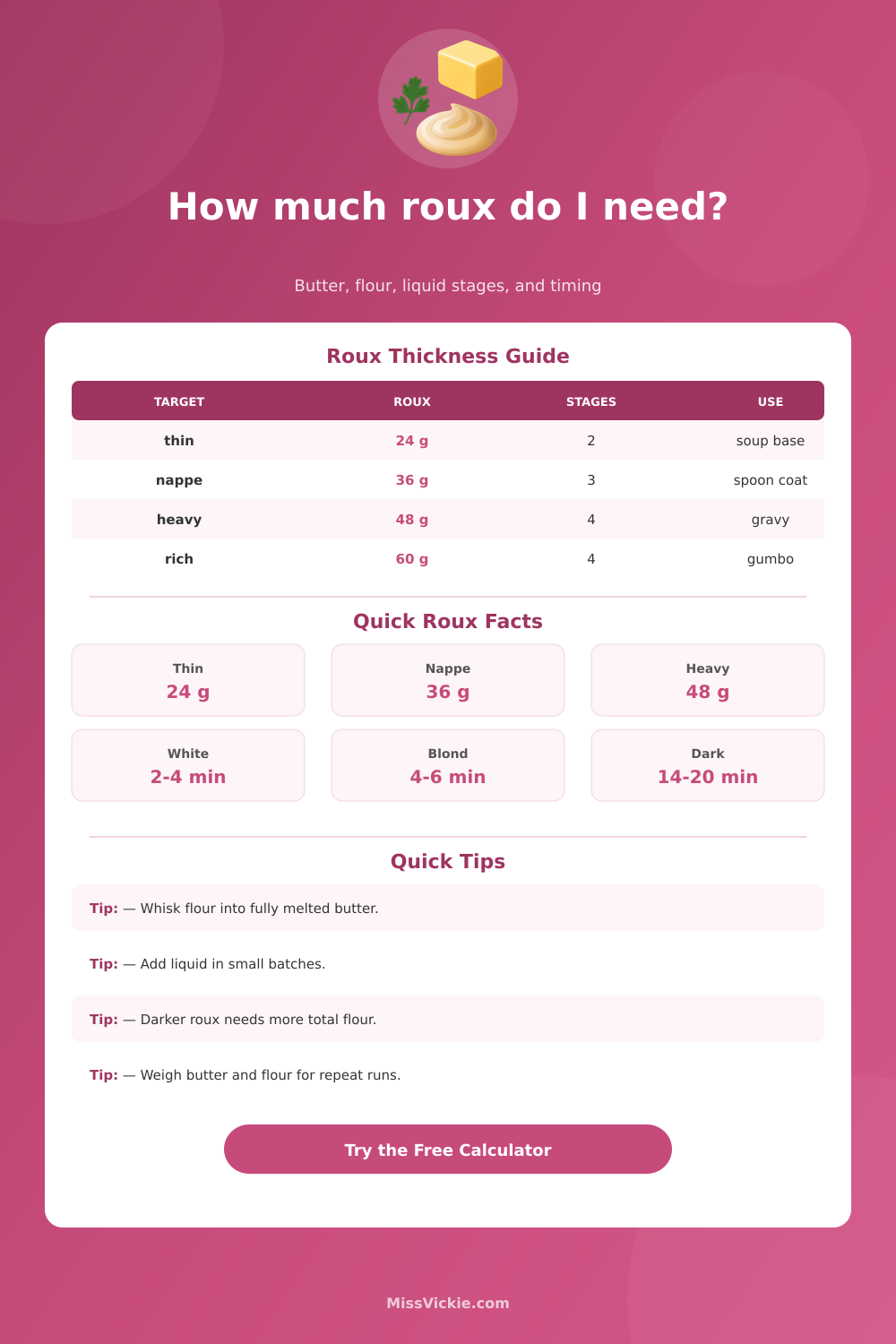
| Target | Roux Per Cup | Stage Count | Best Use |
|---|---|---|---|
| Thin | 24 g | 2 | Soups |
| Nappe | 36 g | 3 | Spoon coat |
| Heavy | 48 g | 4 | Gravy |
| Rich | 60 g | 4 | Gumbo |
| Color | Time | Power | Flavor |
|---|---|---|---|
| White | 2-4 min | 100% | Soft |
| Blond | 4-6 min | 95% | Nutty |
| Brown | 8-12 min | 88% | Toasty |
| Dark | 14-20 min | 80% | Deep |
| Mode | Split | Whisk Style | Best For |
|---|---|---|---|
| Auto | By target | Target based | Any batch |
| 2-stage | 65 / 35 | Quick whisk | Thin sauces |
| 3-stage | 45 / 30 / 25 | Steady whisk | Nappe sauces |
| 4-stage | 35 / 25 / 20 / 20 | Slow pour | Heavy sauces |
A smooth roux needs a whisk, a wide pan, and a little patience. These cards keep the essentials visible while you scale the batch.
Breaks the flour cleanly into fat.
Use a wide base for even color.
Best for equal-weight roux math.
Helps stage the liquid smoothly.
A roux is a mixtures of fat and starch that is used to thicken liquid. To create a roux, the cook combines butter and flour together in a one to one ratio of butter to flour by weight. Using this ratio of butter to flour ensure that each individual starch molecule is coat in fat.
If the starch molecules are not coat in fat, the starch will form lump in the liquid when the liquid is added to the roux. Therefore, using this one to one ratio of butter to flour by weight will ensure that the sauce that is created does not contain any lump. The thickness of the sauce that is created are dependent upon the amount of roux that is added to the liquid.
How to Make and Use a Roux
The more roux that is added to the liquid, the more thicker the sauce will be. Therefore, if the desired thickness of the sauce is thin, lesser roux will be added to the liquid. If the desired thickness of the sauce is thick (like gravy), the cook will increase the amount of roux that is added to the liquid.
Sauce thickness can range from thin to thick, and one level of thickness is referred to as a nappe consistency, meaning the sauce will coat the back of a spoon. The thickness of the sauce is a sliding scale, so the chef must decide on the desired thickness prior to add the roux to the liquid. The color of the roux change as it is cooked.
As roux is cooked, it can change from a white roux to a blond roux, a brown roux, and finally to a dark mahogany roux. A white roux is cooked for a short period of time to eliminate the raw taste of the roux. A blond roux, brown roux, and dark roux is cooked for longer periods of time.
As roux is cooked to become blond, brown, and dark mahogany in color, the thickening power of the roux decrease. Consequently, dark roux must be used in larger amounts than white roux in order to achieve the same thickness for a sauce. Roux must be monitor while it is being cooked to ensure that it does not burn.
A white roux is cooked for short periods of time, but dark roux must be cooked for long periods of time. Consequently, the cook must monitor dark roux while it is being cooked or it will burn. If the roux burn, it will ruin the flavor of the sauce that is created with that roux.
The addition of liquid to the roux must be slow to avoid create lumps in the sauce. If liquid is added to a roux that contains butter (fat) all at once, the fat will seize. To avoid this, the liquid should be added in stages.
Small amount of the liquid are added to the roux to create a thick paste. More liquid is added to create a heavy cream. The remainder of the liquid is added to create a smooth sauce.
If the sauce that is being made is a heavy gravy, the liquids should only being added in stages to allow the sauce to emulsify properley. The type of liquid that is added to the roux can change the way in which the roux should be cook. Liquids like milk and cream are thick liquids.
Additionally, milk and cream has a high chance of scorching on the saucepan surface. Therefore, low heat should be used if milk or cream is to be added to the roux. Liquids like stock and water are thin liquids and are more forgiving of heat than milk and cream.
Additionally, if hot stock is added to the roux, the hot stock will reduce the temperature shock on the roux when it is added to the saucepan. Finally, hot stock will help the sauce emulsify more faster when it is added to the saucepan. By understanding the effect of the ratio of butter to flour, the color of the roux, and the addition of liquid to the roux, a chef can successfully create a sauce that is smooth when taste.