🐦 MissVickie pheasant guide
Roast Pheasant Cooking Temperature Calculator
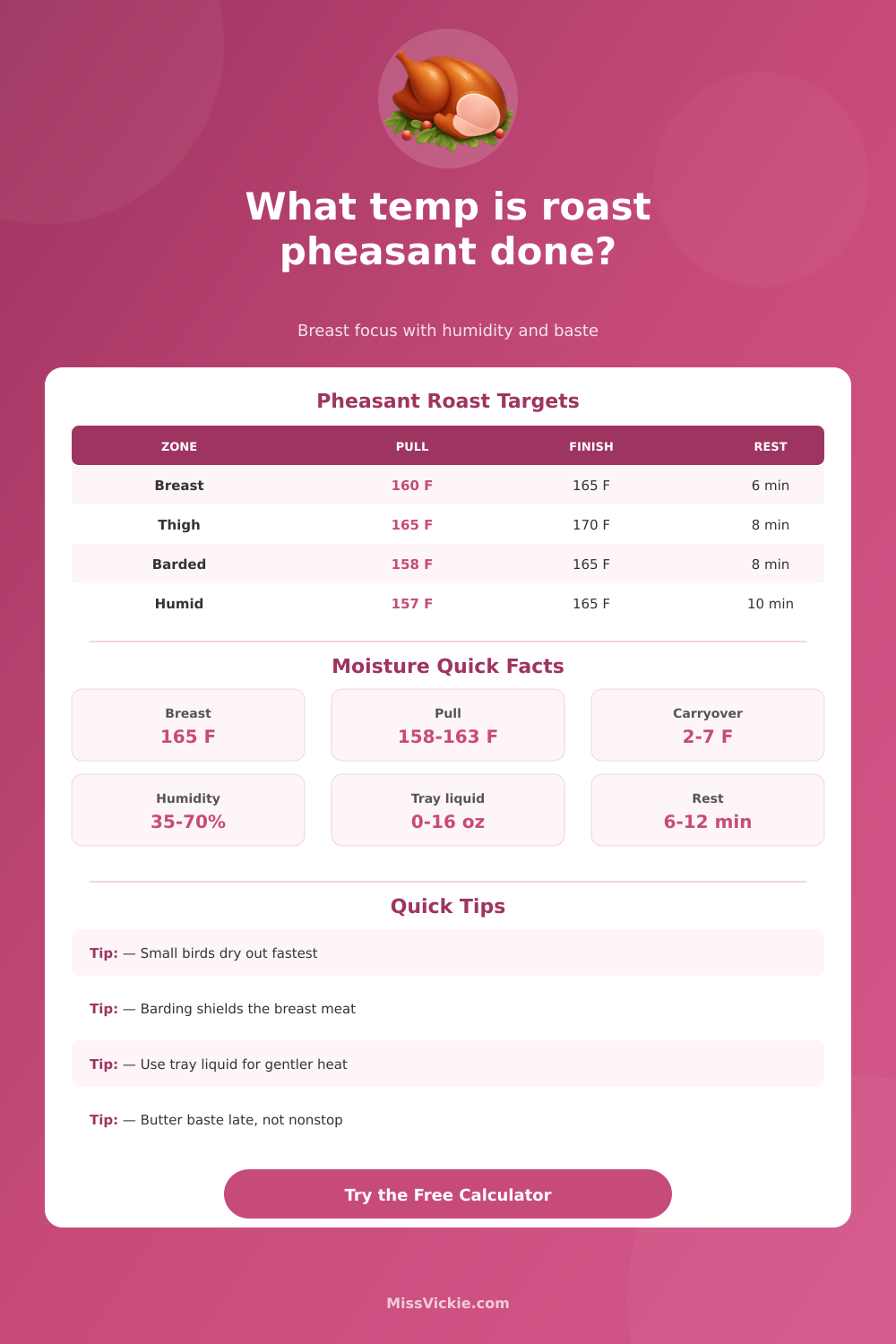
Use a breast-first model that blends small-bird dryness, humidity, tray liquid, barding, and butter baste so the pheasant stays juicy.
Each preset loads a real pheasant setup with bird size, roast style, moisture support, humidity, tray liquid, and rest.
The calculator solves from the thickest breast point, then checks thigh pull and dryness risk for small birds.
These tables are tuned for lean game birds, not heavy roasting hens.
| Setup | Pull | Finish | Rest |
|---|---|---|---|
| Lean bird | 163 F | 165 F | 6 min |
| Barded bird | 159 F | 165 F | 8 min |
| Butter bird | 160 F | 165 F | 8 min |
| Humid roast | 157 F | 165 F | 10 min |
| Factor | Mild | Medium | Strong |
|---|---|---|---|
| Humidity | 40% | 55% | 70% |
| Tray liquid | 0 oz | 8 oz | 16 oz |
| Barding | none | bacon | caul fat |
| Baste | none | light | frequent |
| Bird | Weight | Time | Risk |
|---|---|---|---|
| Small | 2 lb | 45-55m | high |
| Medium | 2.5 lb | 55-65m | med |
| Large | 3.5 lb | 65-80m | low |
| Metric | 1.5 kg | 60-75m | med |
Roast Pheasant Results
Higher means safer juiciness
Oven air support
Steam around the pan
Surface protection choice
Calculation Breakdown
Roasting a pheasant require precise temperature management because pheasants is incredibly lean birds. Because pheasant meats contains very little fat, there is no protection for the meat from the heat of roasting. A chicken contains more fat than a pheasant.
Due to this difference in fat content, chickens can tolerate higher roast temperatures then pheasants can. If the temperature of roasting a pheasant are too high, the pheasant will lose its moisture, and the resulting pheasant will be dry. The temperature to which you cook the pheasant will continue to rise after you take the pheasant out of an oven.
How to Roast a Pheasant Without Drying It
This process is referred to as carryover cooking. Carryover cooking occurs because the muscles of the pheasant retain heat, and that heat will redistribute to the center of the pheasants body. If you allow the pheasant to continue cooking after you remove it from the oven, the pheasants breast will overcook.
To determine the proper cooking temperature for a pheasant, use a temperature calculator. A temperature calculator will account for the weight of the pheasant and the amount of heat that will cook the pheasant after removing it from the oven. A pheasants origin can play a significant role in how the pheasant reacts to heat.
Farm raised pheasants tend to have more intramuscular fat than wild pheasants. This fat is responsible for providing moisture to the pheasants meat during the roasting process. Because of the presence of this fat, farm-raised pheasants are more forgiving of cooking temperatures than wild pheasants.
Wild pheasants has more muscle and contain less fat than farm-raised pheasants. This is likely due to the fact that wild pheasants naturaly exhibit more physical activity than farm-raised pheasants. Additionally, brined pheasants can better handle higher cooking temperatures than unbrined pheasants due to the water retention capability of the salt in the brine.
The cooking temperatures for the breast and thigh meat of a pheasant are different. Because the breast meat is more lean than the thigh meat, the breast meat will dry out very easy. The thigh meat of a pheasant contains more connective tissue and will require more heat to break down the collagen.
This means that if you cook the thigh meat of the pheasant to the necessary temperature, the breast meat of the pheasant will become overcooked. One technique that you can use to avoid overcooking the breast meat is called barding. Barding involves placing strips of fat, like bacon, over the breast meat of the pheasant.
The fat will act as a thermal insulator that will protect the breast meat from the heat of the oven. The humidity in the oven can also impact the moisture content of the pheasant. High humidity will allow the pheasant to remain juicy due to the reduced evaporation of moisture from the pheasants skin.
To increase the humidity in the oven, add liquid, like stock or wine, to the bottom of the roasting pan. This will create steam that will protect the pheasant from the dry air in the oven. If you take steps to provide the pheasant with more moisture, the carryover cooking will be less of a concern.
Another method for roasting a pheasant is butter basting. You achieve butter basting by brushing the pheasant with melted butter. Butter will brown the skin of the pheasant and create a fat barrier that will protect the pheasant from drying out.
However, you should limit butter basting during the roasting of the pheasant to avoid overcooking the surface meat. Butter basting can be used as a technique to finish roasting the pheasant. Finally, allow the pheasant to rest after removing it from the oven.
If you immediately carve the pheasant once removed from the oven, the juices will exit the meat of the pheasant, and the pheasant will become dry. Allowing the pheasant to rest allows its muscle fiber to reabsorb the juices. This period should of last six to twelve minute depending on the size of the pheasant and the amount of moisture support provided during roasting.