🍗 MissVickie roast chicken calculator
Roast Chicken Cooking Temperature Calculator
Estimate whole-bird roast time, breast and thigh pull temperatures, and carryover for stuffed or unstuffed chickens using convection or conventional heat.
Each preset loads a real whole-bird scenario with weight, stuffing, oven type, bird profile, and rest so the calculator can solve the pull temps fast.
The model uses bird weight first, then adjusts for stuffing, oven style, pan setup, roast method, and rest so the pull temp stays realistic.
Roast Temperature Results
Breast and thigh targets update with the whole-bird model, stuffing status, oven mode, and rest.
Calculation Breakdown
Use this grid to compare the main tradeoffs between conventional heat, convection heat, and stuffing choices before you set the oven.
Default roast pace and broad browning.
Faster cooking with a lower pull target.
Slower center heat and longer rest.
Easier breast and thigh temp balance.
| Zone | Safe Finish | Typical Pull | Probe Spot |
|---|---|---|---|
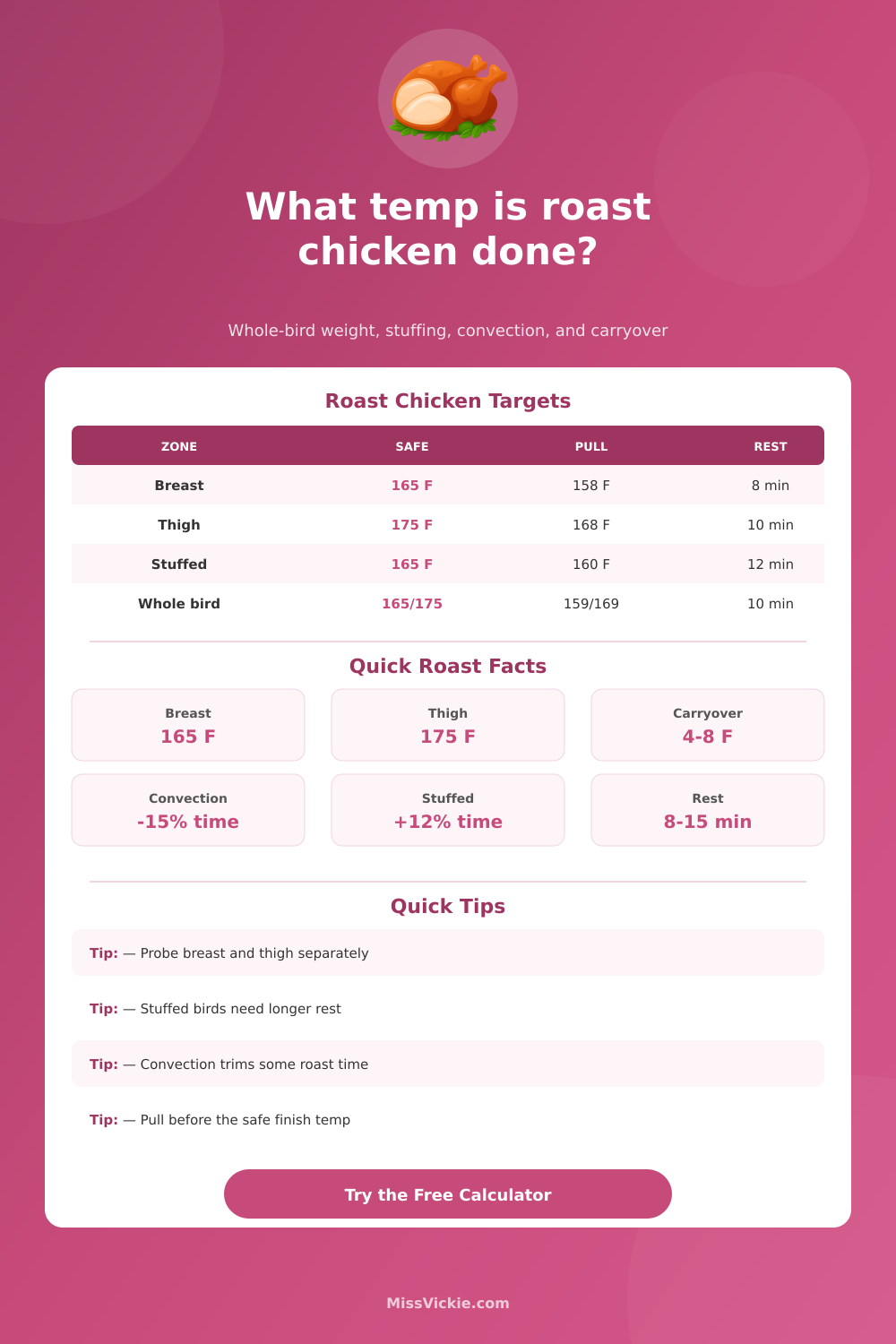
| Breast | 165 F | 158-160 F | Thickest lobe |
| Thigh | 175 F | 168-170 F | Inner thigh |
| Stuffing | 165 F | 160-162 F | Center mass |
| Whole bird | 165/175 F | 159/169 F | Breast and thigh |
| Weight | Conventional | Convection | Notes |
|---|---|---|---|
| 3 lb | 56 min | 47 min | Fast weeknight bird |
| 4 lb | 74 min | 62 min | Small family roast |
| 5 lb | 93 min | 78 min | Classic dinner size |
| 6 lb | 111 min | 93 min | Feeds a crowd better |
| Stuffing | Time Factor | Carryover | Rest Note |
|---|---|---|---|
| Unstuffed | 1.00x | Base | Shortest rest |
| Lightly stuffed | 1.08x | Moderate | Hold a bit longer |
| Fully stuffed | 1.15x | High | Verify the center |
| Loose cavity | 1.04x | Slight add | Between the two |
| Method | Set Temp | Time Bias | Best Use |
|---|---|---|---|
| Conventional | 350 F | Base | Standard roast |
| Convection | 325 F | -15% | Even airflow |
| Covered pan | 325-350 F | +8% | Gentler heat |
| Hot roast | 375-400 F | -8% | Extra browning |
These tools matter because a whole bird cooks by the thickest point, the airflow around the pan, and how cleanly the probe reads the breast or thigh.
Fast breast and thigh checks at the end.
Tracks rising temp without opening the oven.
Improves air movement under the bird.
Helps protect the breast during rest.
Cooking a roast chicken can result in uneven cooking due to the different requirements of each part of the chicken. For instance, the breast portion of the chicken is the leanest part of a bird. Because of the lack of fat in the breast of the chicken, the breast can easily dry out during the cooking process if you cook the chicken for too long.
The thigh portion of the chicken contain some of the fat of the chicken. Because of the fat in the thigh of the chicken, it require more heat to cook than the breast of the chicken. These differences in the requirements of each part of the chicken will cause the breast of the chicken to often dry out while the thigh portion of the chicken are undercooked.
How to Roast Chicken and Keep It Juicy
To cook a roast chicken correctly, it is important to understand the concept of carryover cooking. Carryover cooking is the phenomenon in which the exterior of the cooked chicken remain hot even after the roast is removed from the oven. This heat will continue to travel toward the center of the chicken and cook the center of the breast and thighs even after you have removed the chicken from the oven.
If you remove the chicken from the oven once the internal temperature of the chicken reach the safe temperature with a meat thermometer, the carryover cooking will continue to cook the center of the chicken after it is removed from the oven. This may lead to the chicken breast being overcooked and dry when the chicken is ready to eat. To avoid these issues cause by carryover cooking, it is important to use a temperature calculator to determine the correct pull temperature for the chicken.
Pull temperature is the temperature at which you should remove the chicken from the oven. Temperature calculators accounts for the weight of the chicken as well as the type of oven in which you will roast the chicken. For instance, convection oven use fans to circulate the hot air within the oven.
Because of the circulating hot air, the cooking times and temperatures for chicken roasted in a convection oven may differ than those roasted in a conventional oven. Using a temperature calculator will allow you to correctly remove the chicken from the oven without guessing the cooking times. The type of chicken you use will impact the cooking process.
For instance, if you brined the chicken prior to roasting, it contains more moisture due to the brining solution that coat the chicken. Brined chickens can better handle temperature changes compared to non-brined chickens. In addition, the cooking equipment will also impact the cooking process.
If you place the chicken into a roasting pan with high walls, it will limit the amount of hot air that can circulate around the chicken. Limiting the circulation of hot air will slow the cooking of the chicken. However, using a roasting rack will allow hot air to circulate under the chicken, keeping the underside of the chicken from becoming soggy.
If the chicken is stuffed with breadcrumbs or vegetables, the stuffing act as a heat sink for the chicken. A heat sink absorbs heat and keeps that area hot. Stuffing will cook at a slower rate than the rest of the chicken.
Because of the slow cooking of the stuffing, it will retain heat within the center of the chicken. This added heat will contribute to the amount of carryover heat from the chicken. Thus, if the chicken is stuffed, it will cook for a longer period of time and rest for a longerer period of time.
It is essential to use a meat thermometer correctly. You should not insert the meat thermometer into a random part of the chicken. The meat thermometer should reach the thickest part of the chickens thigh and breast meat.
If you measure the breast of the chicken, do not allow the thermometer to touch the rib bone of the chicken. If the meat touch the bone, the temperature will register as too high. For the thigh of the chicken, insert the meat thermometer into the inner thigh of the chicken without touching the bone.
Additionally, if the chicken is stuffed, insert the meat thermometer into the center of the stuffing to ensure that the stuffing have cooked to a safe temperature. Finally, allowing the chicken to rest for a period of time after it is roasted is a mandatory step in the cooking process. During this resting phase, the juices that have accumulated in the center of the chicken will redistribute itself to the edges of the chickens breast and thighs.
If you carve the roast chicken while it is still hot, the juices will exit the chicken and onto the cutting board. Carving the chicken while too hot will make the meat of the chicken dry. Allow the chicken to rest for ten to fifteen minutes.
During this resting period, the juices will remain inside the chicken. By measuring the temperature of the chicken and allowing it to rest, you ensure that the chicken has reached the proper internal temperature and that its meat will remain moist after it is carved.