Fried Egg Cooking Time Calculator
Match sunny-side, over-easy, over-medium, and over-hard eggs with pan heat, fat type, and lid steam so whites set cleanly and yolks land where you want them.
Each preset loads a real breakfast setup with doneness, egg count, pan heat, fat, pan size, and lid assist so the timer updates instantly.
Breakdown
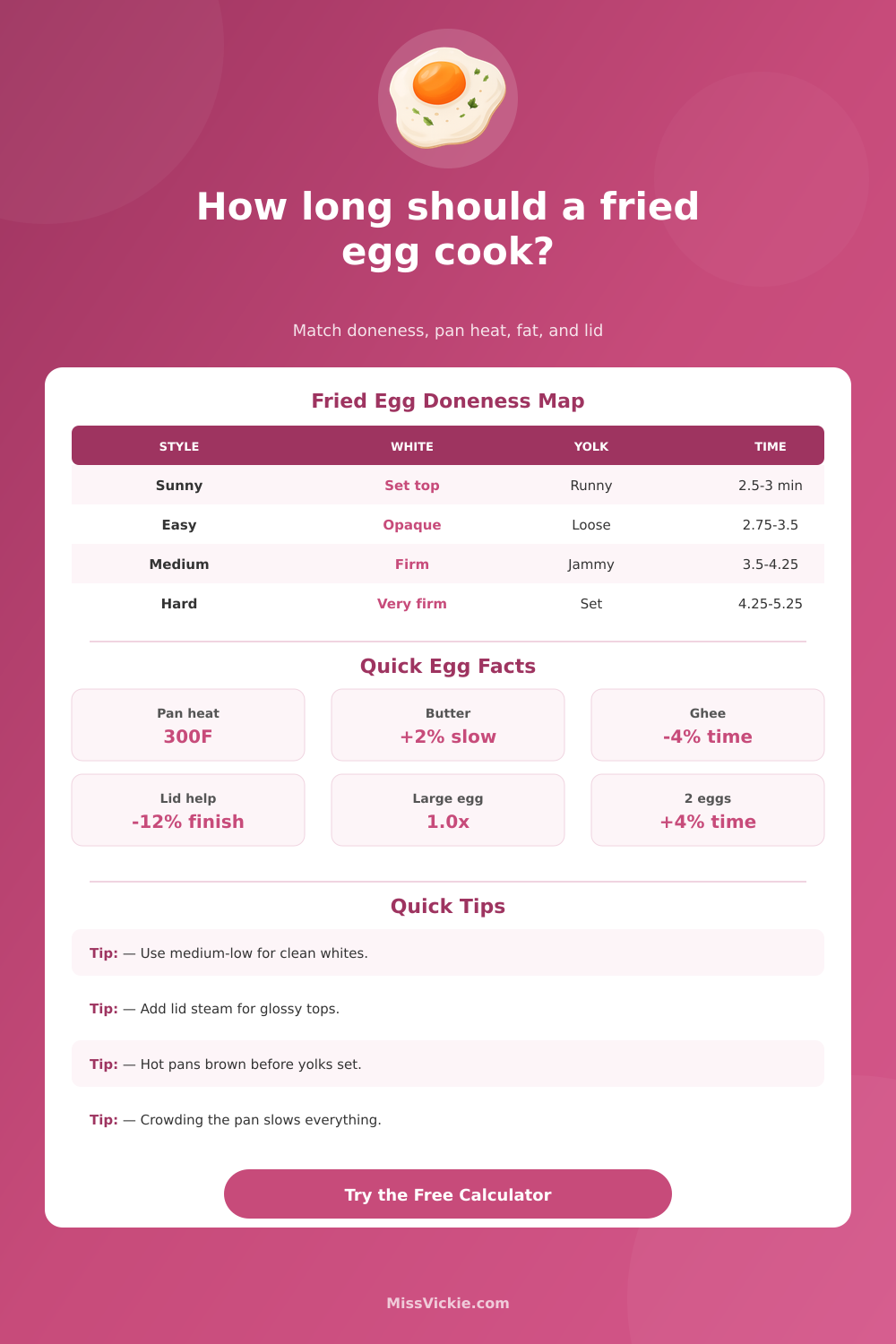
| Style | White | Yolk | Time |
|---|---|---|---|
| Sunny-side | Set top | Runny | 2.5-3 min |
| Over-easy | Opaque | Loose | 2.75-3.5 |
| Over-medium | Firm | Jammy | 3.5-4.25 |
| Over-hard | Very firm | Set | 4.25-5.25 |
| Heat | Range | Factor | Risk |
|---|---|---|---|
| Low | 250-275F | 1.18x | Soft set |
| Med-low | 280-300F | 1.00x | Best balance |
| Medium | 300-325F | 0.88x | Faster top set |
| Hot | 325-350F | 0.68x | Brown edges |
| Size | Weight | Factor | Use |
|---|---|---|---|
| Small | 38 g | 0.92x | Snack plate |
| Medium | 44 g | 0.96x | Light breakfast |
| Large | 50 g | 1.00x | Default |
| Jumbo | 63 g | 1.10x | Brunch plate |
| Fat | Flavor | Factor | Best |
|---|---|---|---|
| Butter | Rich | 1.02x | Sunny-side |
| Ghee | Clean | 0.96x | Hotter pan |
| Olive oil | Soft | 1.00x | Everyday |
| Bacon fat | Smoky | 0.98x | Over-hard |
White sets on top while yolk stays loose and glossy.
Quick flip keeps the yolk runny with a thinner film.
Center firms into a jammy middle with a softer edge.
Both sides set for a fully cooked yolk and firm white.
Frying an egg involve many variable. These variable must be accounted for in order to determine the texture of the fried egg. Many person feel anxious when frying an egg due to the many variable such as the temperature of the pan, the temperature of the egg, and the type of fat use in the pan.
If these variable are not accounted for, then the fried egg may have rubbery egg whites or the egg yolk may be overcooked. Another variable to consider when frying an egg is the material of the pan. For instance, a cast-iron skillet will hold heat more aggressive than a thin nonstick pan.
Things That Affect Frying an Egg
Thus, an egg will cook faster in a cast iron skillet than in a nonstick pan. Other metal, such as stainless steel, will react different than cast iron skillet. Furthermore, you must use more fat in a stainless steel pan to prevent the egg from sticking to the pan.
Therefore, the material of you pan will determine the cooking time needed to fry your egg to your liking. Another variable to consider is the type of fat use in the pan. Butter will add flavor to the fried egg.
However, butter will burn if the pan is too hot. Using ghee or avocado oil will allow more heat to be used in frying the eggs since the smoke points of these fats are higher then that of butter. Therefore, the type of fat use will affect the cooking time needed to fry the egg.
Another variable to consider is the starting temperature of the egg. Many people does not account for this variable. However, the starting temperature of the egg will affect the way the egg cooks in the pan.
Using an egg that is taken out of the refrigerator will create thermal shock to the egg, causing the egg whites to cook unevenly. Instead, using an egg at room temperature will allow for even cooking. Thus, the starting temperature of the egg will affect the amount of heat that are required to allow the proteins in the egg to coagulate.
Using a lid on the pan will affect the frying process of the egg. Steam, which is create when using a lid on the pan, is a better conductor of heat than air. Therefore, using a lid will allow the top of the egg whites to cook faster.
This allow the egg whites to cook to an opaque texture without having to flip the egg. Thus, if you use a lid in frying an egg, the cook must account for the cooking time, as the steam will cook the egg to the desired doneness more quick. Using a heat setting will create a specific result in relation to the frying process.
However, the heat setting will also change the time in which the egg must be fried. Using a low heat setting will cook the egg whites to a tender texture. Using a high heat setting will fry the egg whites such that they develops crispy edges.
Therefore, using a high heat setting will also cause the egg yolk to cook more quick. Thus, when using a high heat setting, there is a limited window of time during which to manage the frying of the egg. The number of eggs use in the pan is another variable to consider.
If you place too many egg into a small pan, the pan temperature will drop due to the absorption of heat by the cold egg. If the pan temperature drops, the cooking time of the eggs will increase. Therefore, to fry the eggs to perfection, the pan must be large enough such that the eggs do not all be crowded into the pan.
The goal of frying an egg is to control the transition of the protein in the egg from a liquid state to a solid state. The cook must cook the proteins in the egg whites from a liquid to solid state, as well as the proteins in the egg yolk must also be cooked from a liquid to solid state. In preparing an over-easy egg, the cook must flip the fried egg rapid such that the egg yolk remains in a liquid state.
In contrast, in order to fry an over-hard egg, the fried egg must be cooked on the heat for longer to allow the egg yolk to become completely solid. Thus, if you control the type of pan, fat, and temperature of the eggs to achieve a specific cooking time, the outcome will have cooked egg whites that are opaque in texture, as well as an egg yolk that is cooked to your preference.