🌽 MissVickie ratio kitchen
Polenta to Water Ratio Converter
Build instant, fine, medium, coarse, and traditional polenta batches with texture goals, liquid blend options, and serving-scale adjustments in one calculator.
Polenta Presets
Preset buttons fill real cooking situations. Each one sets grind, method, texture, input unit, and serving scale so you can adjust quickly.
Inputs
Use any dry starting unit, then choose a water output unit and the calculator converts and scales everything automatically.
Full Breakdown
Reference Tables
Use these quick tables to compare baseline ratios, method adjustments, liquid blend behavior, and unit references before you fine-tune.
Base Ratio by Grind and Texture
| Grind | Loose | Creamy | Classic | Firm | Slice |
|---|---|---|---|---|---|
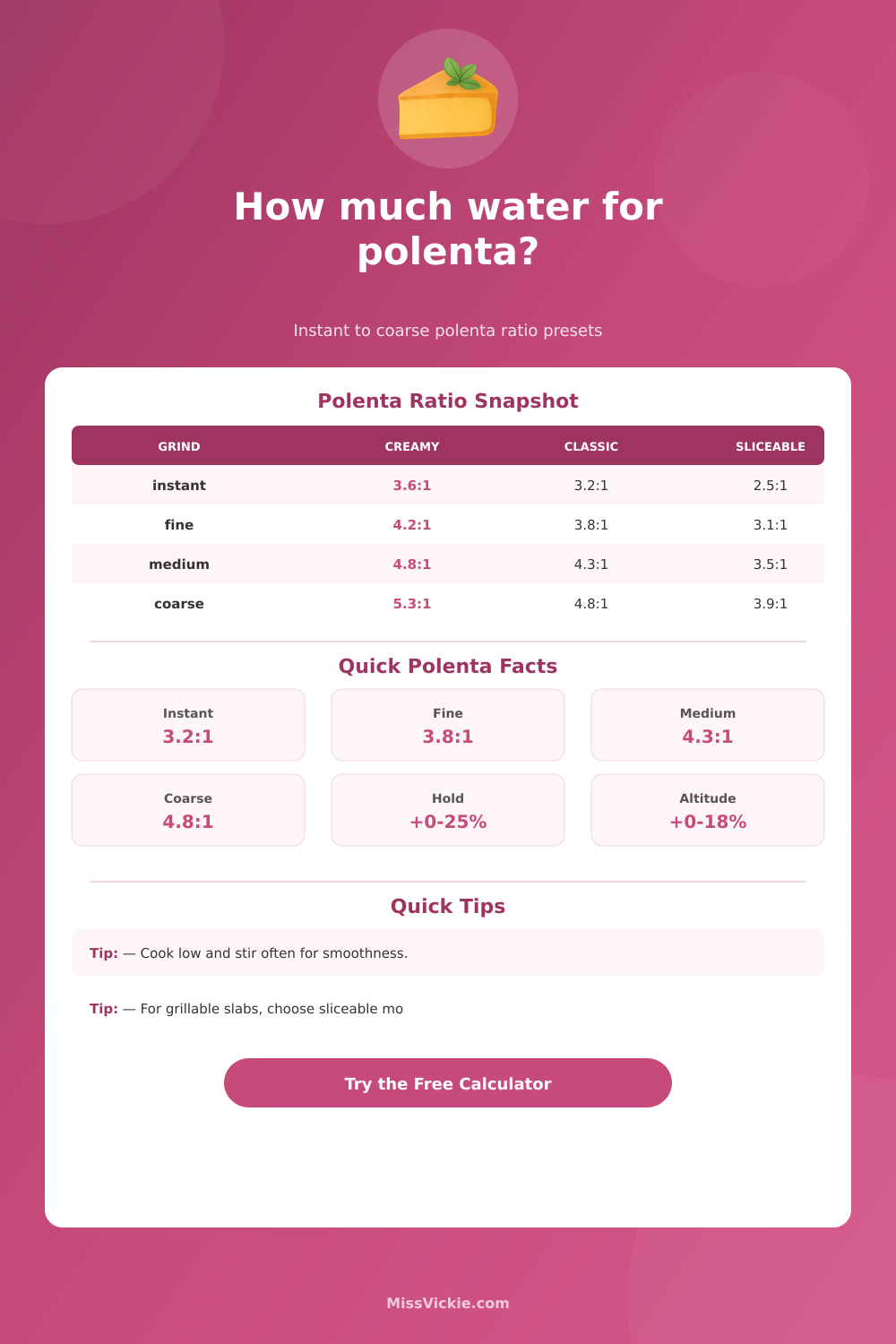
| Instant | 4.0:1 | 3.6:1 | 3.2:1 | 2.8:1 | 2.5:1 |
| Fine | 4.6:1 | 4.2:1 | 3.8:1 | 3.4:1 | 3.1:1 |
| Medium | 5.2:1 | 4.8:1 | 4.3:1 | 3.9:1 | 3.5:1 |
| Coarse | 5.8:1 | 5.3:1 | 4.8:1 | 4.4:1 | 3.9:1 |
| Traditional | 5.5:1 | 5.0:1 | 4.5:1 | 4.1:1 | 3.7:1 |
Method and Time Adjustment Factors
| Method | Factor | Best For | Typical Time |
|---|---|---|---|
| Stovetop simmer | 1.00x | Everyday batches | 20-45 min |
| Covered oven | 1.08x | Hands-off finish | 35-55 min |
| Slow cooker | 1.12x | Large coarse batch | 90-120 min |
| Baked tray finish | 0.94x | Sliceable slabs | 25-35 min |
| Double boiler | 1.05x | Silky creamy texture | 35-60 min |
Liquid Blend Behavior
| Blend | Factor | Texture Shift | Usage Note |
|---|---|---|---|
| All water | 1.00x | Neutral | Most flexible base |
| All stock | 1.00x | Savory body | Pairs with braises |
| Half milk + water | 0.93x | Creamier set | Great for brunch |
| All milk | 0.88x | Rich thickening | Stir often to prevent sticking |
| Stock + cream finish | 0.92x | Silky finish | Add cream near end |
| Water + butter finish | 0.96x | Glossy mouthfeel | Whisk in off heat |
Quick Unit and Density Reference
| Item | Value | Meaning | Use In Calc |
|---|---|---|---|
| 1 cup water | 236.588 ml | US cup baseline | Volume conversion |
| Instant cup dry | 140 g | Light grind density | Dry mass conversion |
| Fine cup dry | 155 g | Dense fine grind | Dry mass conversion |
| Medium cup dry | 165 g | Standard bagged polenta | Default density |
| Coarse cup dry | 175 g | Larger granules | Dry mass conversion |
| Traditional cup dry | 170 g | Classic yellow grind | Dry mass conversion |
Method Comparison Grid
A quick visual comparison across common approaches so you can choose batch style before calculating exact liquid.
Most responsive method. Best when you need to tune texture in real time.
Steady heat and less stirring. Useful for medium and coarse batches.
Great for buffet volume and long holding windows with extra hydration.
Lower liquid and firm set for fries, rounds, cakes, and grilled slabs.
Two Practical Tips
Polenta is a foods made from dried corn kernels that have been ground into a meal. The texture of polenta depends on a ratio of liquid to cornmeal that is used to cook the polenta. Polenta that contains too little liquid will be dry and gritily to eat, while polenta that contains too much liquid will be thin like an soup.
The grind of the cornmeal impact the amount of liquid and the time of cooking that is required for the polenta. Polenta that utilizes instant polenta or ground fine cornmeal set the standard for cornmeal that has a fine grind. Fine cornmeal absorbs the cooking liquid quick and forms a smooth texture when prepared.
How to Get the Right Polenta Texture
Cornmeal that has larger granules, such as coarse cornmeal, require more liquid and cooking time to soften the cornmeal. Polenta that is prepared with more liquid will result in a creamy texture that is suitable for eat with a spoon. Polenta that is prepared with less liquid will result in a sliceable texture that is prepared for grilling or frying.
Polenta can be cooked in different methods which impacts an amount of liquid that is required. Polenta cooked on the stove can be stirred during the cooking process. Polenta cooked in a slow cooker require more liquid to be added during the cooking process due to the different way in which the slow cooker releases steam from the pot.
Polenta baked in an oven require less liquid because the dry air in the oven affects the texture of the polenta. The type of liquid used can impact the thickness and flavor of the polenta. Water will create a polenta with purity.
Stock will add flavor to the polenta. Polenta prepared with milk or cream will thicken more faster than polenta that utilizes water or stock. Because milk and cream will cause the polenta to thicken more quickly, less liquid should be used if milk or cream are the liquid component of the recipe.
Other factors beyond the recipe can affect the amount of liquid that should be used in the preparation of polenta. Polenta kept warm for long periods require extra liquid to the pot. Polenta prepared at high altitudes require extra liquid to the pot due to the evaporation of the water.
If the recipe for polenta is to be prepared for more people, the amount of liquid and cornmeal should be scale together for best results. Polenta should be mixed with hot liquid to avoid creating clumps in the polenta. If dry polenta is dumped directly into cold water, the cornmeal will clump together.
Hot water should be heated first. The cook should then whisk the cornmeal into the hot water in a stream. Whisking cornmeal into hot liquid ensure that each particle of cornmeal is hydrated.
If the cornmeal is not hydrated even, the cornmeal will clump. The cook should stir the polenta during the cooking process to ensure that the polenta does not scorch at the bottom of the pot. Polenta can be cooked to a variety of textures to best suit the way in which the polenta is to be served.
Polenta that is prepared to be soft can be portioned into bowls for eat. Polenta that is prepared to be firm is better for grilling. If the polenta was too soft, use less liquid when preparing polenta.
If the polenta was too stiff, add more liquid or more dairy to the pot when cooking polenta. Polenta will always turn out best when the grind of the cornmeal and the liquid ratio is matched to the desired texture.