🥩 Steak Doneness Temperature Calculator
Enter your measured temperature to identify exact doneness level — with carryover & pull temp guidance
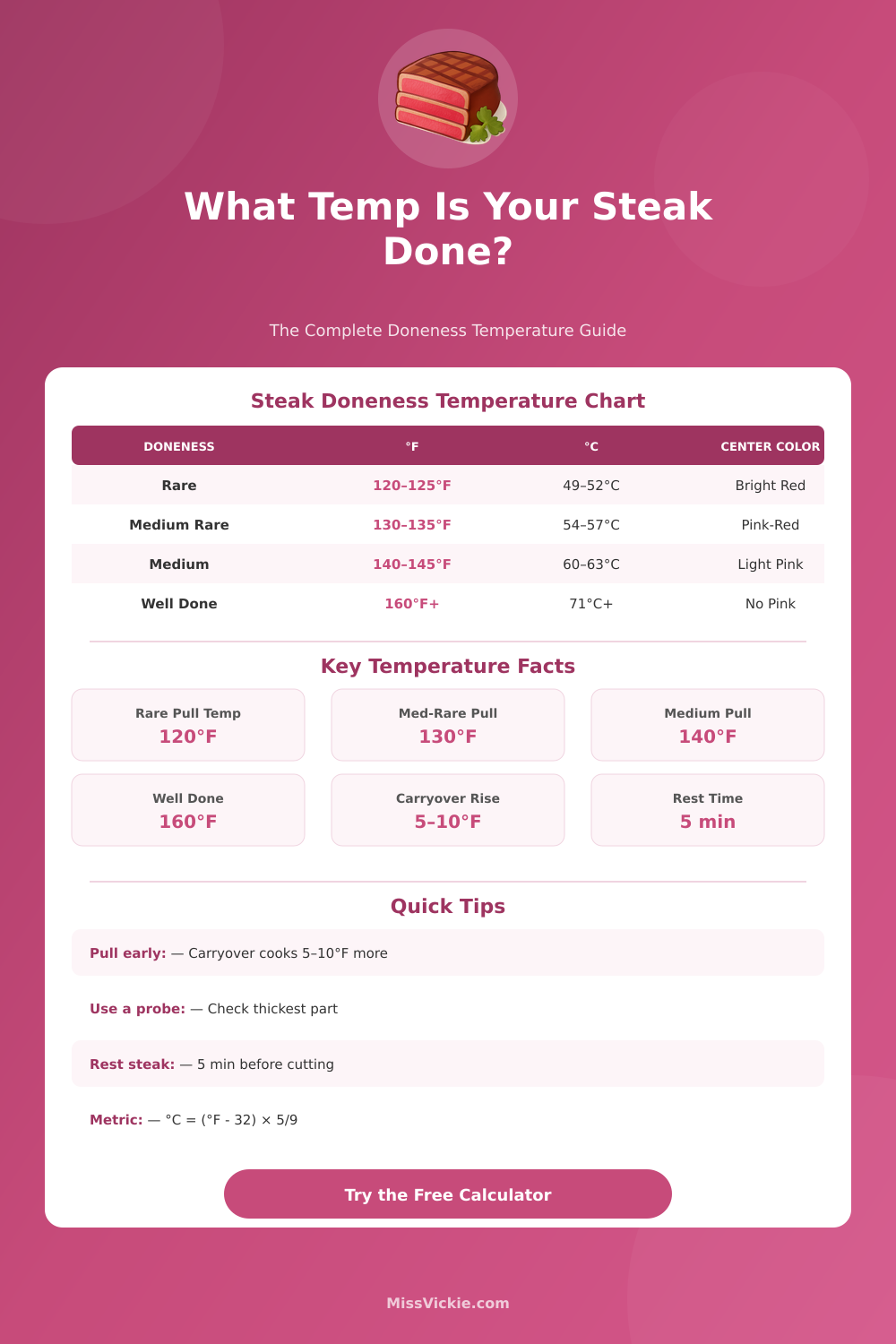
| Doneness | °F Range | °C Range | Pull Temp (°F) | Center Color | Texture |
|---|---|---|---|---|---|
| Blue Rare | 115–119°F | 46–48°C | 108–112°F | Deep purple-red | Very soft, almost raw |
| Rare | 120–129°F | 49–54°C | 115–120°F | Bright red | Soft, very juicy |
| Medium Rare | 130–139°F | 54–59°C | 125–130°F | Pink-red center | Slightly firm, very juicy |
| Medium | 140–149°F | 60–65°C | 135–140°F | Light pink | Firm, moderately juicy |
| Medium Well | 150–159°F | 66–71°C | 145–150°F | Slight pink | Firmer, less juicy |
| Well Done | 160°F+ | 71°C+ | 155°F+ | No pink (gray-brown) | Very firm, dry |
| °F | °C | Doneness | Notes |
|---|---|---|---|
| 115°F | 46°C | Blue Rare | Below safety threshold |
| 120°F | 49°C | Rare | Very undercooked to some |
| 125°F | 52°C | Rare | Classic rare finish temp |
| 130°F | 54°C | Medium Rare | Most popular doneness |
| 135°F | 57°C | Medium Rare | Chef’s preferred |
| 140°F | 60°C | Medium | Balanced texture & juice |
| 145°F | 63°C | Medium | USDA min for whole muscle |
| 150°F | 66°C | Medium Well | Minimal pink remaining |
| 160°F | 71°C | Well Done | USDA safe for ground beef |
| Steak Thickness | Carryover Rise (°F) | Carryover Rise (°C) | Pull Temp Adj. |
|---|---|---|---|
| Under 1 inch (thin) | 3–5°F | 1.5–3°C | Pull 5°F early |
| 1–1.5 inches | 5–8°F | 3–4.5°C | Pull 7°F early |
| 1.5–2 inches | 8–10°F | 4.5–5.5°C | Pull 9°F early |
| 2+ inches (thick) | 10–15°F | 5.5–8°C | Pull 12°F early |
| Roast / large cut | 15–20°F | 8–11°C | Pull 15°F+ early |
Carryover cooking are the process whereby the internal temperature of a steak continue to rise after you remove the steak from the heat source. Carrying over cook occurs because the exterior of the steak are hotter than the center of the steak, so the heat from the exterior of the steak move towards the center of the steak while the steak rest. Carryover cooking is a factor to consider when cooking a steak, because if you dont account for carryover cooking, the steak may become overcook.
However, if you account for carryover cooking by removing the steak from the heat source too early, the steak may end up undercooked. The thickness of the steak will impact how much the temperature of the steak rise during the resting period. Thin cut of steak have less mass than thick cuts of steak, so the thin steak will experience a smaller rise in temperature then thicker cut of steak.
Why Steak Keeps Cooking After You Take It Off the Heat
For example, a steak that is less than one inch thick may only carry over a few degree of heat, while a thick steak may carry over ten degree of heat or more. The cooking method may also impact the carryover cooking of the steak. For example, because a cast-iron pan retain heat well, a steak cooked on a cast-iron pan may experience more carryover cooking than a steak cooked on an open grill.
Similarly, because a reverse sear cook the steak to an internal temperature with low heat prior to searing it on high heat, the amount of carryover cooking of a steak cooked with the reverse sear method is more predictable. The starting temperature of the steak can impact the cooking process of a steak. For example, if the steak is very cold from the refrigerator, the temperature of the steak may jump unpredictably during cooking.
If you allow the steak to reach room temperature before it is cooked, however, the steak will have more consistent cooking process. Finally, the presence of bones in the steak will impact the cooking process of the steak. Because bones retain heat better than meat, a steak that include bones will experience more carryover cooking than a steak that does not contain bones.
A meat thermometer can be used to measure the internal temperature of the steak. You should probe the interior of the steak at the thickest portion of the steak, since the fatty edges of the steak may reach higher temperatures than the interior of the steak. Touch can also be used to determine doneness, but a thermometer will provide a more accurate measurement of doneness.
For example, a steak that is cooked to medium-rare will feel springy when touch, while a medium steak will feel firm. During cooking, the steak must rest after cooking to allow the juices to redistribute within the steak. Thin cuts of steak require more shorter resting periods than thick cuts of steak.
If you dont allow the steak to rest, the juices will exit the steak when the steak is sliced. If the steak is rested for too long, however, the steak will become cold. Therefore, you should scale the resting period of the steak according to the thickness of the steak.
To avoid common mistake when cooking a steak, it is important to pat the steak dry prior to searing the steak. Water will cause the steak to steam instead of sear. Use oils with a high smoke point when searing the steak, as oils with low smoke points will burn while searing the steak.
Place salt on the steak early in the cooking process to allow the salt to penetrate the steak. Finally, always slice the steak against the grain to allow for easy chewing. Its actualy important to be careful with the furnitures in the kitchen too.
Youll need to be careful not to make a mess when your preparing the meat. All of these steps should of been followed to make a perfect meal.