🍬 Sugar to Calories Converter
Instantly convert any amount of sugar into calories – supports grams, teaspoons, tablespoons & cups
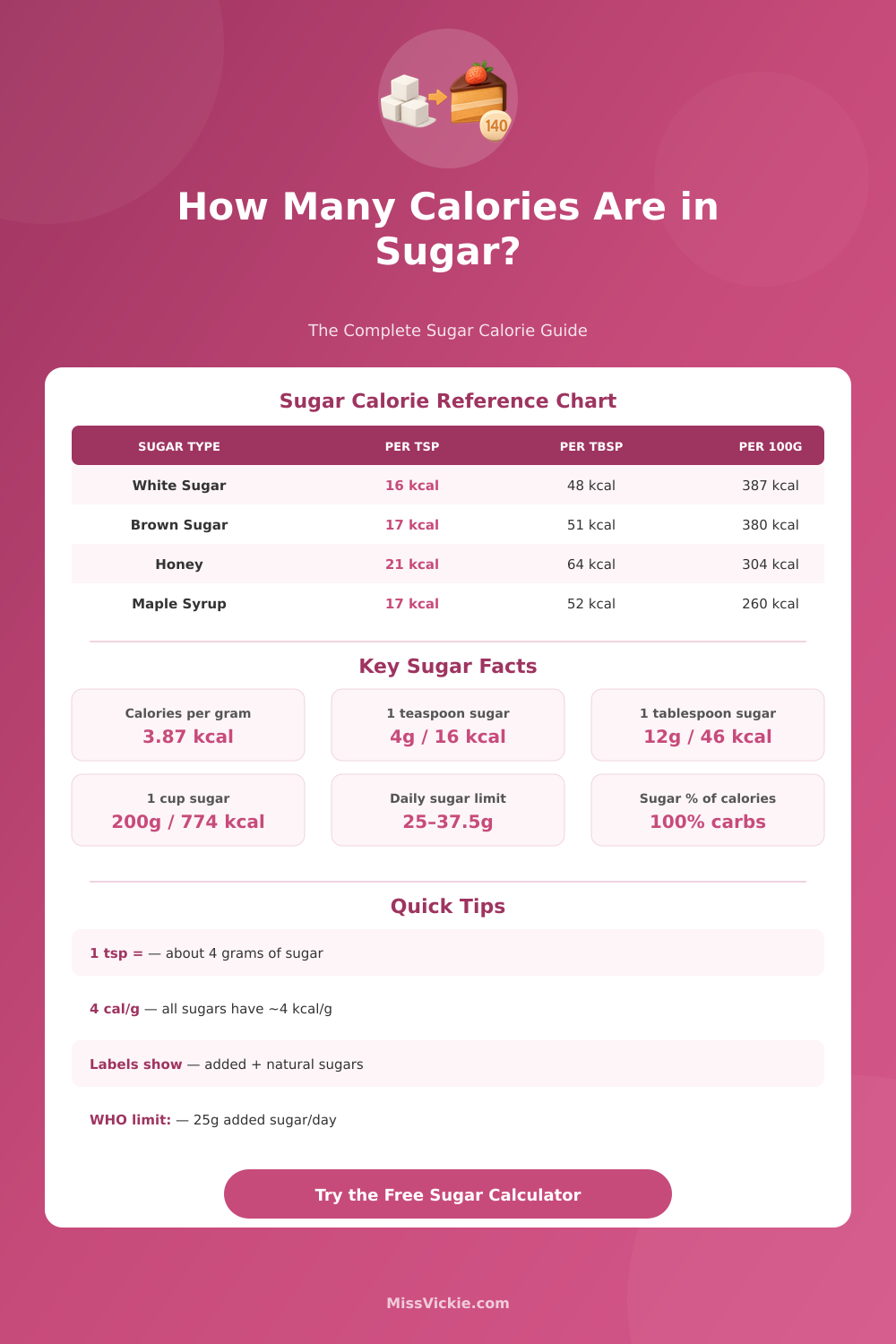
| Sugar Type | Per Teaspoon | Per Tablespoon | Per Cup | Per 100g |
|---|---|---|---|---|
| White Sugar | 16 kcal (4g) | 46 kcal (12g) | 774 kcal (200g) | 387 kcal |
| Brown Sugar | 17 kcal (4.5g) | 51 kcal (13.5g) | 836 kcal (216g) | 380 kcal |
| Powdered Sugar | 10 kcal (2.5g) | 29 kcal (7.5g) | 467 kcal (120g) | 389 kcal |
| Raw / Turbinado | 18 kcal (4.6g) | 53 kcal (13.8g) | 869 kcal (224g) | 399 kcal |
| Honey | 21 kcal (7g) | 64 kcal (21g) | 1031 kcal (340g) | 304 kcal |
| Maple Syrup | 17 kcal (6.7g) | 52 kcal (20g) | 840 kcal (322g) | 260 kcal |
| Agave Nectar | 20 kcal (6.7g) | 60 kcal (20g) | 960 kcal (320g) | 310 kcal |
| Coconut Sugar | 15 kcal (4g) | 45 kcal (12g) | 720 kcal (192g) | 375 kcal |
| Measurement | Grams (White Sugar) | Ounces | Approximate Calories |
|---|---|---|---|
| 1 teaspoon (tsp) | 4 g | 0.14 oz | 16 kcal |
| 1 tablespoon (tbsp) | 12 g | 0.42 oz | 46 kcal |
| 1/4 cup | 50 g | 1.76 oz | 194 kcal |
| 1/2 cup | 100 g | 3.53 oz | 387 kcal |
| 1 cup | 200 g | 7.05 oz | 774 kcal |
| 1 ounce (oz) | 28.35 g | 1 oz | 110 kcal |
| 100 grams | 100 g | 3.53 oz | 387 kcal |
| Food / Drink | Serving Size | Sugar Content | Calories from Sugar |
|---|---|---|---|
| Can of Soda (Cola) | 355 ml (12 fl oz) | ~39g | ~151 kcal |
| Orange Juice (glass) | 240 ml | ~21g | ~81 kcal |
| Chocolate Bar (avg) | 45g bar | ~23g | ~89 kcal |
| Fruit Yogurt | 170g container | ~26g | ~101 kcal |
| Sports Drink | 500 ml bottle | ~34g | ~132 kcal |
| Ketchup | 1 tbsp (17g) | ~4g | ~15 kcal |
| Coffee (with 2 tsp sugar) | 240 ml + 8g sugar | ~8g | ~31 kcal |
Sugar contain calories and provides energy to the body in the form of carbohydrate. As sugar provides energy to the body, it is essential to understand how many sugar an individual consumes. The weight of the sugar can be difficult to track as the weight of the same type of sugar can vary depending on how it is measured.
The number of calories that sugar contains also depends on it’s weight. For example, one cup of granulated white sugar weigh 200 grams; however, a cup of powdered sugar weigh 120 grams. This is due to the fact that powdered sugar is less dense than granulated sugar.
Measuring Sugar and Calories
Brown sugar contain more calories than granulated sugar due to its moisture and molasses content. Using these different density of sugar, the weight of the sugar will alter the total number of calories that sugar contains. One level teaspoon of sugar contain 4 gram of sugar, and 4 grams of sugar contain 16 calories.
To account for the different densities of sugar, it is essential to take note of the weight and density of the sugar when measuring for calorie count. Another factor that will influence the weight of the sugar is how it is scooped. Using a loose spoonfuls will allow for the sugar to contain more air than if it is packed into the cup.
Using a spoonful of sugar that contains more air will weigh less than a spoonful that is packed. Packing sugar into a cup will allow it to be more denser than if it is scooped loose with a spoon. Using packed sugar will result in a higher weight and more calories than loose sugar.
For instance, brown sugar will weigh 8% more than level white sugar. Using packed brown sugar will result in an individual consuming more calories from a recipe than if using level white sugar. The method with which sugar is scooped should of been matched with the requirements of the recipe.
The amount of sugar that is use in a recipe can be scaled. If you double a recipe, the amount of sugar will need to be doubled as well. In cooking, it is possible to lose some of the sugar during the cooking process.
For instance, sugar can spill from a spoon while transferring it into a pot or the sugar can evaporate during the simmering of a sauce. To account for this, it is suggested to make a small buffer of 2% to 4% of the amount of sugar for the recipe. When calculating the calories in a batch of food, it is essential to calculate the calories per serving.
The batch of food may contain many calories. However, the number of calories per serving of the food will allow individuals to understand how much calories are consumed during one sitting of the food. The types of sugar contain a different number of calories.
For instance, granulated and caster sugar contain 387 calories per 100 grams of sugar. Coconut sugar contain 375 calories per 100 grams of sugar. Brown sugar contain 380 calories per 100 grams.
Raw and demerara sugar are heavier in weight than other type of sugar. Therefore, raw and demerara sugar will weigh more than other types of sugar per cup. While the calories from sugar differ by less than 10% per teaspoon, the difference in calories is more significant with the larger amount of sugar.
These mathematical principles can be applied to different scenarios. For instance, two level teaspoons of sugar contains 8 grams of sugar and 31 calories. Four cups of coffee with two teaspoons of sugar per cup will contain 124 calories from the sugar.
A recipe for cookies with one cup of granulated sugar contains 774 calories from the sugar. If you divide the batch of cookies into 48 cookies, each cookie will contain 32 calories from the sugar. To manage the sugar intake in the kitchen, rounding number can be used.
For example, teaspoons can be used for drinks. Tablespoons can be used for mixing into recipes for baking. Cups can be used for the preparation of food in large batches.
Grams can also be used for the measurement of sugar for more repeatable recipes. Depending on the country of origin of the recipe, the units of measurement for sugar can also be convert. For instance, one pound of sugar weigh 453 grams.
453 grams of sugar weigh 2.25 cups of sugar when it is unpacked. Another important point regarding sugar is that the body process all types of sugar into glucose. The body uses this glucose as energy.
In healthy individual, the recommendation is to limit the intake of added sugar to no more than 25 to 36 grams per day. By understanding and measuring the amount of sugar that an individual consumes, and understanding how density affects the weight of the sugar, individuals can gain a better understanding of how to manage there sugar and calorie intake.