🧂 MissVickie salt conversion math
Salt ML to Grams Converter
Convert salt volume into grams with density presets, packing adjustment, moisture adjustment, and serving scale in one calculator. Every result includes a transparent formula breakdown so you can trust the numbers for baking, brining, and meal prep.
Choose a salt preset to auto-fill realistic density and context settings. You can still override density manually afterward.
Enter your amount and controls. This calculator supports volume-to-weight conversion for recipe scaling, brine prep, and consistency checks.
Full Calculation Breakdown
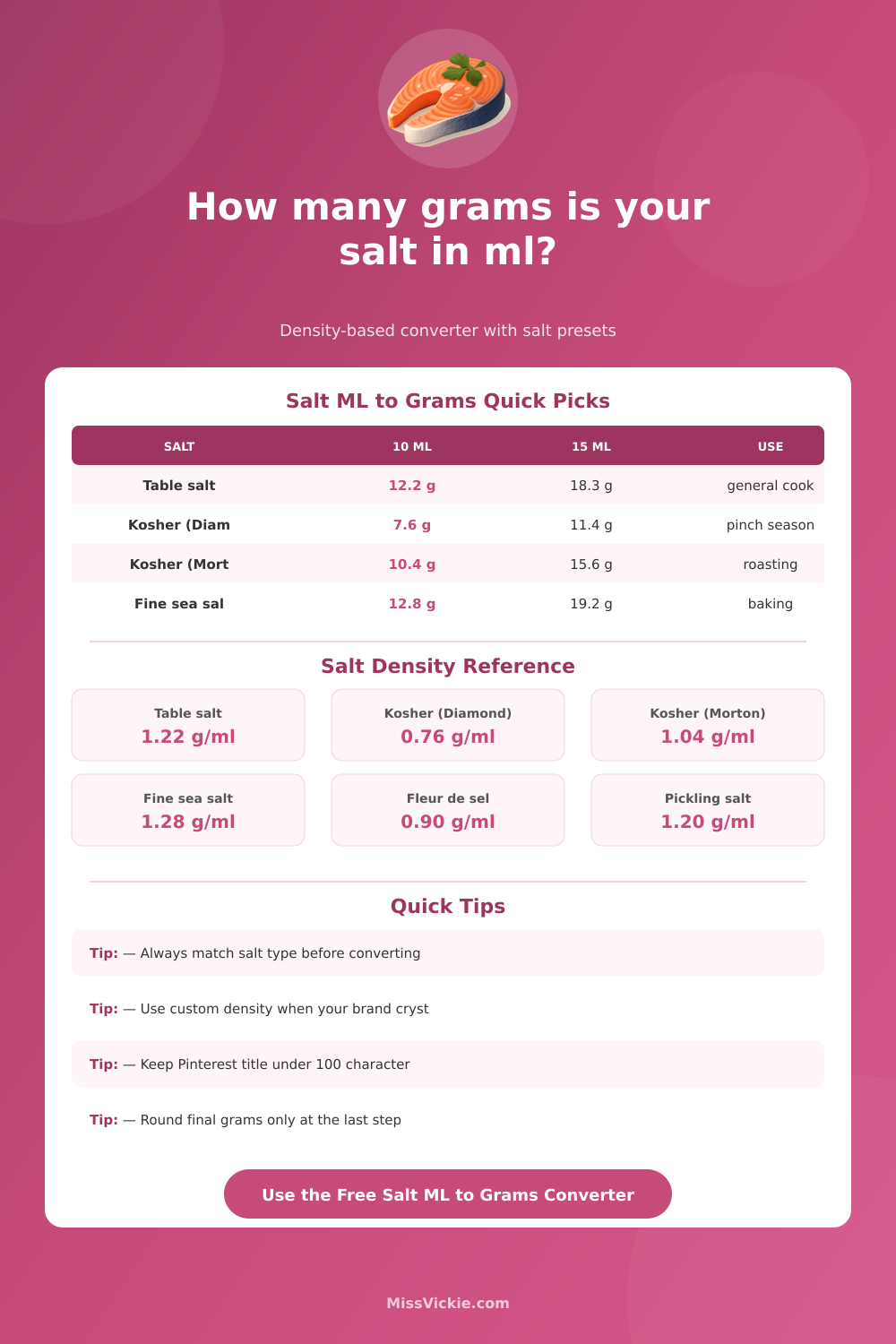
This grid compares how many grams each salt type would weigh for your current input volume after serving scale, before packing and moisture adjustments. It helps prevent oversalting when swapping salts.
Density values are practical kitchen estimates for dry volume conversions. Crystal shape, humidity, and brand differences can shift outcomes, so adjust with custom density when possible.
| Everyday Cooking Salts | Density (g/ml) | Approx grams per tsp | Typical kitchen use |
|---|---|---|---|
| Table salt (fine) | 1.22 | 6.0 | General seasoning, baking, sauces |
| Sea salt (fine) | 1.28 | 6.3 | Breads, pastry, soups |
| Sea salt (coarse) | 1.10 | 5.4 | Roasting, crusting, rubs |
| Himalayan pink (fine) | 1.25 | 6.2 | Everyday cooking, finishing pinch |
| Celtic sea salt (moist) | 1.16 | 5.7 | Mineral-forward savory recipes |
| Black lava salt | 1.12 | 5.5 | Finishing contrast on plated food |
| Kosher and Flake Salts | Density (g/ml) | Approx grams per tbsp | Conversion caution |
|---|---|---|---|
| Kosher (Diamond Crystal) | 0.76 | 11.2 | Very light crystal; much less salty by volume |
| Kosher (Morton) | 1.04 | 15.4 | Denser than Diamond; measure carefully |
| Flake sea salt | 0.72 | 10.6 | Large flakes collapse when crushed |
| Fleur de sel | 0.90 | 13.3 | Finishing salt; avoid replacing 1:1 by volume |
| Maldon-style flakes | 0.68 | 10.1 | Low density, best for final sprinkle |
| Pyramid flake salt | 0.70 | 10.4 | Fragile crystals; variable packing |
| Brining and Preservation Salts | Density (g/ml) | Sodium profile | Common usage |
|---|---|---|---|
| Pickling salt | 1.20 | High sodium, no anti-caking | Pickles, fermented vegetables |
| Canning salt | 1.19 | Clean dissolving | Brines and canning liquids |
| Curing salt #1 | 1.18 | Contains nitrite blend | Short-cure meats (strict recipe use) |
| Curing salt #2 | 1.16 | Nitrite and nitrate blend | Long cures and dry aged products |
| Smoked salt | 1.08 | Flavor-forward, variable crystals | Dry rubs and finishing |
| Pretzel salt | 0.95 | Chunky crystal structure | Topping breads and snacks |
| Quick Volume Conversion Anchors | Volume (ml) | Table salt grams | Kosher (Diamond) grams |
|---|---|---|---|
| 1/4 tsp | 1.23 | 1.50 | 0.94 |
| 1/2 tsp | 2.46 | 3.00 | 1.87 |
| 1 tsp | 4.93 | 6.01 | 3.75 |
| 2 tsp | 9.86 | 12.03 | 7.50 |
| 1 tbsp | 14.79 | 18.04 | 11.24 |
| 2 tbsp | 29.57 | 36.08 | 22.47 |
| 1/4 cup | 59.15 | 72.16 | 44.95 |
| 1/2 cup | 118.29 | 144.31 | 89.90 |
| 1 cup | 236.59 | 288.64 | 179.80 |
Use these limits to keep pin metadata valid and readable. The counters below flag when you exceed recommended maximum length.
Another factor that influence the weight of salt is the densities of the different types of salt. Each type of salt can have a different weight when measured by volume. The weight of salt also depend on the size of the salt crystals.
Fine table salt crystals are small and dense, so fine table salt have a high density. Kosher salt crystals are large and contain air pockets between each crystals, which cause the density of kosher salt to be low. Because the density of kosher salt is low, using a tablespoon of kosher salt will add less salt then using a tablespoon of fine table salt.
Why Different Types of Salt Weigh Different Amounts
The concept of density are the reason that volume measurements of salt are often inaccurate. Table salt is very dense and weigh approximately 1.22 grams per milliliter. Because the pyramid shapes of the kosher salt crystals contains air pockets between each salt crystal, the density of kosher salt is low and it weigh approximately 0.76 grams per milliliter.
If you use kosher salt for table salt, the density of the salt will be insufficient for a dish. If table salt is used for kosher salt, the density of the salt will be to high and the salt will taste too salty in the finished dish. Another factor that can affect the density of salt is how the salt are packed into the measuring spoon.
If you pack the salt tight into the spoon, it will have a more higher density than if the salt is loosely packed into the spoon. The amount of moisture that salt crystals absorb from the air can also alter the density of the salt. To ensure that the density of the salt is accurate in the recipe, it is important to account for these addition factors.
When making a recipe for more people, you must account for the density of the salt. For instance, if a recipe calls for 15 ml of salt to make four people, you have to calculate the weight of that salt. Then, if you are making enough for six people, you would have to calculate 22.5 ml of salt times the density of the salt to get the weight in gram of the salt necessary for six people.
If you did not use the density of the salt in these calculations, the amount of salt in the food will not be even throughout the food. There are various types of salt use in the kitchen for specific purposes. Bakers use fine salt to prevent salt pockets from forming in the baked goods.
Roasters use kosher salt because of the lightness of this salt to easily coat the meat. In applications like pickling, specific densities of salt is necessary to allow the vegetables to ferment properly. If the salt concentration in the brine is too low, the vegetables will be mushy.
If there is too many salt, the vegetables will not ferment properly. Various kitchen mistakes can be avoided by using the weight of the ingredients in place of the volume of the ingredients. People often make the mistake of assuming that all salts weighs the same in a measuring spoon.
However, the weight of the salt differ from one type of salt to the next. Additionally, many assume that a teaspoon of an ingredient will weigh the same as another teaspoon of another ingredient. However, the size of a teaspoon can vary.
Because salt enhances the flavor of food, it is important to use the correct amount of salt in you’re food. If there is too little salt in the food, the flavors will be weakly. There will be too much salt in the food if you use too much salt.
Using a scale in gram to measure the salt will allow for precision of the amount of salt being use in the kitchen.