MissVickie Kitchen Math
Teaspoons to Grams Salt Converter
Convert tsp to g for real salt types, compare brands, scale servings, and estimate sodium without losing seasoning balance.
Quick Presets
Ten starter presets for common cooking and baking situations.
Converter Inputs
Main quantity to convert.
Optional note shown in the breakdown card.
Full Breakdown
Salt Density Comparison Grid
Teaspoon To Grams Salt Tables
| Fine Table Salt | Teaspoons | Grams | Sodium | Kitchen Use |
|---|---|---|---|---|
| Fine table | 1/8 tsp | 0.75 g | 291 mg | Eggs, finishing, dressings |
| Fine table | 1/4 tsp | 1.50 g | 581 mg | Soup seasoning |
| Fine table | 1/2 tsp | 3.00 g | 1162 mg | Vegetables and sauces |
| Fine table | 3/4 tsp | 4.50 g | 1743 mg | Rice, grains, pasta water |
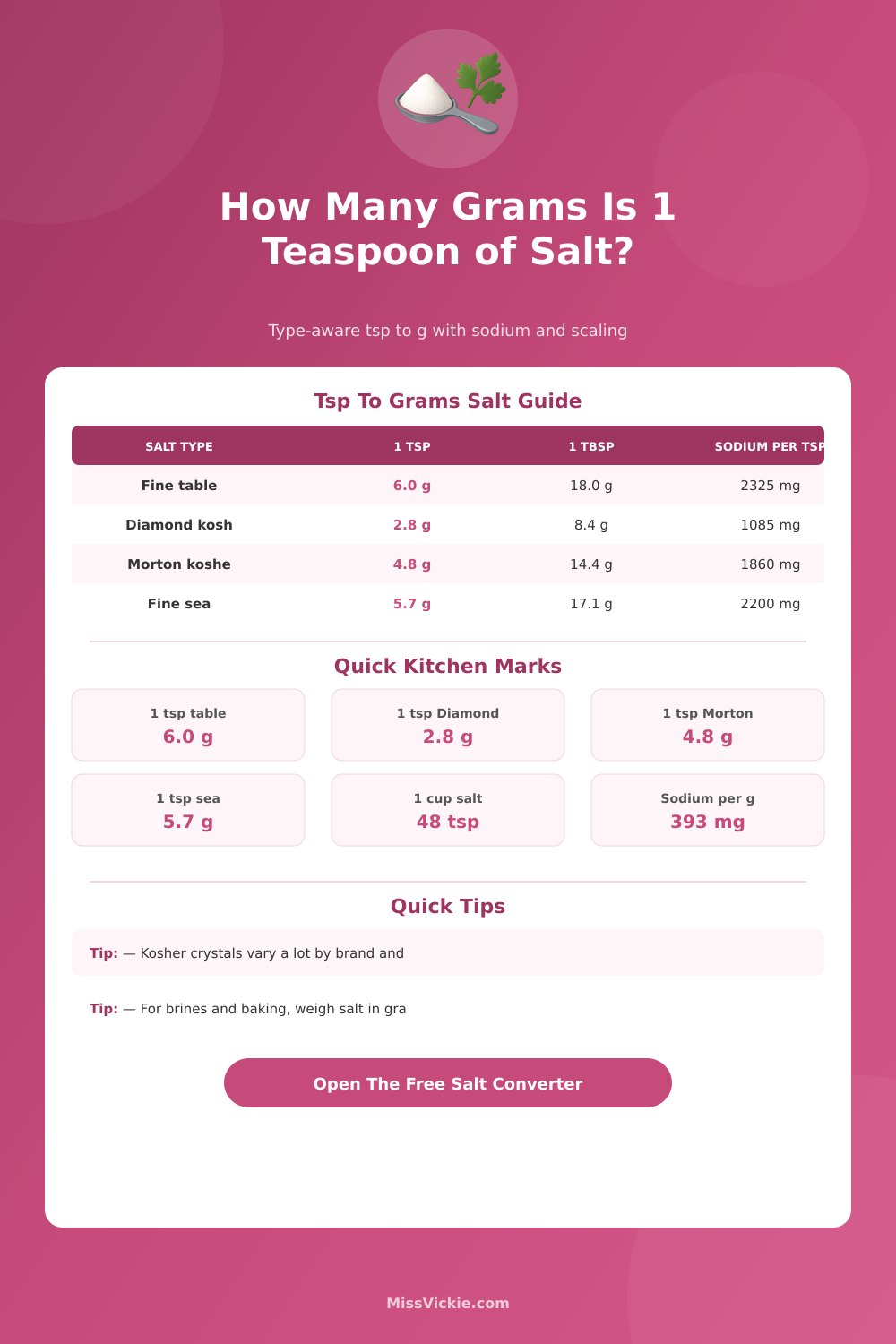
| Fine table | 1 tsp | 6.00 g | 2325 mg | General baking |
| Fine table | 1.5 tsp | 9.00 g | 3488 mg | Braising liquids |
| Fine table | 2 tsp | 12.00 g | 4650 mg | Large pot recipes |
| Fine table | 1 tbsp | 18.00 g | 6975 mg | Brine base |
| Diamond Kosher | Teaspoons | Grams | Sodium | Kitchen Use |
|---|---|---|---|---|
| Diamond Crystal | 1/8 tsp | 0.35 g | 138 mg | Gentle finishing |
| Diamond Crystal | 1/4 tsp | 0.70 g | 275 mg | Salads and dressings |
| Diamond Crystal | 1/2 tsp | 1.40 g | 550 mg | Protein seasoning |
| Diamond Crystal | 3/4 tsp | 2.10 g | 825 mg | Dry rub layers |
| Diamond Crystal | 1 tsp | 2.80 g | 1085 mg | Preferred chef pinch profile |
| Diamond Crystal | 1.5 tsp | 4.20 g | 1628 mg | Sear and roast prep |
| Diamond Crystal | 2 tsp | 5.60 g | 2170 mg | Stockpot seasoning |
| Diamond Crystal | 1 tbsp | 8.40 g | 3255 mg | Batch cooking |
| Morton Kosher | Teaspoons | Grams | Sodium | Kitchen Use |
|---|---|---|---|---|
| Morton kosher | 1/8 tsp | 0.60 g | 233 mg | Sauce correction |
| Morton kosher | 1/4 tsp | 1.20 g | 465 mg | Vegetable seasoning |
| Morton kosher | 1/2 tsp | 2.40 g | 930 mg | Chicken marinades |
| Morton kosher | 3/4 tsp | 3.60 g | 1395 mg | Ground meat blends |
| Morton kosher | 1 tsp | 4.80 g | 1860 mg | Recipe standard in US labels |
| Morton kosher | 1.5 tsp | 7.20 g | 2790 mg | Family dinner batches |
| Morton kosher | 2 tsp | 9.60 g | 3720 mg | Casserole prep |
| Morton kosher | 1 tbsp | 14.40 g | 5580 mg | Roast seasoning |
| Sea And Flaky Salts | Teaspoons | Grams | Sodium | Kitchen Use |
|---|---|---|---|---|
| Fine sea salt | 1 tsp | 5.70 g | 2200 mg | All-purpose cooking |
| Pink Himalayan fine | 1 tsp | 5.80 g | 2240 mg | Dry seasoning blends |
| Pickling salt | 1 tsp | 6.10 g | 2360 mg | Brines and ferments |
| Flaky finishing salt | 1 tsp | 2.00 g | 770 mg | Final sprinkle on plated food |
| Coarse sea salt | 1 tsp | 4.90 g | 1890 mg | Crust seasoning |
| Fine sea salt | 1 tbsp | 17.10 g | 6600 mg | Soup or stew base |
| Pink Himalayan fine | 1 tbsp | 17.40 g | 6720 mg | Meal prep portions |
| Flaky finishing salt | 1 tbsp | 6.00 g | 2325 mg | Texture-focused finishing |
Tips
Density and sodium values are practical kitchen estimates designed for everyday home cooking conversions.
Another factor that can influence how much salt a person must add to a meal when using teaspoons is the salt density. Not all types of salt weigh the same amount when measured with a teaspoon. The shape and size of the salt crystals influence the density of the salt in each teaspoon measurement.
For instance, fine table salt has a high density due to the small grains of salt. One teaspoon of fine table salt weigh approximately 6 grams. In contrast, Diamond Crystal kosher salt have large flakes that do not pack together as tightly.
Why a Teaspoon of Salt Can Weigh Different Amounts
Therefore, one teaspoon of Diamond Crystal kosher salt weigh only 2.8 grams. Morton kosher salt has a more higher density than Diamond Crystal salt because its grains are flatter. A teaspoon of Morton kosher salt weighs approximately 4.8 grams.
The density of sea salt also vary. Fine sea salt weighs approximately 5.7 grams per teaspoon while coarse sea salt weighs less per teaspoon. Understanding salt density can help cooks to control how much salt they add to the recipes.
Using too much or too little salt can change the outcome of the recipe. Using too little salt in bread dough can make the dough spread out flat instead of rising. Using too much salt can make the yeast stop working.
The amount of salt used in brining or fermenting processes need to be precise as the sodium drives these chemical processes. Using the wrong amount of salt may make the meat or vegetables mushy. The salt density can play a significant role in scaling the recipe.
For example, if a soup recipe is for two servings but a person would like to make it for six servings, then the salt density will play a significant role in determine how much salt to add. If the cook ignores the salt density then the soup may become too salty. Due to the impact of salt density, it is essential for cooks to understand how much salt of each type is needed for a recipe.
Not all salts is the same; hence, they are not interchangeable by volume. For instance, cooks use flaky salt to finish steak but it would require nearly three times the volume of table salt to provide the same level of saltiness. The type of salt requires cooks to think about the specific task the salt will perform.
Then cooks can use the knowledge of how much of each type of salt is required to make accurate measurements. The different recipes from different regions of the world may make it difficult for cooks to understand how to measure the salt required for the recipe. Many American recipes uses Morton kosher salt while many European recipes use fine sea salt or fine table salt.
The humidity in the area can make fine salts clump together which will make the salt denser in the spoon. The salt may also be packed into the spoon more or less tightly which will impact the weight of the salt. These variables must be considered when adding salt to a recipe or else salt can be measured in gram.
To scale a recipe, cooks will have to double the ingredients so that the salt levels will remain the same as the original recipe. For large batches of dry rubs or brines, cooks should add extra salt to account for how the salt will distribute in such a large batch. For very small measurements, cooks can round the salt measurements to the nearest quarter-teaspoon.
Knowing how many milligrams of sodium is in a gram of salt can also aid cooks in managing the salt content of the dishes they prepare. There are approximately 393 mg of sodium in every gram of salt. Many cooks make mistakes in the kitchen when they dont take into consideration the differences in salt density.
Many cooks will ignore the differences between brands of salt. This will create food that is either too bland or too salty. Many people will use kosher salt as it has a texture that allows them to evenly sprinkle the salt on food.
However, most recipes dont state the type of salt that should be used. If using another type of salt, such as pink Himalayan salt or pickling salt, cooks will have to adjust the measurements based off the density of this salt compared to others. The choice of salt depends on the goal of the cooking task.
For example, if finishing a dish, flaky salt can be used in small amounts. However, if cooking bread or brining, weighing the salt in grams will allow cooks to control the amount of salt add to the dish. The shape of the salt crystal will dictate the weight of the salt in the spoon.
With this knowledge cooks can make better choices in the kitchen. Additionally, tasting the food will allow cooks to adjust the salt level in the food. Finally, cooks can adjust the salt level to suit they’re needs.