🍳 MissVickie yeast math
Dry Yeast to Instant Yeast Converter
Convert active dry, rapid-rise, and osmotolerant yeast into instant yeast amounts, then scale for dough style, temperature, sugar, and proof timing.
Each preset fills a real kitchen case, from pizza night to sweet dough and cold-proof loaves, then runs the conversion automatically.
Set your dry yeast style, the amount you measured, and the recipe conditions so the instant yeast recommendation stays practical for home baking.
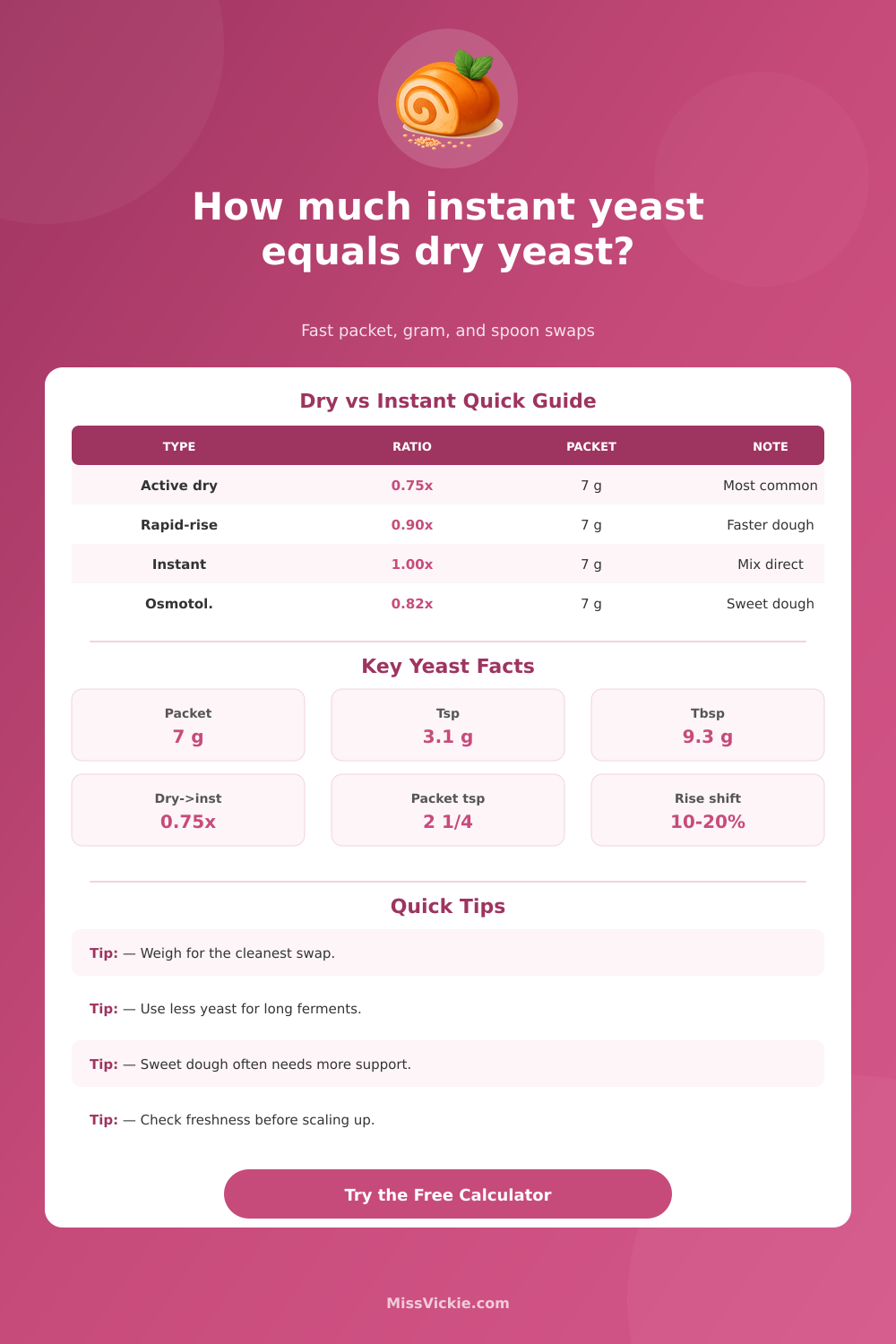
These tables show the ratio logic, common spoon and packet equivalents, and the recipe conditions that most often change yeast behavior.
| Dry yeast type | Instant ratio | Bloom hint | Best use |
|---|---|---|---|
| Active dry | 0.75x | Optional bloom | Most home bread |
| Rapid-rise | 0.90x | Mix direct | Same-day dough |
| Osmotolerant | 0.82x | Sugar-safe | Sweet dough |
| Instant | 1.00x | No bloom | Direct mix |
| Measure | Grams | Packets | Kitchen note |
|---|---|---|---|
| 1 packet | 7 g | 1.00 | 2 1/4 tsp |
| 1 tsp | 3.1 g | 0.44 | Small batch |
| 1 tbsp | 9.3 g | 1.33 | Fast scaling |
| 1 oz | 28.35 g | 4.05 | Bulk pantry |
| Dough style | Amount factor | Time factor | Comment |
|---|---|---|---|
| Lean bread | 0.98x | 0.95x | Clean crust |
| Pizza dough | 1.00x | 0.98x | Balanced rise |
| Brioche | 1.05x | 1.10x | Rich dough |
| Sweet dough | 1.08x | 1.14x | Sugar slows it |
| Condition | Amount factor | Time factor | What it means |
|---|---|---|---|
| Cool kitchen | 1.04x | 1.10x | Needs more lift |
| Room temp | 1.00x | 1.00x | Baseline |
| Warm room | 0.97x | 0.92x | Moves faster |
| Hot kitchen | 0.94x | 0.85x | Watch proofing |
Use this quick grid to compare the common dry yeast styles before you scale the recipe or switch from one packet format to another.
Best for classic bread and rolls when you want the common dry-to-instant swap.
Good for same-day dough that should move faster without changing the whole recipe.
Direct-mix style with no blooming step and the simplest packet math.
Useful for sweet dough and richer formulas that slow fermentation.
There are two different types of yeasts, and to master the art of baking bread successful, one must understand the differences between these two types of yeast. Active dry yeast require a blooming process in which the baker dissolves the dry active yeast in warm water. Instant yeast, on the other hand, dont require blooming because the yeast are produced to dissolve more quickly in the dough.
Furthermore, if using instant yeast as a replacement for active dry yeast, the baker should use 0.75 of the amount of active dry yeast call for in the recipe. This ratio is used because active dry yeast contains 25 percent less yeast because of the difference in the cell structures in each type of yeast. Other than the type of yeast that is used in the baking of bread, there are other environmental factors that can play a role in the behavior of the yeast in the dough.
Types of Yeast and How to Use Them
One of the most important of these factor is the temperature in the kitchen in which the bread is being baked. If the kitchen is warm, the yeast will work more quick to ferment the dough. As a result, the baker should use less yeast in the recipe compared to a colder kitchen.
With the same concept in play, if it is very cold in the kitchen, more yeast or more time need to be allowed for the dough to rise. Another of these environmental factors that affect the behavior of the yeast is the sugar content in the dough. With dough that contain a higher amount of sugar, the yeast will ferment at a slower rate.
This is due to the fact that the sugar will draw the moisture away from the yeast cells, which can lead to a slowing of the yeast cells activity. To compensate for this, the baker should add 6 to 8 percent more yeast to sweet dough recipes. Another factor to consider when baking bread with yeast is the weight of the yeast.
More accurate than measuring the weight of the yeast is the measurement of the weight of the yeast. Yeast can weigh between 2.5 and 3.5 grams per teaspoon of yeast. Most yeast packets contains 7 grams of active dry yeast.
7 grams of active dry yeast is equal to approximately 2.25 teaspoon. Furthermore, there are various types of yeast that can be used in the baking of bread. Rapid rise yeast will work more quickly than active dry yeast.
Additionally, osmotolerant yeast will work in recipes that contain high amounts of sugar. Bakers can also test the freshness of the yeast that is to be used in the baking of bread. The yeast test will determine whether or not the yeast is still fresh and active.
To conduct a yeast test, the baker should mix yeast with warm water and a small amount of sugar. After five minute, the baker will observe the mixture to determine if the yeast is still fresh. If there is no foam after five minutes, the yeast is not fresh and should not be used in the recipe.
Additionally, you can store yeast in the freezer in airtight bags to help ensure that the yeast stay fresh for a longer period of time. Some of the most common mistake made with yeast are using too much yeast in the recipe or using too little yeast in the recipe. Using too much yeast may lead to bread that has large holes throughout it and may have a strong taste of alcohol because of the rapid fermentation of the dough.
If too little yeast is used, the bread will be dense and will not rise as much as it should of. The best way to determine if the dough is ready is to observe the dough to see if it has doubled in size. Another common mistake by new bakers is not adjusting the amount of yeast according to the size of the recipe to be baked.
Additionally, if the recipe changes the fermentation time of the bread, the amount of yeast will have to be adjusted, as well. For instance, if the recipe calls for the dough to ferment in the refrigerator for several hours, the baker should use less yeast because the long time allow the yeast to effectively ferment the dough.