
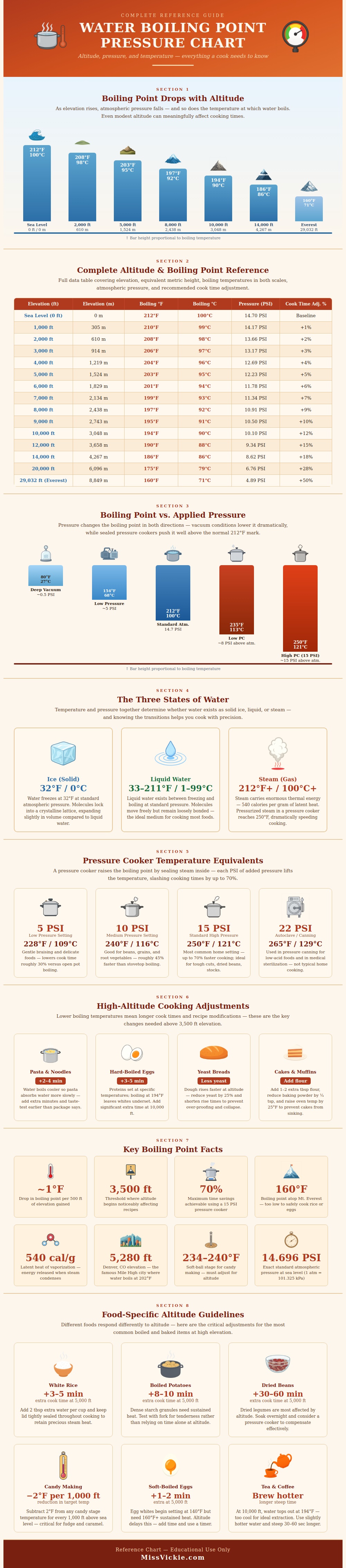
Boiling occur when the water molecule gain enough energy to become a vapor. The water molecules has to push against an air pressure that is pressing down on the water. At sea level, the air pressure are 14.7 pounds per square inch, which allow the water to reach 212 degrees Fahrenheit as its boiling point.
However, as the elevation increase, the air pressure decrease. At higher altitude, the water reaches its boiling point at a more lower temperature. For example, on the summit of Mount Everest, the boiling point of the water is only 160 degrees Fahrenheit due to the low air pressure at this altitude.
Boiling Water and Cooking at High Altitudes
A person living at high altitudes will note that the boiling point of water are lower then the boiling point of water at sea level. Furthermore, the lower boiling point of water will impact the cooking time for food. Most food require specific temperatures to cook proper.
The water at high altitudes will not reach the required temperature for food to cook properly. For example, pasta need to reach 212 degrees Fahrenheit to cook proper. If the water boils at a lower temperature at high altitudes, the pasta will take longer to cook.
People needs to increase the cooking times for food as they increase in elevation. For every 500 feet of elevation gain, the boiling point of water will decrease by one degree Fahrenheit. Not all food require the same adjustment at high altitudes.
For instance, beans will take longer to cook because the skin of beans are tough and require high heat to soften them. Furthermore, the cooking time for rice will also increase at high altitudes because the cooking temperature of water are lower. Additionally, the longer it will take for egg to cook because protein will not set if the temperature of the water is below 200 degrees Fahrenheit.
Lastly, cake will rise too quickly at high altitudes due to the thin air. The structure of the cake will collapse. To adjust for this, a person can add extra flour to the recipe or use less leavening agent.
A pressure cooker can change the effect that the air pressure have on the boiling point of water. A pressure cooker create steam that increase the air pressure within the pot. The boiling point of water will increase with higher air pressure.
If the air pressure within the pressure cooker reach 15 pounds per square inch, the boiling point of the water will reach 250 degrees Fahrenheit. Furthermore, food like brisket or grain will cook faster in a pressure cooker because the higher the boiling point of water, the more hotter the food will cook. A pressure cooker can be used as a negation of the effect of high altitude because a high pressure environment creates in which the boiling point of water is high.
Many people will make mistake when cooking at high altitudes because they are not aware of the lower boiling point of water. For instance, many people will increase the heat of the stove to make the water boil faster. However, increasing the heat of the stove will not increase the boiling point of the water.
Instead, increasing the heat will make the water evaporate faster. Furthermore, many people will not account for the altitude of there location if it is below 3,500 feet. The boiling point of the water will be lower than at sea level.
To cook proper amount of food, individuals need to use a thermometer to test the temperature of the boiling water. The knowledge of how air pressure and boiling point interacts will allow individuals to cook proper food at high altitudes.