🍚 MissVickie rice converter
Rice Converter
Convert dry rice, cooked rice, and servings across cups, grams, ounces, and pounds while adjusting for rice type, cooking method, buffer, and portion size.
Each preset fills a practical rice scenario, from weeknight bowls to risotto and sushi night, then calculates the batch automatically.
Use dry to cooked for pantry rice, cooked to dry for leftovers, or servings to plan how much rice a group needs.
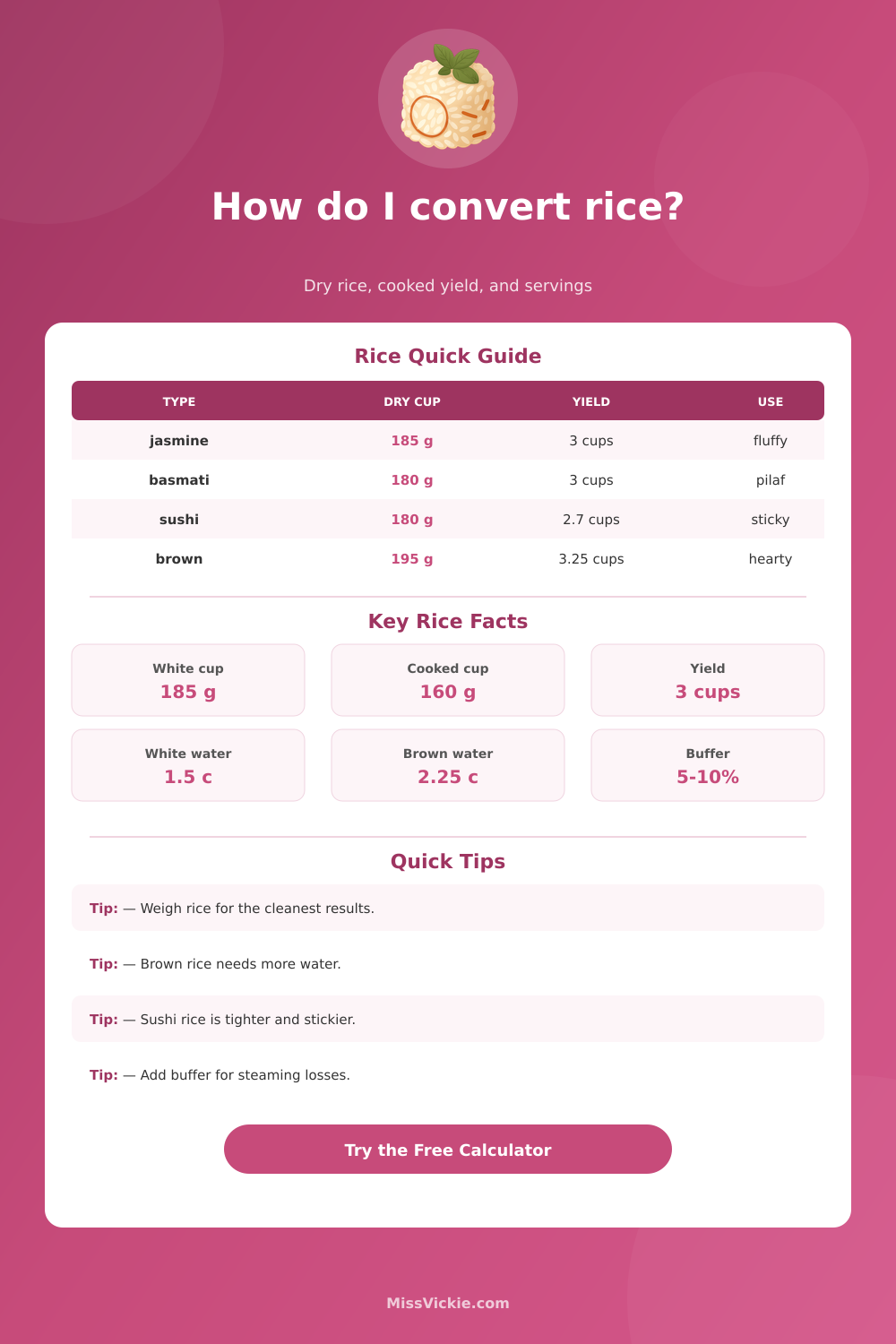
This table highlights the core rice families used in the calculator, with dry-cup weights, cooked yield, and the most common use case for each grain.
| Type | Dry Cup | Cooked Yield | Best Use |
|---|---|---|---|
| Jasmine | 185 g | 3 cups | Fluffy bowls and curries |
| Basmati | 180 g | 3 cups | Pilaf and biryani |
| Sushi | 180 g | 2.7 cups | Rolls and sticky bowls |
| Brown | 195 g | 3.25 cups | Meal prep and grain bowls |
Use this reference when you need to move between dry cups, tablespoons, teaspoons, and weight without guessing the base amount.
| Measure | Dry Weight | Cooked Weight | Note |
|---|---|---|---|
| 1 cup dry | 180-195 g | 540-620 g | Depends on rice type |
| 1 tbsp dry | 11-12 g | n/a | Good for small batches |
| 1 cup cooked | n/a | 160-195 g | Common plated portion |
| 1 serving | 0.75-1 cup | 150-200 g | Depends on appetite |
These groups give a quick idea of cooked rice totals before you enter the calculator, especially when you are planning meals for a table or buffet.
| Guests | Cooked Rice | Dry Rice | Setting |
|---|---|---|---|
| 2 | 1.5 cups | 0.5 cup | Side dish |
| 4 | 3 cups | 1 cup | Weeknight dinner |
| 6 | 4.5 cups | 1.5 cups | Family meal |
| 10 | 7.5 cups | 2.5 cups | Buffet tray |
Different methods shift the water ratio and the final yield, so the calculator adjusts for absorption, rice cooker steam loss, pilaf style, and boil-and-drain cooking.
| Method | Water Ratio | Yield | Note |
|---|---|---|---|
| Absorption | 1.5-2.0 c | Base yield | Classic stovetop pot |
| Rice Cooker | 1.45-1.9 c | +2% hold | Steam stays trapped |
| Pilaf | 1.6-2.2 c | +1% lift | Toasted, fragrant grain |
| Drain | 2.0-3.0 c | +5% loss | For wild rice and blends |
This comparison grid makes it easy to choose a rice family before you convert anything, which is useful when recipes call for texture rather than a strict weight.
Soft, fragrant, and ideal for bowls, curries, and side dishes where light separation matters.
Long grains stay separate, so it works well for biryani, pilaf, and plated dinners.
Best when you want cling and shape, especially for rolls, bowls, and small molded portions.
Chewier and more filling, with a stronger water need and a bigger cooked yield for meal prep.
Rice is a staple food for many people around the world. Rice measurements are more difficult for people because rice change size when it is cooked. When people cook dry rice, the rice absorbs water and expands in size.
Different type of rice expand at different rates. As a result, there is no standard rice measurement for all varieties of rice. To calculate the correct amount of dry rice to cook, individuals can use a rice converter tool.
How Much Rice to Cook
The type of rice that an individual use will change the amount of rice that is cooked. For instance, jasmine rice expand to three times its dry volume. Jasmine rice is perfect for making rice bowls or curries.
Sushi rice contains more starch than other types of rice and sticks together. As a result, there is less expansion of sushi rice. Basmati rice and brown rice has a similar cooking process but require more time to cook.
The starch structure of rice changes the amount of water required to cook rice and the amount of rice that are cooked. The method used to cook the rice will impact the amount of rice that is cooked. If the rice is cooked in a covered pot using the absorption method, the steam will remain in the pot.
Using a rice cooker will trap the steam and increase the amount of rice that is cooked. If the cook cooks the rice in a pan with oil as in the case of the pilaf cooking method, more liquid will have to be added to the rice because the heat will cause some of the liquid to evaporate. Using the boil-and-drain method for wild rice will allow the excess water and starch to be drained away.
Adding a buffer to the amount of water use will allow for water loss during the cooking process. Rice portion size can be measured as follows: one serving of cooked rice contains between three-quarters of a cup to one cup of rice. Using weight measurements, one serving of rice contains between 150 to 200 gram of rice.
For large group, the amount of dry rice should be calculated. If the cooked rice have remained after the meal, the rice converter will allow an individual to calculate the amount of dry rice that was used to make the cooked rice leftovers. Using a scale to weigh the rice as opposed to using measuring cups to measure the rice is more accurate.
A cup of dry jasmine rice weighs 185 grams. A cup of dry basmati rice weighs 180 grams. A cup of dry brown rice weighs 195 grams because it is denser than white rice.
Scooping rice into measuring cups can result in varying amount of rice being measured. Weighing the rice guarantee accuracy. Once the weight of dry rice is known, that weight can be multiplied by the rice type expansion factor to determine the cooked weight of the rice.
There are a few steps that can be followed to ensure rice is cooked proper. White rice should be rinsed until the water runs clear. Rinsing rice remove the starch that makes the rice turn to gel when cooked.
Brown rice should be soaked before cooking. Soaking allow the rice to cook more evenly. In high altitudes, the amount of water to rice should be increased by 10 to 25 percent because the water boils at a lower temperature at high altitudes.
After cooking is done, allow the rice to rest for five to ten minutes. Letting the rice rest allow the rice grains to firm up. Many people make mistakes when preparing rice.
Using too little water when preparing rice will result in rice that is undercooked in the center. The problem is common with brown and wild rice because they require more water then white rice. Rinsing sushi rice too much can remove the starch that makes the rice stick together when cooked.
When cooking rice for a group of people, it is better to add extra rice to the rice recipe by a quarter-cup measure so that there is enough rice for everyone who are having rice. Brown rice is a specific type of rice that has more fiber than white rice and can be prepared in advance. Approximately two and a quarter cups of water should be used for every cup of dry brown rice.
Brown rice take longer to cook than white rice. This hearty rice can be stored in the refrigerator after cooking.