
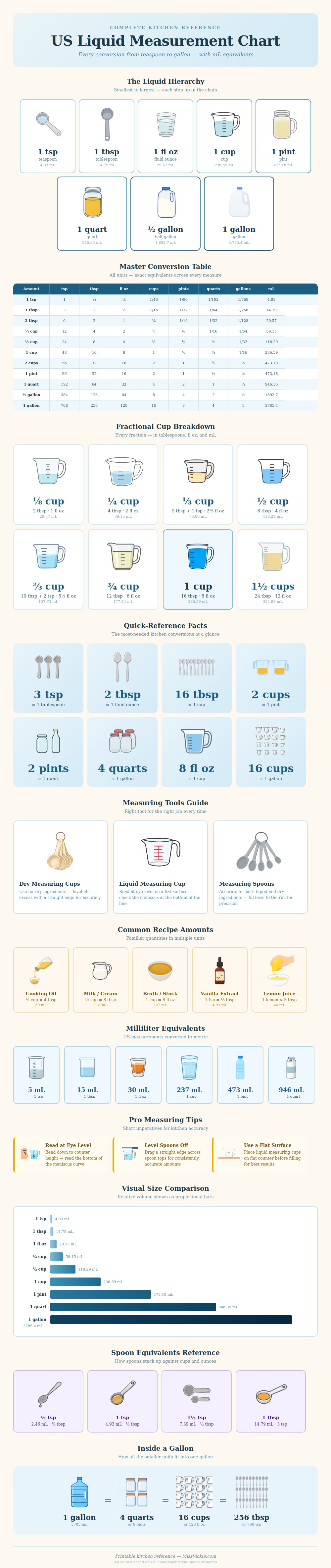
In the United States, there is a specific hierarchy for liquid measurement. By understanding the different unit of measurement for liquids and the math behind each unit, an individual can easily convert the volumes of liquid that may be required. Liquids can be measured in a variety of unit that start with small measurement and continue to larger units of measurement.
Some of the smallest unit of liquid measurement are teaspoons and tablespoons. However, there are also larger units of measurement for liquid, as well, such as fluid ounces, cups, pints, quarts, and gallon. A teaspoon is the smallest unit of liquid measurement.
How to Measure Liquids in the US
Three teaspoons will make one tablespoon. A tablespoon is larger than a teaspoon; two tablespoons will make one fluid ounce. An ounce is larger than a tablespoon; eight fluid ounces will make one cup of liquid.
One cup is a common unit of measurement for liquids; two cups will make one pint of liquid. A pint is larger than one cup; two pints will make one quart of liquid. Finally, four quarts will make one gallon of liquid.
In order to perform conversions of these different unit, an individual needs to know the following measurement: teaspoons to tablespoons, tablespoons to fluid ounces, fluid ounces to cups, cups to pints, pints to quarts, and quarts to gallons. For instance, if a recipe call for four tablespoons of some liquid, an individual knows that two tablespoons equal one fluid ounce; thus, four tablespoons will equal two fluid ounces. If a recipe calls for one cup of some liquid, an individual that knows that eight fluid ounces equal one cup can determine that one cup of liquid contain eight fluid ounces of liquid.
For liquids in large quantity, an individual can use the fact that four quarts will make one gallon of liquid. Precision is required in measuring liquids. An individual must take liquid measurement at eye level on a flat surface.
The meniscus of the liquid must be read at eye level. Specifically, you should read the bottom of the meniscus; you should not read the top of the meniscus. Additionally, the measuring cup should not be tilted when reading the meniscus of the liquid; tilting the cup will result in an inaccurate reading of the volume of the liquid.
Different tool can be used to measure the different units of liquid measurements. For instance, person can use a measuring spoon to measure small amount of liquid; cups can be used to measure larger amount of liquid. Measuring spoons and liquid measuring cup have handles and spouts that allow for easy pouring of the measured liquid.
Additionally, measuring cup for liquids are usually made of clear glass or plastic liquids so that the individuals can easily read the amount of liquid in each cup. Dry measuring cups must not be used to measure liquid. In addition to the unit of measurement described in the United States, the metric system of measurement can also be used to measure liquid.
Many international recipes use the metric system for liquid measurements. For instance, one teaspoon is equal to 5 milliliters, one tablespoon is equal to