💧 MissVickie hydration math
ML to Cups Water Converter
Convert ml water into US cups, metric cups, fluid ounces, liters, and bottle counts in one pass. Use kitchen presets for recipes or hydration presets for daily intake planning.
Select a preset to auto-fill realistic values for cooking, meal prep, gym bottles, and day-long hydration targets.
Set measurement style, amount, output preference, and context controls. This calculator supports both recipe scaling and hydration planning in one layout.
Full Conversion Breakdown
Use this to compare direct ml values with both cup systems. It is the fastest way to avoid cup standard mix-ups.
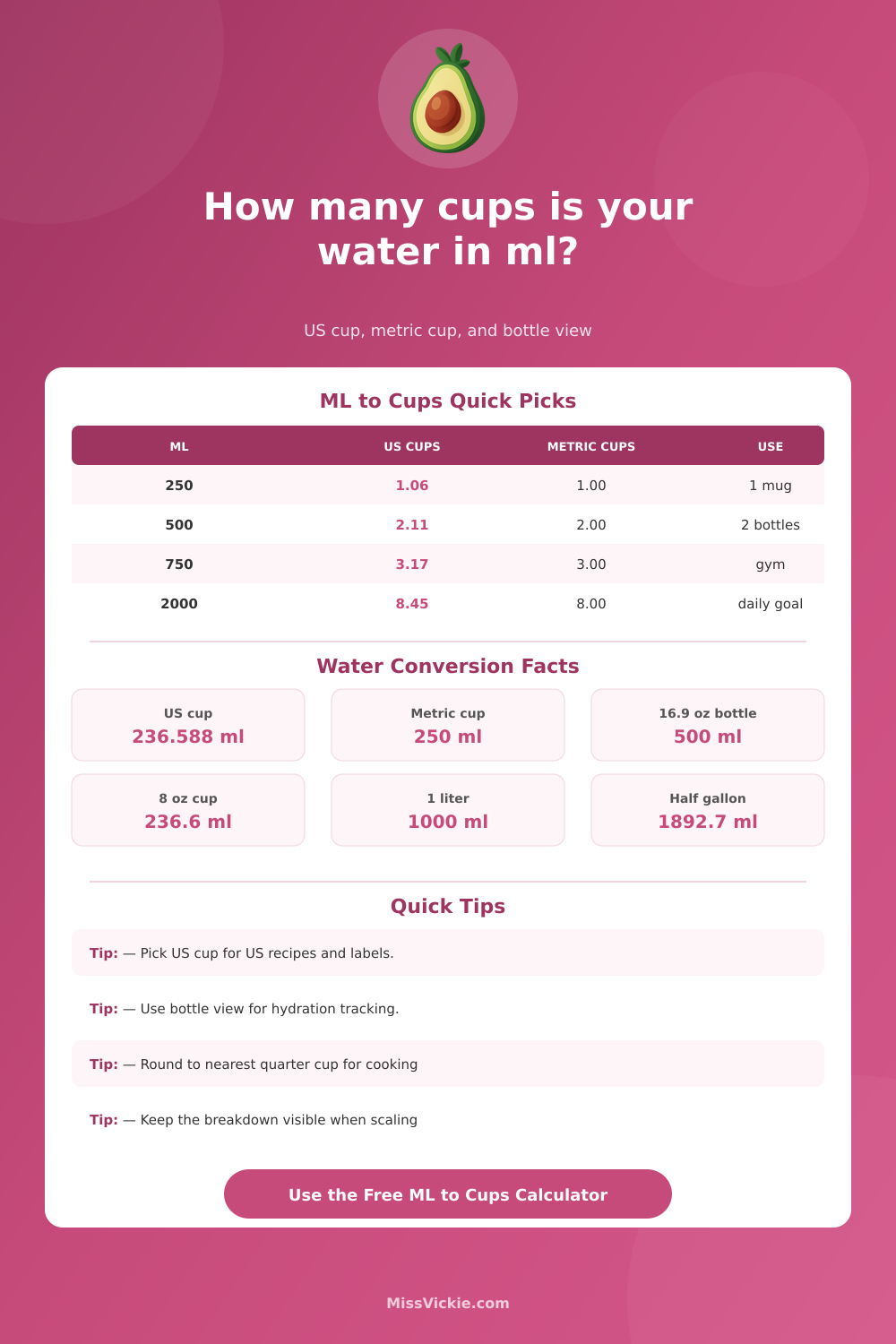
| Milliliters | US cups (236.588 ml) | Metric cups (250 ml) | US fl oz | Kitchen note |
|---|---|---|---|---|
| 60 ml | 0.25 cup | 0.24 cup | 2.03 oz | Quarter cup splash |
| 120 ml | 0.51 cup | 0.48 cup | 4.06 oz | Half cup close |
| 180 ml | 0.76 cup | 0.72 cup | 6.09 oz | Three-quarter cup zone |
| 236.6 ml | 1.00 cup | 0.95 cup | 8.00 oz | Exact US cup |
| 250 ml | 1.06 cup | 1.00 cup | 8.45 oz | Exact metric cup |
| 500 ml | 2.11 cups | 2.00 cups | 16.91 oz | Common bottle |
| 750 ml | 3.17 cups | 3.00 cups | 25.36 oz | Large sports bottle |
| 1000 ml | 4.23 cups | 4.00 cups | 33.81 oz | 1 liter target |
| 1500 ml | 6.34 cups | 6.00 cups | 50.72 oz | High hydration block |
| 2000 ml | 8.45 cups | 8.00 cups | 67.63 oz | Daily hydration benchmark |
Translate cups into real drink containers to quickly decide how many refills you need.
| Container | Size (ml) | US cups | Metric cups | Hydration use |
|---|---|---|---|---|
| Small juice glass | 200 | 0.85 | 0.80 | Breakfast quick drink |
| Standard mug | 250 | 1.06 | 1.00 | Coffee, tea, broth |
| Can bottle | 330 | 1.39 | 1.32 | Short workout |
| US bottle | 500 | 2.11 | 2.00 | Day carry bottle |
| Sports bottle | 600 | 2.54 | 2.40 | Gym refill |
| Large flask | 750 | 3.17 | 3.00 | Training session |
| 1 liter bottle | 1000 | 4.23 | 4.00 | Desk hydration |
| Party pitcher | 1500 | 6.34 | 6.00 | Table service |
| 2 liter jug | 2000 | 8.45 | 8.00 | Whole day target |
These are practical recipe checkpoints where cup conversion errors happen most often.
| Use case | Water (ml) | US cups | Metric cups | Ounces |
|---|---|---|---|---|
| Instant oatmeal bowl | 180 | 0.76 | 0.72 | 6.09 oz |
| Pancake batter splash | 240 | 1.01 | 0.96 | 8.11 oz |
| 1 cup rice absorption | 475 | 2.01 | 1.90 | 16.06 oz |
| Small pasta boil top-up | 750 | 3.17 | 3.00 | 25.36 oz |
| Soup starter pot | 1000 | 4.23 | 4.00 | 33.81 oz |
| Family stew batch | 1500 | 6.34 | 6.00 | 50.72 oz |
| Stock pot starter | 2500 | 10.57 | 10.00 | 84.53 oz |
| Large broth batch | 4000 | 16.91 | 16.00 | 135.26 oz |
Best for US recipe cards and nutrition labels using ounces and cups.
Best for metric cookbooks and kitchen scales calibrated in metric units.
Fast for beverage conversion, bottle labels, and hydration tracking.
Practical for daily intake goals and refill planning through the day.
Measuring water in the more correct amount can be difficult due to the difference in measurements within different cup systems. For instance, a recipe may ask for liquid measurements in an form of milliliters of water. However, a person may not have measuring cup in there kitchen that use US cups to measure liquids.
Using the wrong system to measure water will lead to the water being measured incorrect. In turn, using the wrong amount of water to a recipe can cause that recipe to fail. For example, if a cook adds too much water to the rice, the rice will become mushy.
How to Measure Water Correctly
If too little water is added to the rice, the rice will be too hard to eat. Water measurement are different from other liquid in that the US cup and metric cup are not the same size. One US cup contains 236.6 milliliters of water, whereas one metric cup contains 250 milliliters of water.
Thus, the metric cup contains 5.6 percent more water than a US cup. Although this percentage is small when measuring a single cup of water, the difference can become more prominent when using a recipe for a greater number of individual. Thus, if a cook is preparing a recipe for eight individuals, the difference in water measurements will be greater then if it were being prepared for two individuals only.
Water can be measured in two different way: volume and mass. One milliliter of water weighs one gram of water. Therefore, milliliters is used as a way to weigh water, as well as measure the volume of the water.
Most cookbooks from international area use metric measurements to weigh and measure the water needed for their recipes. However, many recipes from America use US cups to measure the water needed for the recipe. Thus, if these two systems are mixed together, the cook will not measure the correct amount of water for the recipe.
Understanding how water behave during the cooking process can help cooks to avoid mistake in the recipe related to water measurements. For instance, when water is heated, it can be converted to steam and leave the pot in which the water was measured. If this happen to an individual while simsimmering a recipe, more water will need to be added.
Water measurements are critical in baking so that the crust of baked good will not be too wet with too much water or too dry with not enough water. Furthermore, when tracking the amount of water that an individual drink for the body, that water can also be tracked through the use of water bottle. For example, using a 500 milliliter water bottle is significant easier than using cups to measure water for the bodys hydration needs.
Many people can make mistakes when measuring water for their recipes. For instance, many people round the number of milliliters of water too soon in the recipe. If the cook rounds the number of milliliters of water too early in the recipe, the amount of water may drift from the amount needed.
Furthermore, many people make the mistake of assuming that all measuring cup are made equal when they are not. US cups are not the same as metric cups. To avoid these mistake with water measurements in recipes, individuals should use only one system of measuring water for a specific recipe.
Thus, if a recipe ask for metric measurements for water, metric measurements should be used for all the other ingredient, as well. Using presets and tables can make measuring water easier for individuals. For instance, reference table can show the number of milliliters in different amount of cups.
These reference tables allow individuals to avoid wasting water when adding it to their recipes. Presets and reference tables that show that 250 milliliters of water is equivalent to one metric cup can help cooks to prepare their recipes with the proper amount of water. Additionally, individuals can also use bottles to track the amount of water that they consume for the body.
For instance, if an individual want to drink two liters of water per day, they would drink four 500 milliliter bottle of water. Thus, measuring water with 500 milliliter bottle is more tangible for the body than reading the number of cups of water that an individual would drink. Overall, measuring water require individuals to pay attention to the cup system for measuring water.
The individual should remember that a US cup contains less water than a metric cup. Furthermore, individuals must remember that water evaporate while cooking. When measuring water, the use of milliliters will provide individuals with more precision in their measurements of water.
Using water bottle will make it easier for an individual to track their hydration need. By understanding the water measurements described in this passage, individuals will find that they can cook better and will have a better understanding of how to stay hydrated.