💧 MissVickie water conversion studio
Grams to Cups Water Converter
Convert water grams to US cups, metric cups, ounces, liters, and bottles. Use hydration and cooking presets, serving scaling, and full line-by-line math so your cup math stays consistent from recipe prep to daily intake tracking.
Pick a preset to load realistic water scenarios, then fine-tune inputs for your exact kitchen or hydration plan.
Control unit style, conversion direction, serving scale, temperature profile, and practical rounding for both recipe work and hydration planning.
Full Conversion Breakdown
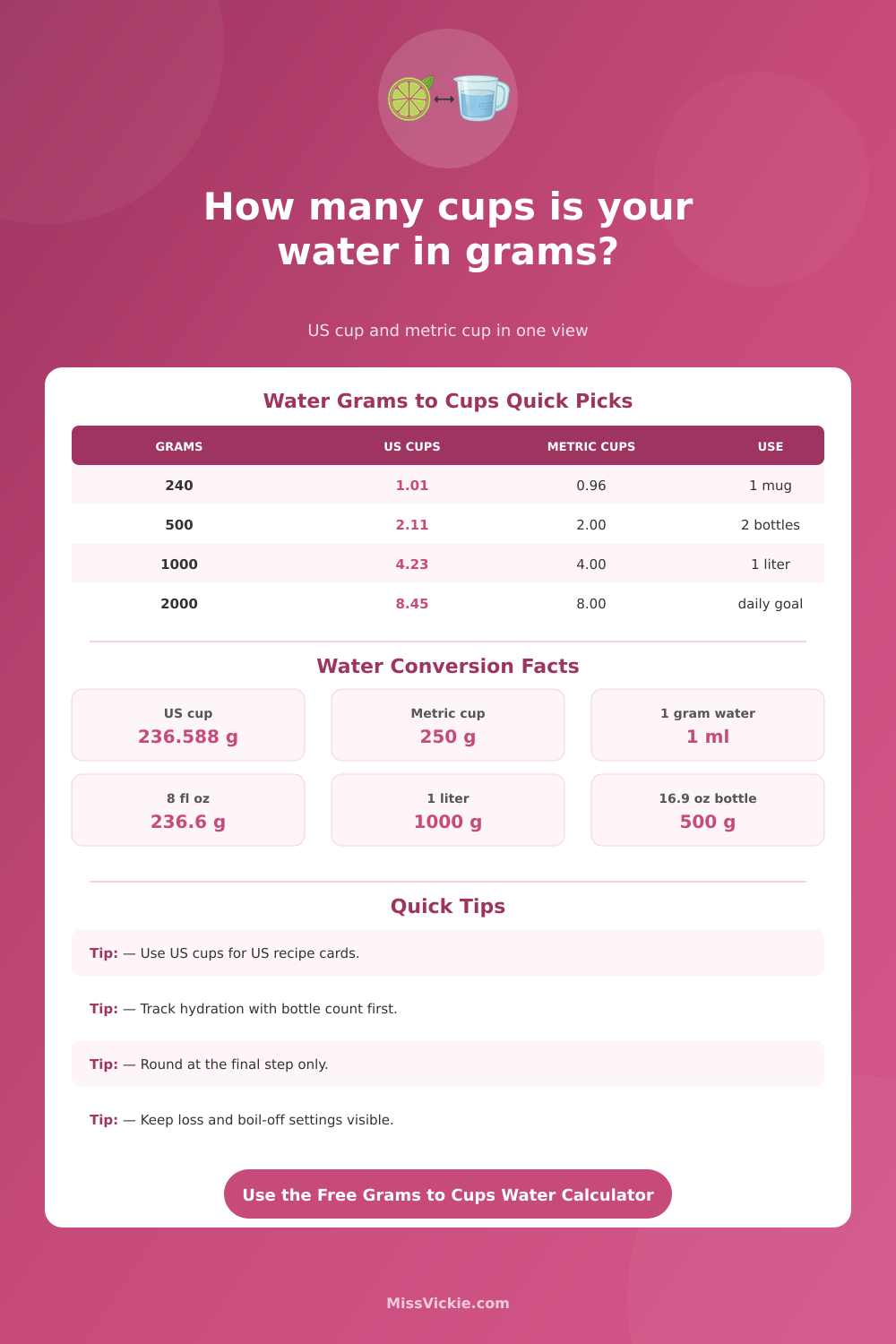
Use this table when your recipe is in grams but your measuring cup is in cup units.
| Water grams | US cups (236.588 g) | Metric cups (250 g) | US fl oz | Kitchen checkpoint |
|---|---|---|---|---|
| 30 g | 0.13 cup | 0.12 cup | 1.01 oz | Sauce loosen |
| 60 g | 0.25 cup | 0.24 cup | 2.03 oz | Quarter cup splash |
| 120 g | 0.51 cup | 0.48 cup | 4.06 oz | Half cup zone |
| 180 g | 0.76 cup | 0.72 cup | 6.09 oz | Oatmeal water |
| 236.6 g | 1.00 cup | 0.95 cup | 8.00 oz | Exact US cup |
| 250 g | 1.06 cups | 1.00 cup | 8.45 oz | Exact metric cup |
| 355 g | 1.50 cups | 1.42 cups | 12.00 oz | Soda can volume |
| 473 g | 2.00 cups | 1.89 cups | 16.00 oz | US pint water |
| 500 g | 2.11 cups | 2.00 cups | 16.91 oz | Standard bottle |
| 750 g | 3.17 cups | 3.00 cups | 25.36 oz | Large flask |
| 1000 g | 4.23 cups | 4.00 cups | 33.81 oz | 1 liter |
| 1500 g | 6.34 cups | 6.00 cups | 50.72 oz | Pitcher block |
| 2000 g | 8.45 cups | 8.00 cups | 67.63 oz | Daily hydration target |
| 3000 g | 12.68 cups | 12.00 cups | 101.44 oz | High activity day |
Start with the cup measure and read across to grams for precise scale-based measuring.
| Cup amount | US cup grams | Metric cup grams | Milliliters | Typical use |
|---|---|---|---|---|
| 1/8 cup | 29.6 g | 31.3 g | 29.6-31.3 ml | Deglaze splash |
| 1/4 cup | 59.1 g | 62.5 g | 59-63 ml | Sauce adjust |
| 1/3 cup | 78.9 g | 83.3 g | 79-83 ml | Small batter add |
| 1/2 cup | 118.3 g | 125 g | 118-125 ml | Baking liquid |
| 2/3 cup | 157.7 g | 166.7 g | 158-167 ml | Stew top-up |
| 3/4 cup | 177.4 g | 187.5 g | 177-188 ml | Pancake pour |
| 1 cup | 236.6 g | 250 g | 236.6-250 ml | Recipe baseline |
| 1 1/4 cups | 295.7 g | 312.5 g | 296-313 ml | Gravy or stock |
| 1 1/2 cups | 354.9 g | 375 g | 355-375 ml | Soup starter |
| 2 cups | 473.2 g | 500 g | 473-500 ml | Rice and grains |
| 3 cups | 709.8 g | 750 g | 710-750 ml | Pasta reserve |
| 4 cups | 946.4 g | 1000 g | 946-1000 ml | Quart zone |
| 6 cups | 1419.5 g | 1500 g | 1.42-1.50 L | Family soup batch |
| 8 cups | 1892.7 g | 2000 g | 1.89-2.00 L | Daily jug fill |
Translate grams into real containers to plan intake quickly through the day.
| Container | Weight (g) | US cups | Metric cups | Hydration context |
|---|---|---|---|---|
| Espresso water glass | 120 g | 0.51 | 0.48 | Medication sip |
| Small tumbler | 200 g | 0.85 | 0.80 | Desk quick drink |
| Coffee mug fill | 250 g | 1.06 | 1.00 | Morning start |
| Soda can equivalent | 330 g | 1.39 | 1.32 | Short workout |
| US bottle standard | 500 g | 2.11 | 2.00 | Daily carry bottle |
| Sports bottle | 600 g | 2.54 | 2.40 | Gym refill |
| Large flask | 750 g | 3.17 | 3.00 | Training session |
| One-liter bottle | 1000 g | 4.23 | 4.00 | Half-day target |
| Family pitcher | 1500 g | 6.34 | 6.00 | Meal service |
| Two-liter jug | 2000 g | 8.45 | 8.00 | Full-day benchmark |
These checkpoints are useful for scaling recipe water while keeping unit drift under control.
| Use case | Water grams | US cups | Metric cups | Notes |
|---|---|---|---|---|
| Instant oatmeal bowl | 180 g | 0.76 | 0.72 | Single bowl hydrate |
| Pancake batter loosen | 240 g | 1.01 | 0.96 | Breakfast stack |
| One-cup rice simmer | 475 g | 2.01 | 1.90 | Covered pot method |
| Quinoa absorption | 420 g | 1.78 | 1.68 | Fluffy grain target |
| Small pasta reserve | 750 g | 3.17 | 3.00 | Sauce emulsifying |
| Soup starter pot | 1000 g | 4.23 | 4.00 | Weeknight soup |
| Stew family batch | 1500 g | 6.34 | 6.00 | 6-8 servings |
| Stock pot starter | 2500 g | 10.57 | 10.00 | Weekend stock |
| Large broth prep | 4000 g | 16.91 | 16.00 | Meal prep freeze |
| Party drink dilution | 5000 g | 21.13 | 20.00 | Big dispenser fill |
Best when your scale gives exact grams and you want stable batch repeatability.
Great when your recipe card is cup-first but you need scale-ready grams for precision.
Useful for tracking intake by refill count instead of tiny glass-by-glass math.
Applies base-to-target serving ratio before output so scaling remains transparent.
In order to convert gram of water to cups of water, an understanding of the relationship between weight and volume are necessary. For instance, a scale may show that there are 500 grams of water in a container, but it may be necessary to know how many cups of water 505 grams of water equal. Converting grams to cups are necessary for understanding that grams are a unit of weight, while cups are a unit of volume.
Thus, specific conversion factors is necessary for moving from grams to cups. The density of water allow for the conversion of grams to milliliters, as one gram of water is equal to one milliliter of water. However, converting grams to cups is more difficult due to the difference in cup sizes across the world.
How to Convert Grams of Water to Cups
For instance, one US customary cup contain 237 grams of water, but one metric cup contains 250 grams of water. Using the incorrect type of cup for the recipe can lead to error in the recipe; if you use US customary cups for a recipe that require metric cups, there will not be enough water to properly cook the ingredients. Conversely, if you use metric cups in a recipe that requires US customary cups, there will be too much water for the ingredients to cook properly.
Correct ratios of water to ingredients is important in cooking, such as cooking grain like rice. Many recipes include both water and rice, but often the recipe measures water in grams while the rice is measured in cups. For instance, one cup of rice weigh 185 grams.
Thus, 370 grams of water are required for cooking rice. However, 370 grams of water is closer to 1.75 US customary cups than it is to two cups of water. If there is not enough water to cook the rice, the rice will be too dry after cooking.
If there is too much water, the rice will be too mushy. Another reason to measure water in grams is to track one’s hydration of the body. Many individuals track the number of gram of water that they drink throughout the day to ensure that they are meeting there health goals.
500 grams of water is equal to two US customary cups of water. Thus, individuals can track the number of bottles (of 500 grams) that they drink to ensure they are drinking enough water to meet there target for that day. The temperature of the water can impact its density.
Water that is colder than room temperature is denser than water that is hot. Cold water has a mass of nearly one gram per milliliter of water. Hot water is less dense than cold water, with a mass of approximately 0.97 grams per milliliter of water.
Thus, 250 grams of hot water will not fill a metric cup to the same level that 250 grams of cold water would fill the same cup. For instance, when boiling water for pasta, you will need to add extra water to the pot due to the water evaporating as a result of boiling the water. In order to scale a recipe to provide food for more individuals, you can calculate the amount of water that is required using a multiplier.
If a recipe that serves four individuals requires 500 grams of water, then the same recipe that is to be multiplied for six individuals will require 750 grams of water. The multiplier can be used to calculate this amount. However, rounding this number too early in the recipe can introduce potential error into the recipe; therefore, you should of avoid rounding the number until the end of the recipe.
Some recipes may use US customary cups for some ingredient but metric cups for other ingredients. It is important to stick to one system of measurement for all ingredients in the recipe; otherwise, error in the recipe will result due to the difference between these two systems of measurement. In baking, precision is the name of the game.
Thus, bakers often prefer to use grams of water rather than cups of water. This is due to the difference in how much water absorb different types of flour. For instance, if a recipe requires a dough to contain 70 percent hydration, then the amount of water that should be used is 700 grams of water for every 1000 grams of flour.
Thus, the grams of water allow for accuracy in the baking recipe. Finally, you can use conversion tables to find the correct amount of water that should be used in a variety of task. Conversion tables can be used to determine how many grams are in a single cup of water.
Additionally, conversion tables can be used to find out how many cups are in a large volume of water. These tables allow for the avoidance of guesswork in the kitchen; thus, they ensure that the amount of water measured for cooking tasks or hydration tasks is accurate.