
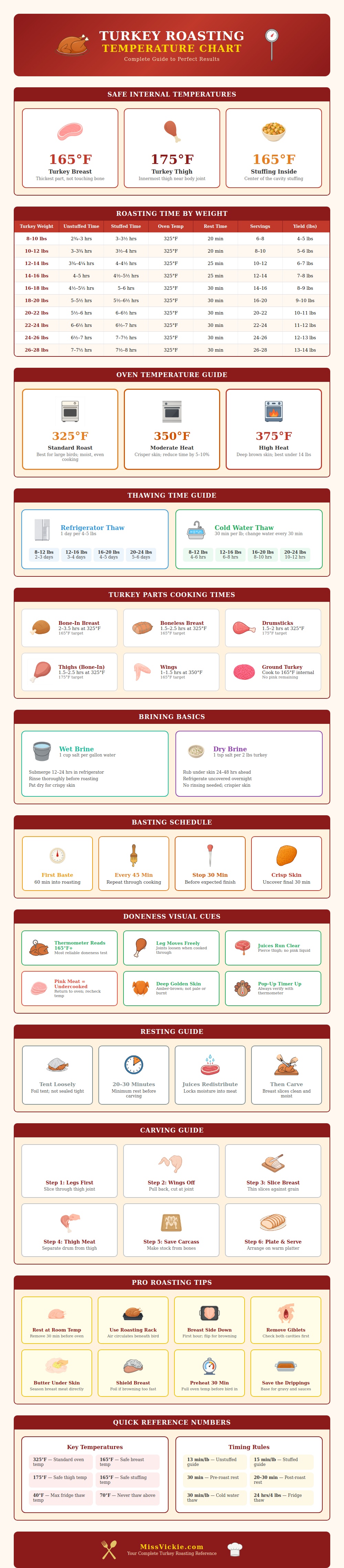
Roasting a turkey require careful management of the temperature at which the turkey is roasted. Temperature management of the turkey ensure that the turkey is safe to eat as well as moist. In order to cook the turkey safely, the turkey must reaches specific internal temperatures.
For instance, the breast of the turkey must reach 165 degrees within the thickest part of the turkeys breast. The dark meat (thighs) of the turkey should reach 175 degrees Fahrenheit near the joint of the turkey. Additionally, if the turkey include stuffing within its cavity, that stuffing must reach 165 degrees Fahrenheit within the center of the stuffing.
How to Roast a Turkey Safely
It is important to ensure that the turkey reach these temperatures as the turkeys breast will dry out if it reaches over 165 degrees, and the legs of the turkey will remain chewily if they dont reach the 175 degree temperature. To prepare the turkey for roasting, the turkey should first be thawed. The turkey should be thawed in a refrigerator, where the turkey will take approximately one day to thaw for every four to five pound of turkey.
It is important that the refrigerator maintain a temperature of below 40 degrees Fahrenheit. An alternative method is to thaw the turkey in cold water, but you should change the water every thirty minutes. However, you should never allow the turkey to thaw at room temperature, as this will cause the turkey to sit within the “danger zone,” where bacterial growth are rapid and potentially dangerous to consume.
After the turkey is thawed, the turkey should be roasted at a specific temperature within the oven for a specific length of time. For instance, turkeys that weigh between 14 and 20 pounds should be roasted at 325 degrees Fahrenheit. This temperature allow for even cooking of the turkey.
However, smaller turkeys (under 14 pounds) can be roasted at temperatures of 350 or 375 degrees Fahrenheit. However, 375 degrees will take 5 to 10 percent less time to roast the turkey to doneness. Additionally, turkeys that are unstuffed will take 30 minutes less time to roast than turkeys that are stuffed.
Furthermore, the cook should weigh the turkey prior to roasting. However, the cooked turkey will only weigh half the raw weight of the turkey. Brining the turkey prior to roasting help to ensure that the turkey retains moisture during the roasting process.
One method of brining is to soak the turkey in a saltwater solution (known as a wet brine). For a wet brine, one should add one cup of salt to one gallon of water and the cook should soak the turkey for 12 to 24 hour. Alternatively, the turkey could be dry brined, which involves rubbing salt (one teaspoon of salt for every two pounds of turkey) direct onto the turkeys skin.
If the turkey is wet brined, it should be rinsed and patted dry prior to roasting. Prior to placing the turkey into the oven to roast, the turkey should sit out at room temperature for 30 minutes. Additionally, the giblets (turkey organs) should be removed from the turkey cavity.
Butter and herbs can be rubbed into the turkey under its skin. The turkey should be roasted on a rack. Additionally, the cook should roast the turkeys breast down (face down) for the first hour of roasting.
After the hour mark, the breast should be roasted breast up. Additionally, the turkey should be basted every 45 minutes after the first 60 minutes of roasting. However, basting should cease 30 minutes prior to roasting time for the skin of the turkey to become crispy.
Lastly, if the turkey breast brown too quickly, the cook should cover the turkey breast in aluminum foil. A thermometer should be used to measure the doneness of the turkey. The turkey is considered to be done when the juices begin to run clear from the turkeys thigh and reach the specified temperatures.
After removing the turkey from the oven, the turkey should be allowed to rest for 20 to 30 minutes. During this resting period, the turkeys juices will redistribute within the turkey. This redistributing of the turkeys juices will ensure that the turkey retain its moisture when it is carved.
To carve the turkey, the first step will be to remove the leg from the turkey at the joint of the thigh, as well as removing the wings from the turkey by pulling the wings back from the turkeys body. The turkey breast can be sliced into thin slices against the grain. Additionally, the carcass of the turkey can be saved and use to make stock.
To make stock, the cook can simmer the carcass with onions and herbs. Finally, the roasted turkey can be placed on a warm platter to ensure that the turkey remain hot after carving. It is more better than using a cold plate.
You should of used a warm platter to make sure it stays hot. Actually, its very important for the meat.