MissVickie Kitchen Math
Grams to mL Cream Converter
Convert cream grams into ml, cups, tablespoons, and teaspoons using type-specific density, fat level, and scaling controls for prep, pastry, and sauce work.
1. Cream-Type Presets
Pick a preset to auto-fill values, then fine-tune the details below.
2. Unit System
3. Calculator Inputs
The converter includes density adjustments for cream type, temperature, and fat profile.
4. Density and Fat Reference Tables
| Cream Type | Density | Fat% | Use Case |
|---|---|---|---|
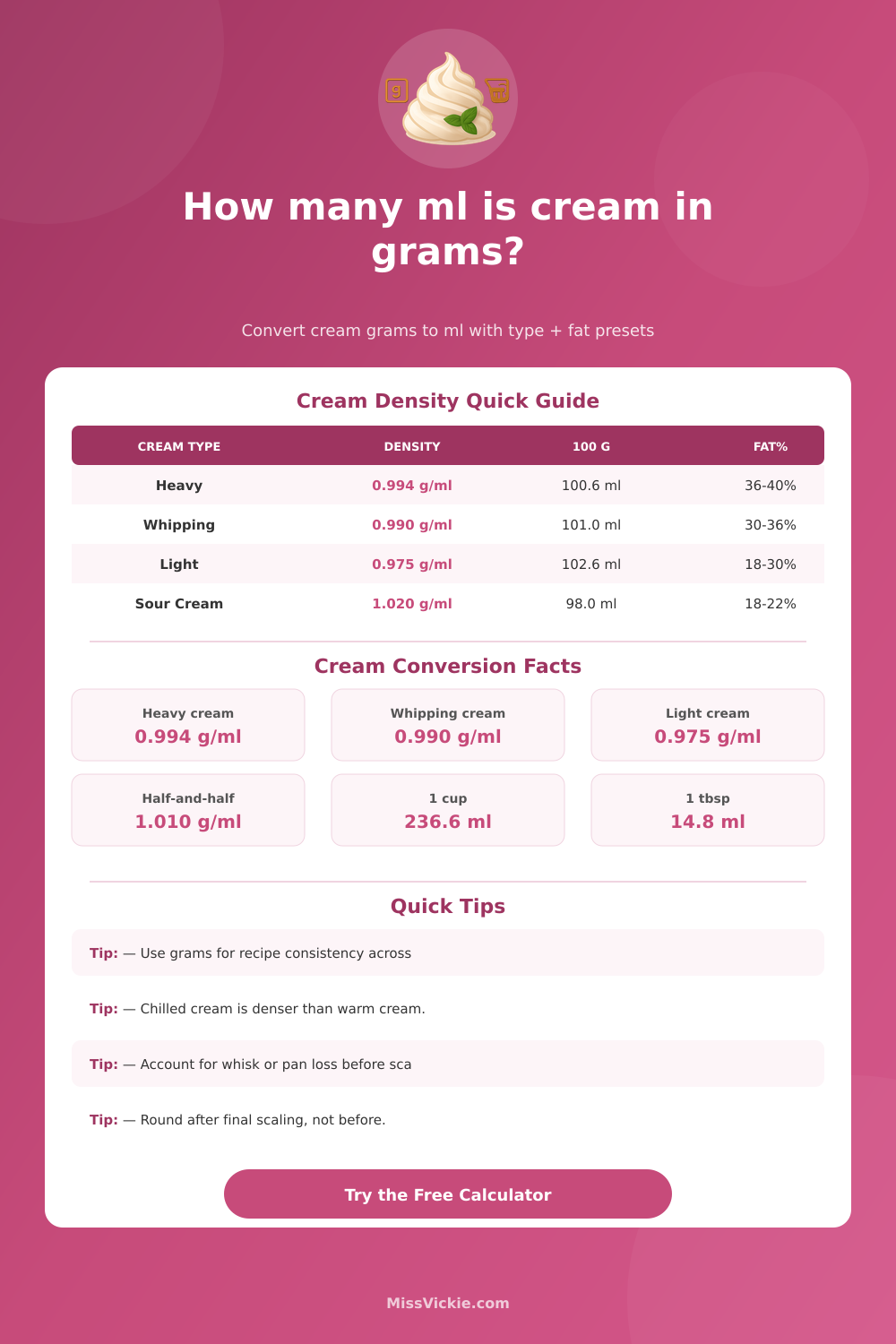
| Heavy cream | 0.994 g/ml | 36-40% | Ganache, piping |
| Whipping cream | 0.990 g/ml | 30-36% | Whipped toppings |
| Light cream | 0.975 g/ml | 18-30% | Soups and coffee |
| Half-and-half | 1.010 g/ml | 10-18% | Sauce finishing |
| Double cream | 1.000 g/ml | 45-48% | Rich desserts |
| Cream Type | Density | Fat% | Texture Note |
|---|---|---|---|
| Clotted cream | 0.960 g/ml | 55-64% | Dense spread |
| Sour cream | 1.020 g/ml | 18-22% | Cultured tang |
| Creme fraiche | 1.005 g/ml | 30-40% | Stable in heat |
| UHT cooking cream | 1.015 g/ml | 20-30% | Shelf stable |
| Lactose-free cream | 0.998 g/ml | 30-35% | Slightly sweet |
| Profile | Density Factor | Typical Fat% | When to Use |
|---|---|---|---|
| Auto | 1.000 | Type default | Most recipes |
| Lean | 1.015 | 10-20% | Light sauces |
| Balanced | 1.000 | 20-35% | General baking |
| Rich | 0.985 | 35-60% | Whipped or luxury prep |
| Temperature | Factor | Approx Range | Kitchen Note |
|---|---|---|---|
| Cold | 1.010 | 4-7C | Most accurate for weigh-ins |
| Cool | 1.005 | 8-12C | Common fridge-rested cream |
| Room | 1.000 | 20-22C | Neutral assumption |
| Warm | 0.992 | 30-35C | Lower density, expands volume |
5. Cream Comparison Grid (100 g Reference)
Use this grid to compare how 100 grams maps to volume across cream styles.
| Cream Type | Density | Fat% | 100 g to ml | 100 g to cups | 100 g to tbsp | Texture |
|---|---|---|---|---|---|---|
| Heavy cream | 0.994 | 36-40% | 100.6 ml | 0.425 cup | 6.80 tbsp | Silky and thick |
| Whipping cream | 0.990 | 30-36% | 101.0 ml | 0.427 cup | 6.83 tbsp | Airy whip |
| Light cream | 0.975 | 18-30% | 102.6 ml | 0.434 cup | 6.94 tbsp | Fluid body |
| Half-and-half | 1.010 | 10-18% | 99.0 ml | 0.418 cup | 6.69 tbsp | Pourable blend |
| Double cream | 1.000 | 45-48% | 100.0 ml | 0.423 cup | 6.76 tbsp | Very rich |
| Clotted cream | 0.960 | 55-64% | 104.2 ml | 0.440 cup | 7.05 tbsp | Spreadable |
| Sour cream | 1.020 | 18-22% | 98.0 ml | 0.414 cup | 6.63 tbsp | Tangy cultured |
| Creme fraiche | 1.005 | 30-40% | 99.5 ml | 0.421 cup | 6.73 tbsp | Creamy stable |
| UHT cooking cream | 1.015 | 20-30% | 98.5 ml | 0.417 cup | 6.66 tbsp | Heat-stable |
| Lactose-free cream | 0.998 | 30-35% | 100.2 ml | 0.424 cup | 6.78 tbsp | Slight sweetness |
6. Two Quick Kitchen Tips
Converting gram to milliliters for cream requires an understanding of the relationship between grams, volume, and density of the cream. Grams and milliliters is not inherently equal for cream because of the amount of fat and water that is contained within the cream. Cream that contains a high amount of fats, such as heavy cream, will be denser than creams that contains less fat.
Because of this, 100 grams of heavy cream will yield a different amount of milliliters then cream that is lighter in composition. Cream that contains less fat than heavy cream will have a lower density. Therefore, the amount of milliliters that is yielded from a gram of light cream will be higher then the amount of milliliters that will be yielded from the same weight of heavy cream.
How to Convert Cream from Grams to Milliliters
The temperature of the cream will also affect how many milliliters of the cream will be yielded from a certain numbers of grams. Cream that is taken direct from the refrigerator will be cold to the touch. Because cold cream has a higher density than warmed cream, taking cream from the refrigerator will yield a higher number of gram of cream per milliliter of cream.
However, if you warm the cream to the touch or even heat for making a sauce, the density of the cream will drop, and the number of grams of cream per milliliter will decrease. Thus, it is important to account for the effect of temperature on the density of cream. Another important factor to consider is fat content of the cream.
Creams that contain a higher percentage of fat than others will have a different density. For example, double cream contain 45% fat or more whereas light cream has 18% fat or less. The fat is less dense than the liquid portion of the cream, so creams with a high fat content will have a lower density.
Because of this, if you make whipped cream or sauce with the cream the fat content will have to be accounted for so that the volume of cream that is measured is the same as what is used in the recipe. If the fat content is not accounted for, the volume of cream that is used will be incorrect and the recipe may fail altogether. When converting grams of cream to milliliters the number of servings also must be accounted for.
If a recipe that is written for 8 people is being made for 12 people, then the cook will have to multiply the grams of cream by the ratio of the two numbers. Additionally, it is recommended to add a buffer to the grams of cream to account for the loss of cream during the cooking process. For instance, a cream may stick to the whisk that is being use to mix the ingredients, or it could evaporate during the cooking process.
A 4% buffer is often used to account for this loss. Thus, if the grams of cream are calculated, the cook can multiply the number by the ratio of the desired number of servings and the original recipe, and then a buffer for possible loss can be added to ensure that there is enough cream to use in the cooking process. Not all cream have the same densities.
For example, sour cream contains elements of acid that allow it to have a tighter structure than other creams. Therefore, it will have a higher density. Clotted cream contains 55% fat by weight which make it less dense than other creams with less fat.
As a result, it will produce more milliliters of cream per gram of cream. People may make the mistake of assuming all creams are the same, but they are not all the same because creams contain different amount of fat and have different densities. By recognizing and understanding these different densities, people will be able to correctly convert the grams of each type of cream into milliliters.
It is also important to note the temperature of the cream that is being measured. If you weigh out the cream while it is cold from the refrigerator, then the cream will be accurate for recipes that require the cream to remain cold. However, the volume of the cream will change with temperature.
For recipes that require the cream to be warmed, such as sauces, the impact of the temperature have to be accounted for when measuring the cream. Therefore, by understanding the relationship between grams, milliliters, fat content, and the temperature of the cream, it is possible to ensure that the volume of cream that is used in recipes is the more correct volume of cream.