🥛 MissVickie milk density math
Milk Liter to Kg Converter
Convert milk liters to kilograms with a practical density model for skim, 1%, 2%, whole, raw, lactose-free, UHT, and creamline milk.
Each preset loads a real milk scenario, adjusts the density inputs, and gives you a fast answer for kitchen, coffee, or batch planning.
Set the milk type, temperature, and batch size. The calculator adjusts density and then converts the scaled volume into your chosen weight unit.
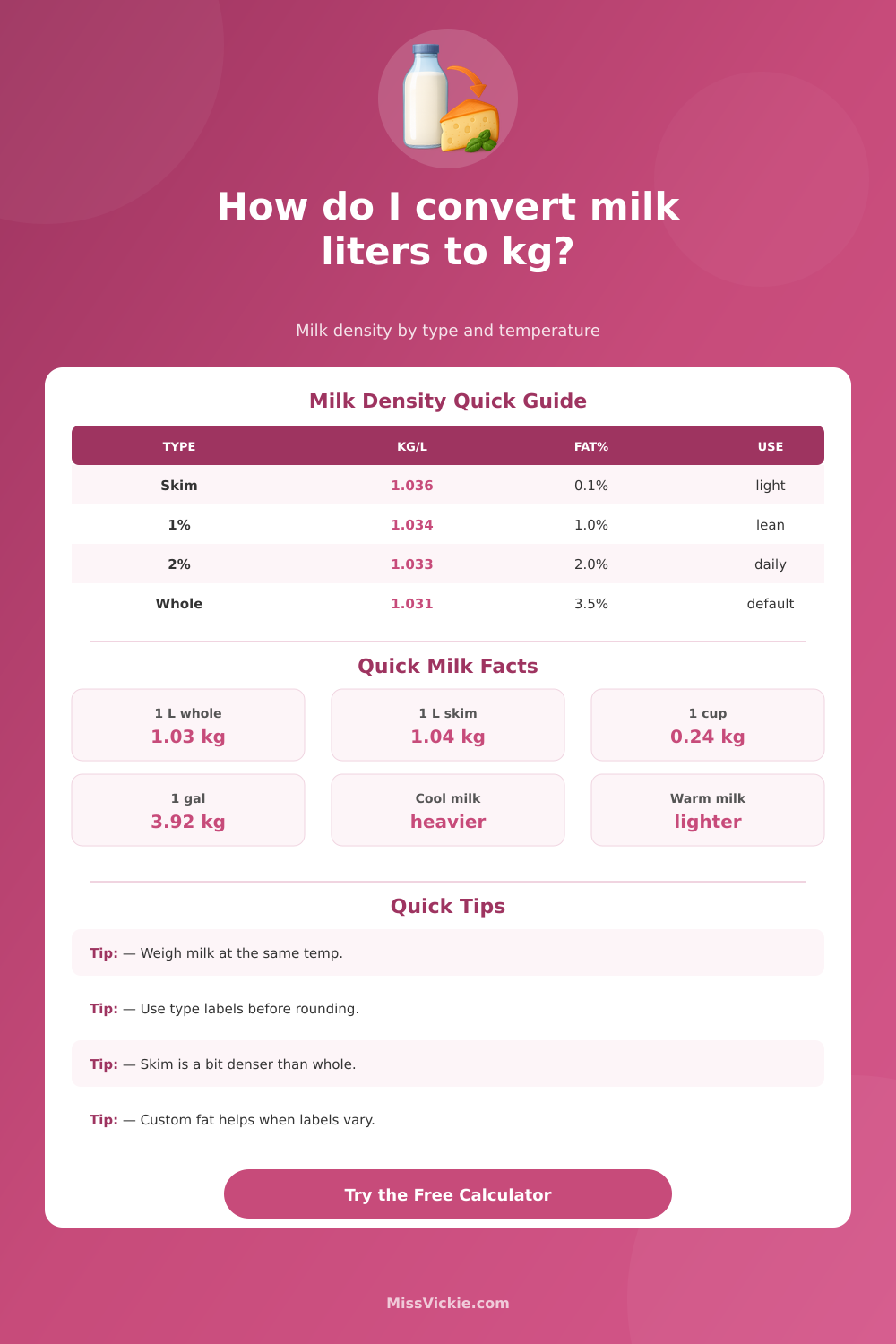
The densities below are practical kitchen references. The calculator uses them as a base and then adjusts for temperature, fat, and label tweaks.
| Milk Type | Density | Fat | Note |
|---|---|---|---|
| Skim milk | 1.0355 kg/L | 0.1% | Highest density here |
| 1% milk | 1.0342 kg/L | 1.0% | Lean everyday milk |
| 2% milk | 1.0329 kg/L | 2.0% | Common household pick |
| Whole milk | 1.0304 kg/L | 3.5% | Baseline kitchen milk |
| Raw milk | 1.0320 kg/L | 3.8% | Follow source label |
| Lactose-free | 1.0312 kg/L | 3.3% | Close to whole milk |
| UHT whole milk | 1.0298 kg/L | 3.5% | Shelf-stable variation |
| Creamline milk | 1.0288 kg/L | 4.0% | Richer and slightly lighter |
Milk is a little denser when cold and a little lighter when warm. These numbers show a simple whole-milk view around room temperature.
| Temp | kg/L | 1 L to kg | Use Case |
|---|---|---|---|
| 4°C | 1.0350 | 1.035 kg | Fresh from fridge |
| 10°C | 1.0339 | 1.034 kg | Cold carton pour |
| 20°C | 1.0304 | 1.030 kg | Room temp default |
| 35°C | 1.0277 | 1.028 kg | Warm kitchen milk |
| 50°C | 1.0250 | 1.025 kg | Steamed or heated |
These are quick checks for common kitchen measures. They help when a recipe gives cups or jugs but you want kilograms instead.
| Measure | Liters | Whole Milk Kg | Quick Note |
|---|---|---|---|
| 1 cup | 0.237 L | 0.244 kg | Small pour |
| 1 fl oz | 0.030 L | 0.031 kg | Bar measure |
| 1 quart | 0.946 L | 0.976 kg | Large carton |
| 1 gallon | 3.785 L | 3.901 kg | Family jug |
| 2 liters | 2.000 L | 2.061 kg | Common bottle pair |
| 5 liters | 5.000 L | 5.152 kg | Bulk kitchen pail |
Use these examples when you are scaling milk for coffee service, baking, cereal prep, or dairy processing and want a fast kilo estimate.
| Scenario | Source | Scale | Result |
|---|---|---|---|
| Breakfast jug | 1.0 L | x1 | 1.03 kg |
| Latte pitcher | 0.75 L | x1.5 | 1.16 kg |
| Pancake bowl | 1.25 L | x2 | 2.58 kg |
| Bakery tray | 3.0 L | x1 | 3.09 kg |
| Food service | 5.0 L | x1 | 5.15 kg |
| Bulk top-up | 2.0 L | x4 | 8.24 kg |
Best when you want the highest density and the cleanest kilo check for low-fat dairy.
A solid middle ground for family cartons, cereal, and most quick recipe conversions.
Use this when a recipe just says milk and does not give a label or fat level.
Choose this when the carton prints a special density, lactose-free note, or processing label.
Milk density are a factor that will affect the weight of the milk if you measure the milk by volume. Because the density of milk change based upon the fat content of the milk and the temperature of the milk, if you measure the milk by volume but the recipe require the weight of the milk, your recipe could have too much or too little milk. Using the wrong amount of milk will change the consistency of the recipe, and may lead to the recipe fail altogether.
The fat content of the milk will affect the density of the milk. Skim milk is more dens than whole milk because skim milk has less fat than whole milk. Fat is less dense than water, so the more fat content in the milk, the less dense the milk will be.
How Fat and Temperature Affect Milk Density
Thus, the more fat you add to the milk, the more less dense the milk will be. If you were to use whole milk instead of skim milk in your recipes, the weight of the milk will be less. The temperature of the milk will also affect the density of the milk.
Cold milk is more dens than warm milk. This is because when milk is cold, it contract as the temperature of the milk decreases. Thus, if you measure milk when it is cold, it will weigh more per liter than if you measured the same milk when it is warm.
As milk is heated, it expand. The expansion of the milk will make the milk less dense. Thus, if you need to measure milk by weight, you must consider the temperature of the milk so that you can ensure that the weight of the milk is the weight that you require for your recipe.
When scaling recipes to prepare large batches of a product, the density of the milk become more important. If you prepare a small amount of food, the weight of the milk dont have to be accurate. However, if you prepare large amounts of food, even a small inaccuracies in the weight of the milk will eventually develop into a large error in the total weight of the milk that is prepared.
If you multiply a recipe by many liter of milk, the density of the milk will become important enough to calculate the total weight of the milk. In this case, first convert the volume of the milk to liter. Then, apply the density of the milk to this volume to calculate the total weight of the milk.
Not all milk have the same density. For instance, raw milk may have a different density than other milk because raw milk may have a layer of cream on top of the milk. Ultra-high temperature milk, or UHT milk, may have a different density than other milk because they heat the milk to high temperatures.
Lastly, lactose-free milk may have a different density than other milk due to the enzymes that are used to make the milk lactose-free. Thus, be aware of these difference in milk types because they will have different weights for the same volume of milk. By knowing these facts about milk and its density, you can improve your cooking.
For example, if you are preparing cheese, you will need to measure the milk by weight. If you are a barista preparing milkshakes, you will need to monitor the temperature of the milk. If you are a baker, you will need to pay attention to the fat content of the milk.
Thus, by knowing how the fat and the temperature of the milk can change its density, you can ensure that you are using the correct amount of milk for each recipe that you create.