MissVickie Kitchen Math
Cups to Grams Converter for Milk
Convert milk cups, tablespoons, milliliters, and ounces to grams using milk-specific density, then scale the output for batch size, spillage buffer, and serving targets.
Pick A Preset
Use one tap presets for cafe prep, pancake batter, creamy soup, custard, and batch drink formulas.
Converter Inputs
Select milk type, unit path, scale target, temperature, and optional prep buffer for extra-safe batch planning.
Formula Breakdown
Every result is calculated from volume or weight input, milk density, serving scale, and optional buffer.
Density Reference Table
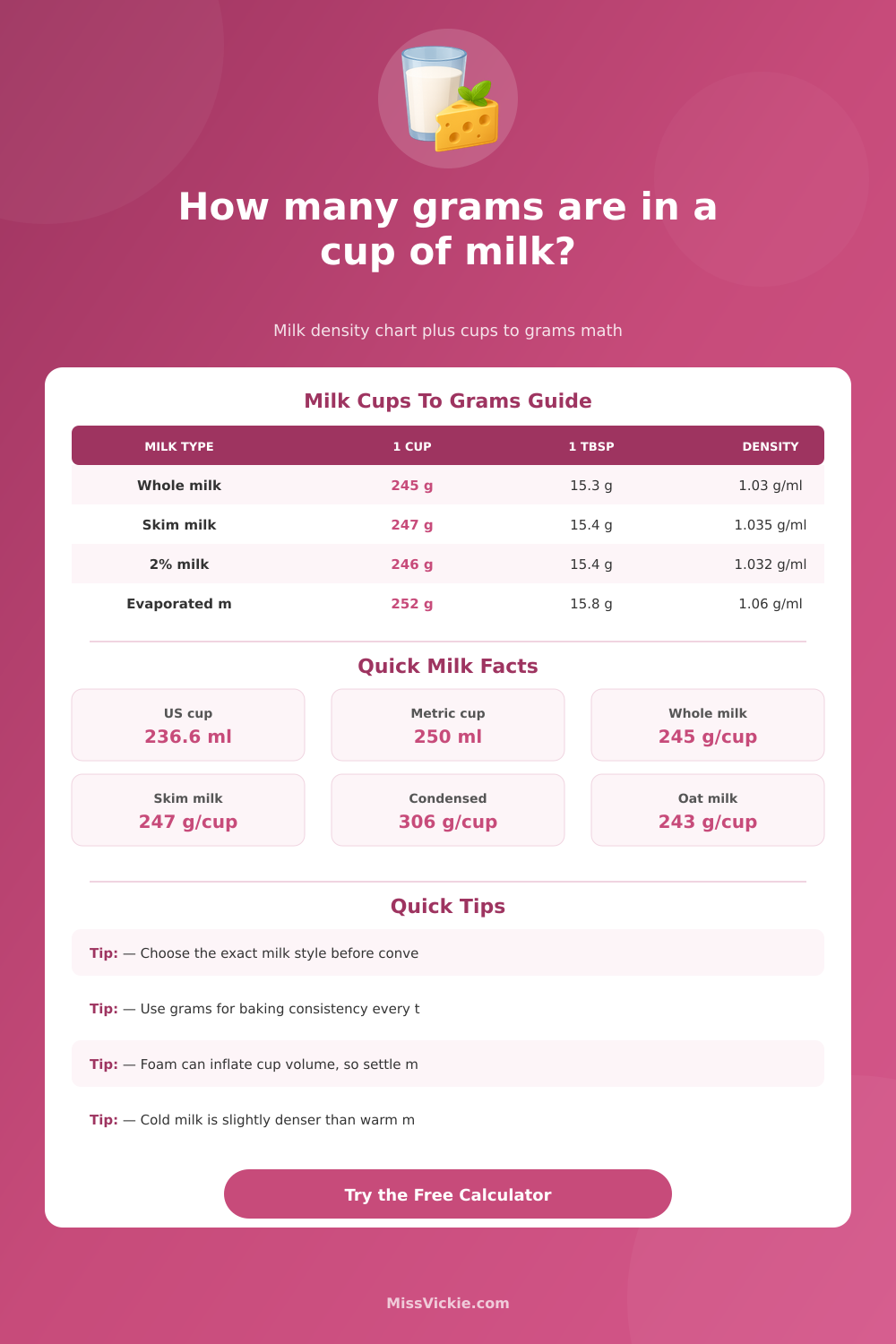
Use this first table for quick milk density checks at normal kitchen temperature.
| Milk Product | Density (g/ml) | US Cup (g) | Metric Cup (g) | Flavor/Use Note |
|---|---|---|---|---|
| Whole milk | 1.030 | 244 | 258 | General baking and sauces |
| Skim milk | 1.035 | 245 | 259 | Lean recipes and bread |
| 2% milk | 1.032 | 244 | 258 | Balanced fat profile |
| Goat milk | 1.032 | 244 | 258 | Tangy dairy swaps |
| Evaporated milk | 1.060 | 251 | 265 | Rich soups and desserts |
| Sweetened condensed milk | 1.290 | 305 | 323 | Sweet bars and candies |
| Unsweetened almond milk | 1.010 | 239 | 253 | Low-calorie beverages |
| Oat milk | 1.025 | 243 | 256 | Creamy plant option |
| Soy milk | 1.030 | 244 | 258 | Protein-rich dairy-free |
| Coconut beverage milk | 1.000 | 237 | 250 | Light tropical flavor |
Unit Weight Table
This table shows approximate whole-milk conversions for common kitchen units.
| Unit | Milliliters | Whole Milk Grams | Skim Milk Grams | Condensed Milk Grams |
|---|---|---|---|---|
| 1 teaspoon | 4.93 ml | 5.1 g | 5.1 g | 6.4 g |
| 1 tablespoon | 14.79 ml | 15.2 g | 15.3 g | 19.1 g |
| 1 fluid ounce | 29.57 ml | 30.5 g | 30.6 g | 38.1 g |
| 1/4 US cup | 59.15 ml | 60.9 g | 61.2 g | 76.3 g |
| 1/3 US cup | 78.86 ml | 81.2 g | 81.6 g | 101.7 g |
| 1/2 US cup | 118.29 ml | 121.8 g | 122.4 g | 152.6 g |
| 3/4 US cup | 177.44 ml | 182.8 g | 183.7 g | 228.8 g |
| 1 US cup | 236.59 ml | 243.7 g | 244.9 g | 305.2 g |
Temperature Adjustment Table
Density shifts slightly as milk warms. Use these multipliers when precision matters.
| Profile | Approx Temperature | Density Multiplier | When To Use |
|---|---|---|---|
| Cold | 4-8 C | 1.004 | Fridge milk for baking |
| Room | 20-22 C | 1.000 | Default kitchen conversions |
| Warm | 40-50 C | 0.996 | Scalded, steamed, or warmed milk |
Recipe Comparison Grid
Compare equal 1-cup portions by milk type to see how weight and calories can change your formula.
Quick Tips
Reference values are practical kitchen averages, suitable for home and cafe prep planning.
When measuring milk, using grams are more accurate than using cups to measure a milk. This is due to the fact that the volume of milk when poured into the measuring cup can vary based off person to person. However, the weight of milk measured in grams will always be the same.
The concept of density explains why it is necesary to measure milk by grams; a density of a liquid is the relationship between the mass and the volume of that liquid. The density of milk can vary depending on the type of milk who is used. For example, whole milk are denser than skim milk because it contains more fat than skim milk.
Why Measure Milk in Grams
Other plant-based milks can also have different densities; oat milk is denser than almond milk because it contains more starch than almond milk. Therefore, a cup of any given type of milk will contain a different weight than another type of milk. To account for this, it is necesary to know the density of the type of milk that will be used in the recipe.
Furthermore, the temperature of the milk can also impact the density of the milk; warm milk will have a lower density than cold milk because warm milk undergoes thermal expansion. Additionally, warm milk will also have a different weight measured at cups; warm milk can expand to take up more space than cold milk. If volume measurements is used for a recipe, it is possible to use a wrong amount of milk if the milk that is used has a different temperature than the recipe specifies.
However, if a weight of the milk is measured in grams, the outcome will be more reliable regardless of the temperature of the milk. Some other types of milk, such as evaporated milk and condensed milk, have much different densities than other types of milk. For example, evaporated milk has a higher density than milk because water has been removed from the milk.
Additionally, condensed milk also has water removed from the milk and sugar has been added to the milk; its density is therefore much higher than that of milk. Condensed milk should always be measured by weight because its very high density due to a high amount of sugar content in the milk. If condensed milk is used as a replacement to milk in a recipe, the outcome will not be correct unless the weight measurements are also changed to account for the diffrences between these two types of milk.
Another consideration when measuring milk is the amount of foam that might be present in the milk. Air and foam will increase a volume of the milk; however, the weight of the milk will remain the same. If the milk that is being measured contains foam, it is possible to obtain the wrong amount of milk.
This can be avoided by allowing the milk to settle or by stirring the milk prior to measuring it. However, using a scale to measure milk in grams will avoid the outcome of this error. When scaling a recipe, it is also necesary to use weight measurements to maintain the recipe consistency.
The weight of the milk will have to be multiplied by the same number for the other ingredients will be multiplied by. For instance, if a recipe is being doubled, the cook will have to double the weight of the milk as well. Using weight measurements allows for a buffer to account for milk that might spill or stick to a side of the pan; the cook can calculate the percentage of milk to add to the recipe in advance.
By using grams to measure the milk, consistency can be achieved in the recipe. The outcome of each batch of a recipe will be the same if the milk is measured by grams. Additionally, by using grams to measure the milk, the cook removes the guesswork involved in using volume measurements.
The density of the milk will also not impact the outcome of the recipe if the milk is measured in grams. Thus, using a scale to measure milk in grams are the best way to ensure accuracy in the kitchen.