MissVickie sugar conversion lab
Grams to Teaspoons Sugar Converter
Switch sugar type, choose spoon standard, apply recipe context, and scale servings to get practical teaspoon, tablespoon, cup, and weight results with full transparency.
Each preset loads a sugar type and a realistic baking context so your teaspoon result starts close to how recipes are actually mixed.
Tune density and spoon behavior with these controls. The calculator recomputes instantly and shows exact math plus practical rounding.
Full Calculation Breakdown
Density values below are baseline cup weights used before context, style, crystal, and humidity multipliers are applied.
| Sugar Type | g per cup | Approx g per US tsp | Texture Profile | Best Recipe Use |
|---|---|---|---|---|
| Granulated white | 200 g | 4.17 g | Medium crystal, neutral | Cookies, cakes, muffins |
| Caster | 200 g | 4.17 g | Fine crystal, quick dissolve | Sponge cake, meringue |
| Superfine | 198 g | 4.13 g | Very fine, light pour | Custards, drink syrups |
| Light brown | 220 g | 4.58 g | Moist, soft pack | Cookie chew, cinnamon rolls |
| Dark brown | 240 g | 5.00 g | Dense molasses note | Caramel, sticky bars |
| Powdered sugar | 120 g | 2.50 g | Airy and siftable | Icing and glaze |
| Demerara | 200 g | 4.17 g | Large golden crystals | Crumble top, coffee cake |
| Turbinado | 200 g | 4.17 g | Raw-style coarse crystal | Topping, tea biscuits |
| Sanding sugar | 190 g | 3.96 g | Sparkle crystals | Decorative finish |
| Coconut sugar | 200 g | 4.17 g | Dry, caramel aroma | Alternative sweetener bakes |
These values use leveled style, normal humidity, and US teaspoons for a fast estimate.
| Grams | Granulated | Caster | Light Brown | Dark Brown | Powdered |
|---|---|---|---|---|---|
| 25 g | 6.0 tsp | 6.0 tsp | 5.5 tsp | 5.0 tsp | 10.0 tsp |
| 40 g | 9.6 tsp | 9.6 tsp | 8.7 tsp | 8.0 tsp | 16.0 tsp |
| 50 g | 12.0 tsp | 12.0 tsp | 10.9 tsp | 10.0 tsp | 20.0 tsp |
| 60 g | 14.4 tsp | 14.4 tsp | 13.1 tsp | 12.0 tsp | 24.0 tsp |
| 75 g | 18.0 tsp | 18.0 tsp | 16.4 tsp | 15.0 tsp | 30.0 tsp |
| 90 g | 21.6 tsp | 21.6 tsp | 19.6 tsp | 18.0 tsp | 36.0 tsp |
| 100 g | 24.0 tsp | 24.0 tsp | 21.8 tsp | 20.0 tsp | 40.0 tsp |
| 120 g | 28.8 tsp | 28.8 tsp | 26.2 tsp | 24.0 tsp | 48.0 tsp |
| 150 g | 36.0 tsp | 36.0 tsp | 32.7 tsp | 30.0 tsp | 60.0 tsp |
| 180 g | 43.2 tsp | 43.2 tsp | 39.3 tsp | 36.0 tsp | 72.0 tsp |
| 200 g | 48.0 tsp | 48.0 tsp | 43.6 tsp | 40.0 tsp | 80.0 tsp |
| 240 g | 57.6 tsp | 57.6 tsp | 52.4 tsp | 48.0 tsp | 96.0 tsp |
Regional spoon standards can change teaspoon output noticeably, especially in larger batches.
| Standard | Teaspoon Volume | Tablespoon Volume | Teaspoon per tbsp | Use Case |
|---|---|---|---|---|
| US customary | 4.9289 mL | 14.7868 mL | 3 tsp | Most US recipes |
| Metric | 5 mL | 15 mL | 3 tsp | Global metric cookbooks |
| Australian | 5 mL | 20 mL | 4 tsp | AU tablespoon recipes |
| Imperial | 5.9194 mL | 17.7582 mL | 3 tsp | Legacy UK references |
These factors are built into the calculator to reflect practical kitchen behavior and texture goals.
| Setting Group | Option | Factor | Typical Effect on Teaspoon Output | Kitchen Interpretation |
|---|---|---|---|---|
| Recipe context | General baking | 1.00 | Baseline | No added process bias |
| Recipe context | Cookie dough | 1.02 | Slightly lower tsp count | Dough often uses firm scoops |
| Recipe context | Sponge cake | 0.99 | Slightly higher tsp count | Fine, even batter dispersion |
| Recipe context | Frosting and glaze | 0.95 | Higher tsp count | Powdered and sifted handling |
| Recipe context | Syrup and drinks | 1.00 | Baseline | Dissolved sugar workflow |
| Recipe context | Dry rub | 1.05 | Lower tsp count | Compacted spooning |
| Recipe context | Jam and preserves | 1.03 | Lower tsp count | Heavier sugar load |
| Recipe context | Caramel and sauce | 1.04 | Lower tsp count | Dense and heat-stable mix |
| Measuring style | Leveled | 1.00 | Reference | Flat spoon edge |
| Measuring style | Lightly packed | 1.04 | Lower tsp count | Slight compression |
| Measuring style | Packed | 1.10 | Noticeably lower tsp count | Firm packed spoon |
| Measuring style | Sifted | 0.92 | Higher tsp count | Airy and fluffy texture |
| Measuring style | Heaped | 1.18 | Much lower tsp count | Rounded spoon overfill |
| Humidity | Dry pantry | 0.98 | Slightly higher tsp count | Loose free-flow sugar |
| Humidity | Normal kitchen | 1.00 | Baseline | Average indoor condition |
| Humidity | Humid weather | 1.04 | Lower tsp count | Minor clumping |
| Humidity | Very sticky sugar | 1.08 | Lower tsp count | Strong clump behavior |
| Sweetness | Light sweetness | 0.92 | Lower gram demand | Reduced total sugar goal |
| Sweetness | Standard sweetness | 1.00 | Baseline | Recipe default target |
| Sweetness | Bold sweetness | 1.10 | Higher gram demand | Dessert-forward profile |
Use this grid when picking the sugar before conversion. Each style changes texture and effective teaspoon volume.
Reliable baseline for spoon and cup conversion in most western baking formulas.
Fine crystals integrate faster and work well in sponge cake and meringue methods.
Higher density and moisture support chewy crumb and deeper caramel notes.
Airy texture means more teaspoons for the same grams, ideal for icing and dusting.
To convert gram of sugar to teaspoons, understand the type of sugar and its density. The density of sugar change based on the type of sugar used. If you use the wrong number of teaspoons to represent the grams of sugar in a recipe, then the recipe wont contain the correct amount of sugar.
Granulated white sugar have a density of 4 grams to a leveled US teaspoon. Powdered sugar has a lower density due to the amount of air that is trapped between the fine crystals of powdered sugar. Brown sugar has a more higher density than granulated white sugar because brown sugar contains molasses and you can pack it into a spoon.
Convert Grams of Sugar to Teaspoons
The humidity in the environment will also play a role in how many grams of sugar you get in a teaspoon. The humidity will alter the amount of moisture content in the sugar. If the humidity is high, the sugar will clump together.
This means that there will be more gram of sugar in a teaspoon. However, if the humidity is low, then there will be more teaspoons needed to reach the desired amount of grams of sugar. The size of the sugar crystals will also play a roll in the amount of sugar that will be in a teaspoon.
Coarse sugar crystals will take up more volume than fine sugar crystals. The type of tool that you use to measure the sugar will also play a roll in the total grams of sugar that you have. You must determine whether the teaspoons are US teaspoons or metric teaspoons.
A US teaspoon is 4.9 ml in volume while metric teaspoons are 5 ml in volume. If the recipe is from a different country, then it is possible that the teaspoons has a different volume. Most measuring spoons are leveled for accuracy but if you are using brown sugar, you may need to pack the sugar into a spoon.
Packing brown sugar will give you more grams of sugar per teaspoon. If you are planning to scale your recipe to bake more items, you will need to change the amount of sugar. If you are doubling the recipe, for example, then you will need to adjust the amount of sugar that you use.
You may want to adjust the amount of sugar to match the level of sweetness that you would like the final baked good to have. Sugar will interact with other ingredients in the recipe. The amount of sugar will affect the texture of the final good.
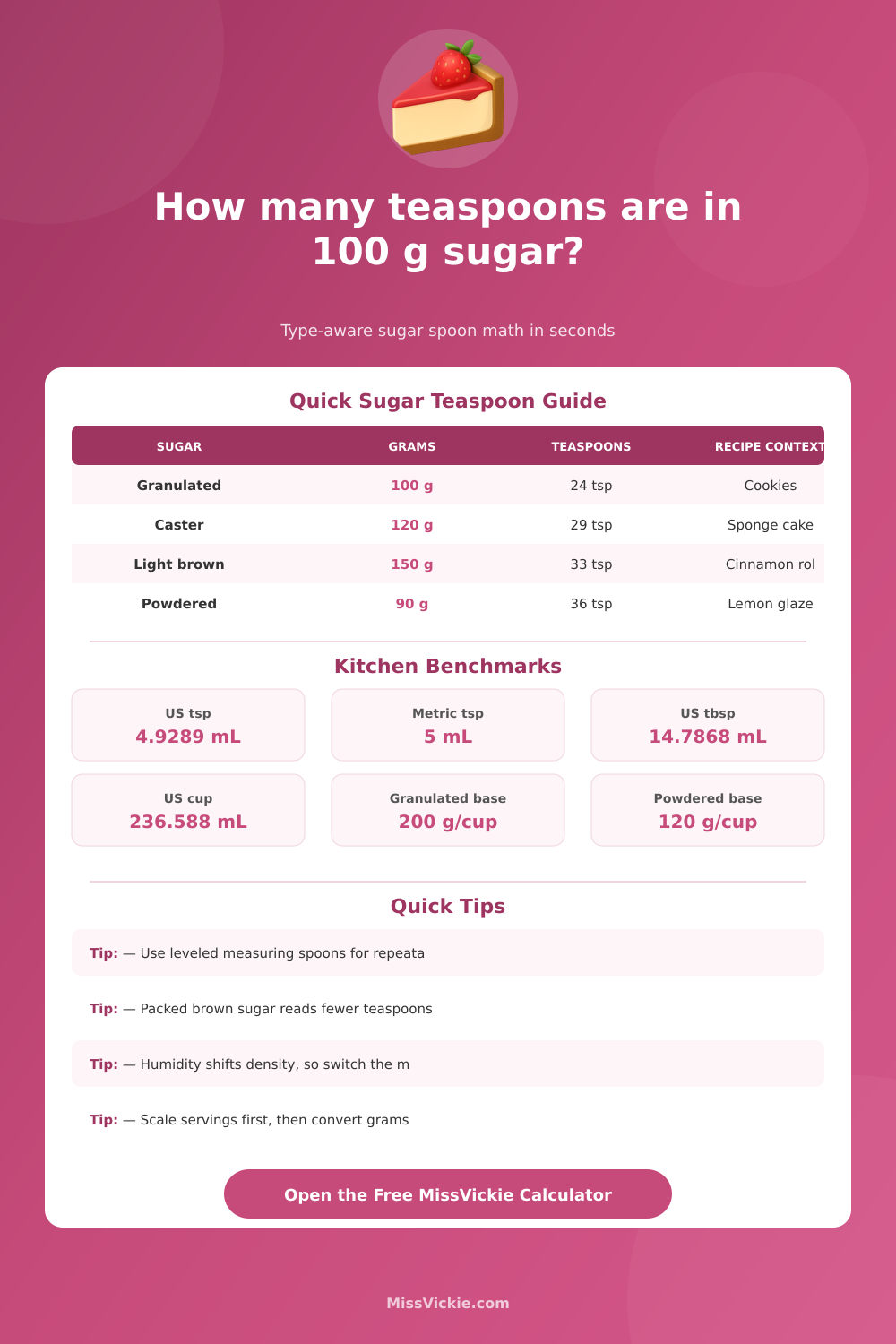
For example, brown sugar will moisten the dough that is baked but powdered sugar will dissolve quick in any liquid that is in the recipe. Use the baseline measurements to convert grams of sugar to teaspoons. Use 24 teaspoons for 100 grams of granulated sugar but 40 teaspoons for 100 grams of powdered sugar.
These baseline measurements differ because powdered sugar has a lower density than granulated sugar. Store your sugar in airtight containers to keep the density of the sugar from changing due to the humidity in your kitchen. Do not assume that all types of sugar will convert to teaspoons in the same way.
Each type of sugar will have a different density. Use a scale to measure the grams of sugar rather than using teaspoons for the most best precision in your kitchen.