🥣 MissVickie butter math
Cups to Grams Converter for Butter
Convert butter between cups, grams, ounces, tablespoons, teaspoons, and milliliters, then scale recipes with a state-aware view of how this butter behaves.
These presets cover real butter use cases, from cold blocks to whipped tubs and browned batches, then run the conversion automatically.
Set the butter type, the way you measured it, and the texture setting in your kitchen so the conversion reflects how this butter behaves.
| Format | 1 cup | 1 tbsp | 1 oz equals | Best use |
|---|---|---|---|---|
| Unsalted block butter | 227 g | 14 g | 0.22 cup | Cookies, cakes |
| Salted block butter | 227 g | 14 g | 0.22 cup | Savory bakes |
| European-style butter | 230 g | 14.4 g | 0.22 cup | Rich pastry |
| Whipped butter | 150 g | 9.4 g | 0.33 cup | Spreads only |
| Clarified butter / ghee | 216 g | 13.5 g | 0.23 cup | High heat |
| Brown butter | 205 g | 12.8 g | 0.25 cup | Sauces, glaze |
| Kitchen amount | Tablespoons | Teaspoons | Metric | Imperial |
|---|---|---|---|---|
| 1 teaspoon | 0.33 tbsp | 1 tsp | 5 g | 0.2 oz |
| 1 tablespoon | 1 tbsp | 3 tsp | 14 g | 0.5 oz |
| 1/4 cup | 4 tbsp | 12 tsp | 57 g | 2 oz |
| 1/2 cup | 8 tbsp | 24 tsp | 113 g | 4 oz |
| 1 cup | 16 tbsp | 48 tsp | 227 g | 8 oz |
| 2 sticks | 32 tbsp | 96 tsp | 454 g | 16 oz |
| Original | Target | Multiplier | Shortcut | Kitchen note |
|---|---|---|---|---|
| 4 servings | 6 servings | 1.5x | Add half again | Good for frosting and glaze |
| 6 servings | 12 servings | 2x | Double everything | Great for cookie dough |
| 8 servings | 12 servings | 1.5x | Add half again | Useful for pastry batches |
| 12 servings | 18 servings | 1.5x | Half plus full | Keep butter cold for crust |
| 12 servings | 24 servings | 2x | Double batch | Best time to switch butter to grams |
| 24 pieces | 36 pieces | 1.5x | Half extra batch | Butter math is easiest by weight |
| Use case | 1/4 cup | 1/2 cup | 3/4 cup | 1 cup |
|---|---|---|---|---|
| Cold block | 57 g | 113 g | 170 g | 227 g |
| Softened | 56 g | 112 g | 168 g | 224 g |
| Melted | 57 g | 113 g | 170 g | 227 g |
| Whipped | 38 g | 75 g | 113 g | 150 g |
| Clarified | 54 g | 108 g | 162 g | 216 g |
| Browned | 51 g | 103 g | 154 g | 205 g |
Best for pastry layers, biscuits, and clean cubes that need a slower melt.
Best for creaming, frosting, and any batter that wants an airy mix.
Best for brownies, glazes, and sauces that want a liquid fat phase.
Best for spreading, but not a direct stand-in for solid block butter.
These totals update from the converted amount so you can estimate the impact of butter calories and fat after scaling.
Butter can be measured by volume in cup or by weight in grams. Weight is the more accurate of the two measurement because the density of butter change based on the type and temperature of the butter. Using volume to measure the amount of butter can result in vary amounts of butter in one cup, which can change the texture of the food product.
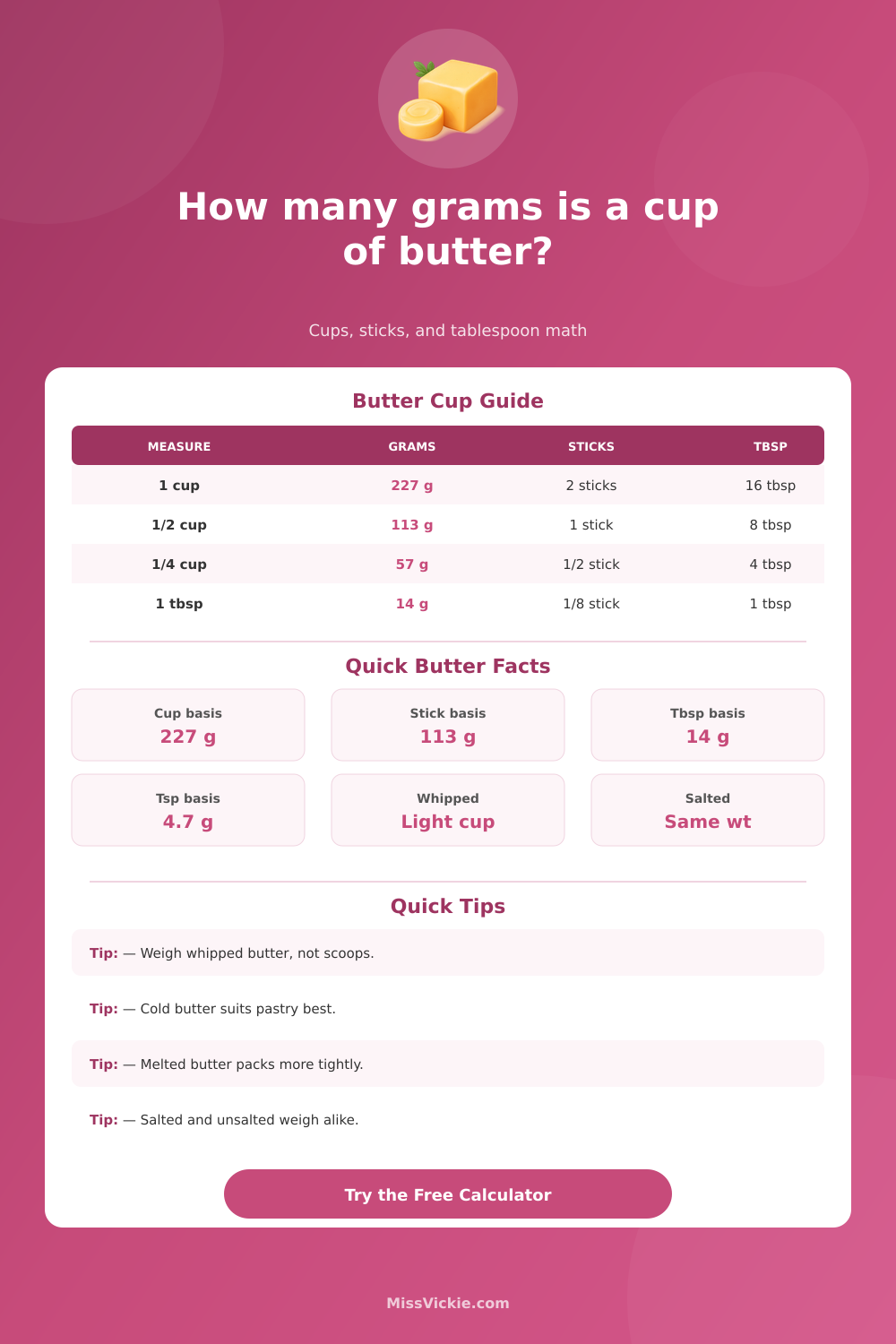
A standard cup of unsalted block butter weigh 227 grams. A cup of softened butter weighs 224 grams. A cup of melted butter weigh 227 grams.
How to Measure Butter in Cups and Grams
Depending on the recipe, butter can be measured in various state to allow for the proper texture and consistency of the end product. For instance, pastry recipes use cold butter while soft butter are used in cake recipes. European style butter weighs 230 grams per cup due to the higher fat content of this butter.
Whipped butter weigh only 150 grams per cup because it contain alot of air. Heating has had the water or solids removed from the clarified butter and browned butter. Clarified butter weighs 216 grams per cup while browned butter weighs 205 grams per cup.
Lastly, the weight of salted and unsalted butter is the same because the salt are dissolved into the butter. To scale a recipe to serve more people, the ingredient have to be multiplied correct. To go from a recipe for four servings to twelve servings, you must triple the recipe.
Using the weight of the ingredients is better than using the volume of the ingredients when scaling a recipe. A quarter cup of butter weigh 57 grams while half a cup of butter weighs 113 grams. One cup of butter weigh 227 grams.
A buffer amount of butter can be added when multiplying a recipe to account for butter that will stick to the bowl while stirring the butter or butter that evaporate during the browning of the butter. Presets can be used to easily convert butter measurements. Using the presets in an application, the start of the recipe can be programmed with the amount of butter to be use in the recipe in cups or grams.
The presets will also allow the chef to program the style of butter that is to be use. The presets will provide the recipe with the amount of grams of butter needed for the recipe based on the number of serving needed. The five percent buffer can be used to account for the amount of butter that could be lost during the cooking process.
Reference tables provides a quick list of the weights of the various forms of butter. One reference table include the weight of unsalted butter, salted butter, clarified butter, browned butter, and whipped butter. Another reference table include the weight of tablespoons of butter.
A tablespoon of butter weigh 14 grams. Finally, a third reference table can be used to convert sticks of butter to cups. Two stick of butter is equivalent to one cup of butter.
Butter contain a high amount of fat. Butter contains 81 grams of fat per 100 grams of butter. Butter contain 717 calories per 100 grams of butter.
Using two cup of butter in a recipe uses a large amount of fat and calories. When measuring butter, it is important to avoid common mistake. Using whipped butter instead of block butter will change the moisture content of the recipe.
Packing butter into the measuring cup will make the dough too tough. The chef must measure the weight of the butter after the browning process is complete as the weight of the butter will change once the solids have been removed from the butter. Using butter at the correct temperature will result in the best texture for the food.
Room temperature butter is best for creaming recipes because the butter will trap the sugar molecule to create a foam. If the butter is too cold, it will crumble. If the butter is too warm, it will make the batter oily.
For recipes that require even distribution of butter, grating frozen butter will allow the butter to distribute even. For instance, if a recipe requires butter to be grated, the chef can grate the butter before it is frozen to ensure it will distribute even throughout the recipe.