🧈 MissVickie kitchen math
Grams to mL Butter Converter
Convert butter by weight and volume with butter type, butter state, and recipe scaling built in for cleaner baking, sauces, and batch prep.
Each preset fills a real butter scenario, from stick measures and frosting batches to sauce finish and pie crust work, then runs the conversion automatically.
Pick the butter style, the way you measured it, and the amount you started with. Then set the target unit and scale for the final kitchen amount.
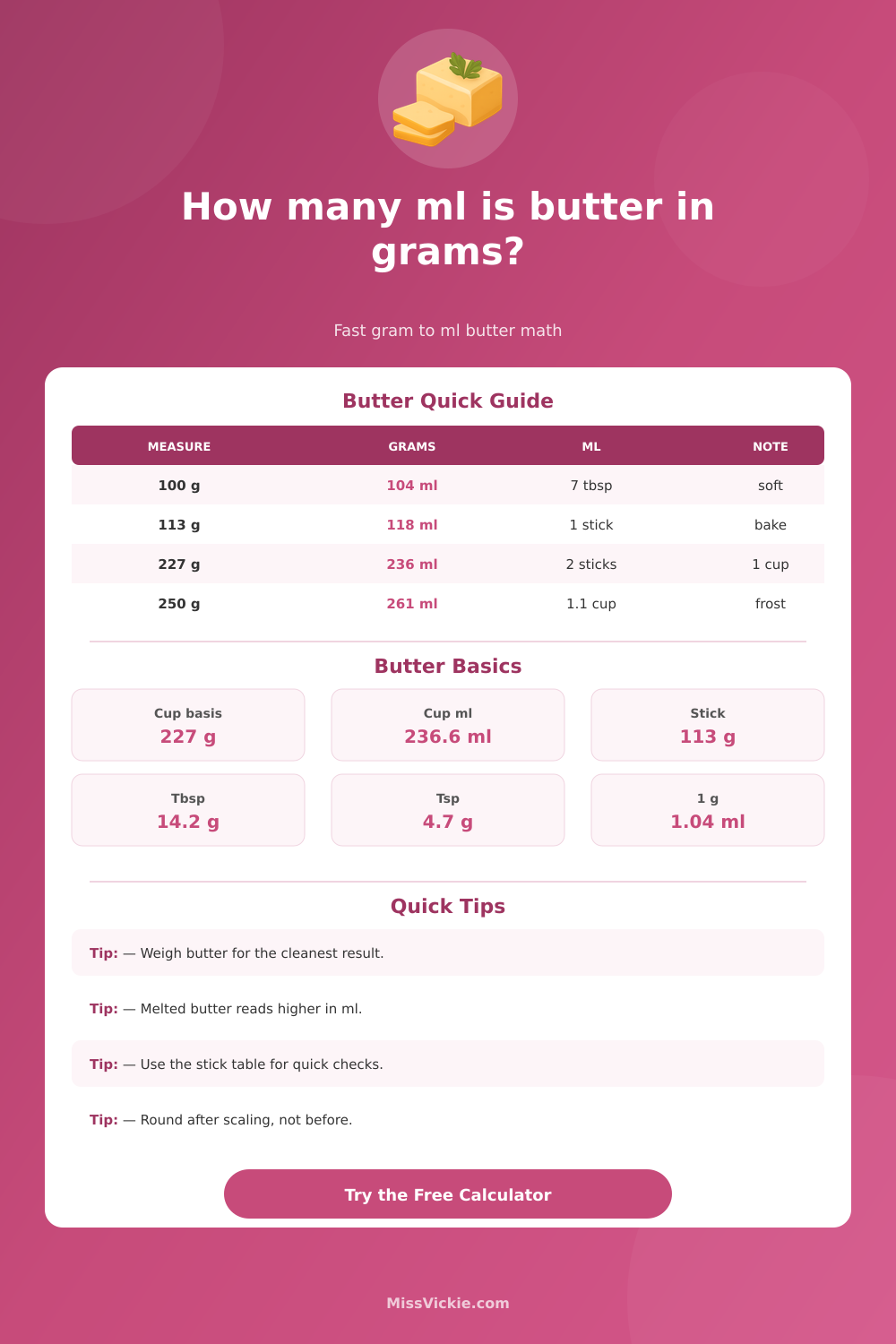
These kitchen references show the most useful butter weights, volumes, and scaling shortcuts so the converter stays practical in real recipes.
| Measure | Grams | Milliliters | Use |
|---|---|---|---|
| 1 tsp butter | 4.7 g | 4.9 ml | finishing |
| 1 tbsp butter | 14.2 g | 14.8 ml | sauces |
| 1 stick butter | 113.4 g | 118.3 ml | baking |
| 1 cup butter | 227.0 g | 236.6 ml | batch prep |
| Butter Type | Density | Texture | Best Use |
|---|---|---|---|
| Unsalted | 0.959 g/ml | standard | baking |
| Salted | 0.956 g/ml | everyday | table use |
| European | 0.948 g/ml | rich | pastry |
| Whipped | 0.680 g/ml | airy | spreads |
| State | Factor | Volume Feel | Notes |
|---|---|---|---|
| Chilled | +1.0% | firm | slices cleanly |
| Softened | 0.0% | smooth | creaming ready |
| Room temp | -0.2% | soft | easy blend |
| Melted | -0.8% | liquid | settles fast |
| Scale | Butter | Volume | Scenario |
|---|---|---|---|
| 2x | 113 g | 118 ml | one stick |
| 3x | 170 g | 177 ml | cake batter |
| 4x | 227 g | 237 ml | cookie dough |
| 6x | 340 g | 355 ml | party tray |
Use this quick comparison when the recipe changes texture or temperature and you want to choose the most realistic butter form.
Firm butter cuts cleanly and keeps volume tighter for flaky layers.
Easy to beat with sugar and ideal for cakes, frostings, and cookies.
Flows smoothly into pan sauces, quick batters, and brushed finishes.
Aerated butter takes more space, so volume rises fast in spoon measures.
Converting butter from grams to milliliter require an understanding of density. Butter are not a liquid, and it’s density change based on the type and temperature of the butter. If you dont take into consideration the different density values of butter, you will add a wrong amount of butter to your food, which will change the texture of the food product.
The density of butter isnt constant. The types of butter you use determine the density. For example, unsalted butter have a density of 0.96 grams per milliliter.
How to convert butter from grams to milliliters
European style butter has a different density then regular butter due to it’s higher fat content and lower water content. European-style butter has a density of 0.95 grams per milliliter. Whipped butter have a low density due to the air content in the butter.
The air increase the volume of whips without increasing the weight of the butter. The density of butter also changes with the temperature of the butter. Chilled butter will take up more space in your measuring cup then softened butter.
Melted butter will settle in a thinner layer in your measuring cup. This change in density with different temperature means that using a volume measurement for melted butter will result in use of a wrong amount of butter for the recipe. The way that you measure the butter will also change the density of the butter.
If you pack the butter into the cup, you will increase the density of the butter. If you spoon the butter into the cup, the density of the butter will be more lower. Therefore, the weight of the butter will change according to the way in which you measure the butter.
In order to scale a recipe, you must take into consideration the different variable of butter. One stick of butter weigh approximately 113 grams. If you are doubling the recipe, you will have to multiply the gram of butter by two.
However, you will also have to take into consideration how the volume of butter change with the state of the butter when it is heated. Finally, it is always a good idea to add a small amount to the recipe to account for any butter that may remain in the bowl or be lost during the cooking process. Some of the most common mistake with butter are packing it into the measuring cup as if it were brown sugar.
This will increase the density of the butter by 5 percent. Therefore, you will use too much butter in your recipe. Another common mistake is using melted butter, but failing to take into consideration that melted butter will contract as it settles and cools.
If you do not account for the density of melted butter when scaling a recipe, the spread of cookies will turn out incorrect. In order to achieve the best precision in your recipes that use butter, you should weigh the butter. Weighing the butter in grams is the most accurately method of measuring the butter instead of using volume measurements in milliliters.
To use volume measurement, you must first know the type of butter that you are using and the state of the butter. With this information, you can calculate the correct density factor to convert the grams of the butter to milliliters. Using the correct conversion factor will allow you to have the correct amount of butter in your recipe, which will result in the food having the texture that you requires from the recipe.