🍞 MissVickie flour math
Grams to Tablespoons Flour Converter
Convert flour grams into tablespoons, teaspoons, cups, and ounces with density-aware controls for flour type, texture, spoon style, sifting, humidity, and recipe scaling.
✨ Quick Flour Presets
These flour-first presets cover pastry, bread, pizza, pancakes, roux, and starter feeding, so you can drop in a realistic scenario in one click.
📏 Flour Converter Inputs
Pick your flour profile and measuring style, then scale servings and kitchen buffer. The cards highlight your selected output while still showing spoon and cup context.
Imperial focus keeps tablespoon output prominent while preserving gram-level math under the hood.
💡 Flour Conversion Results
The primary card follows your chosen output unit, while the supporting cards keep teaspoons, cups, and weight visible for cross-checking.
Full Breakdown
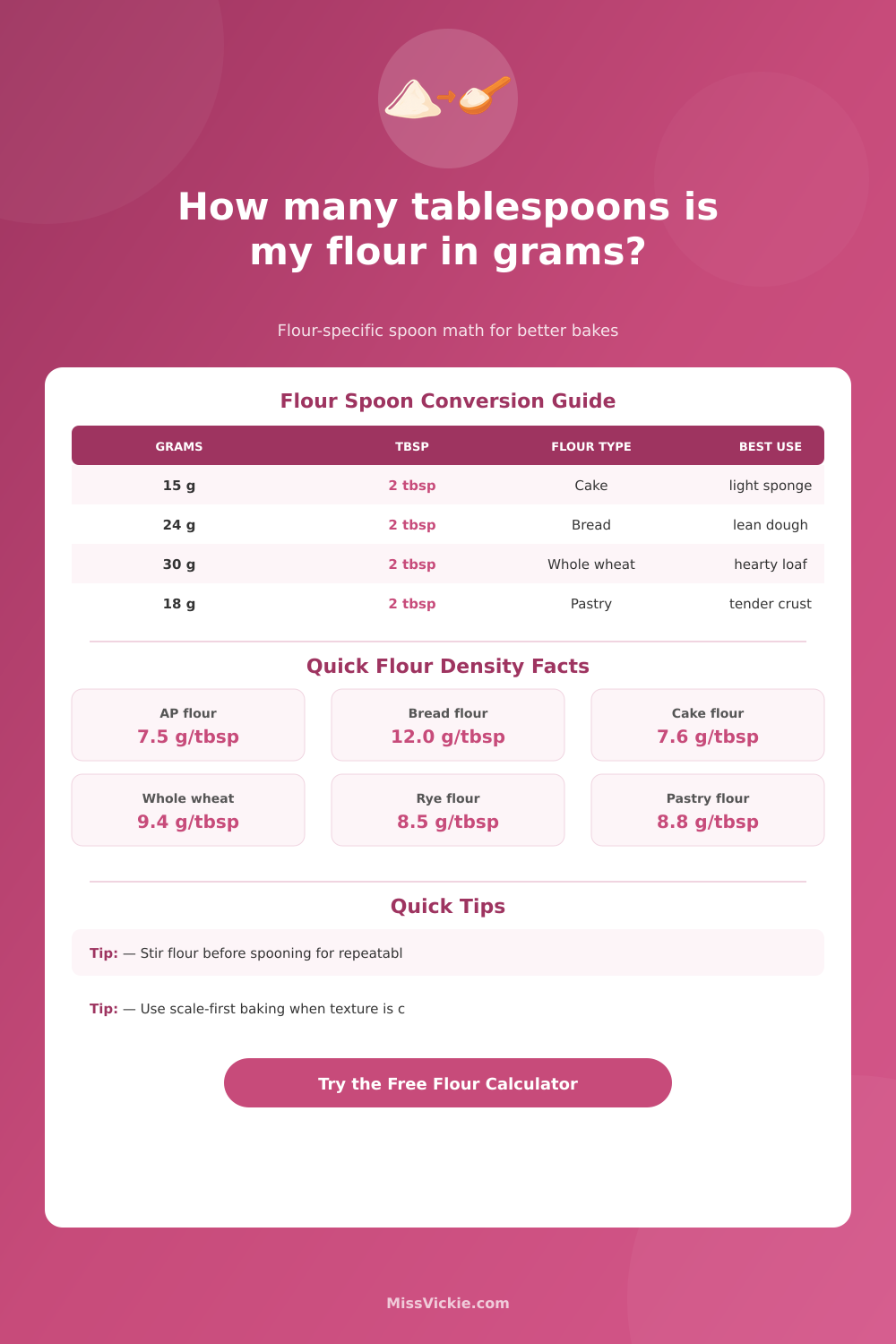
🧪 Flour Density Table: Core Baking Flours
Use this table to compare tablespoon density baselines before any texture or environmental adjustments are applied.
| Flour Type | Approx Protein | Base g per Tbsp | Approx g per Cup | Typical Recipe Zone |
|---|---|---|---|---|
| All-purpose flour | 10-11.5% | 7.50 g | 120 g | cookies, muffins, pancakes, quick dough |
| Bread flour | 12-13.5% | 8.00 g | 128 g | lean bread, rolls, pizza |
| Cake flour | 7-9% | 7.10 g | 114 g | layer cakes, chiffon, tender crumb |
| Pastry flour | 8-10% | 7.35 g | 118 g | pie crust, biscuits, tart shells |
| Whole wheat flour | 12-14% | 8.40 g | 134 g | sandwich loaves, rustic dough |
| Rye flour | 8-11% | 7.65 g | 122 g | rye breads, starters, blended doughs |
| Self-rising flour | 8-10% | 7.30 g | 117 g | biscuits, muffins, quick bakes |
| Spelt flour | 11-13% | 7.80 g | 125 g | flatbreads, enriched loaves |
| Durum flour | 12-15% | 8.20 g | 131 g | pasta blends, hearth loaves |
🧂 Flour Density Table: Texture and Sifting Effects
Texture and preparation change packing behavior. These factors are applied directly in the calculator to adjust grams per tablespoon.
| Condition | Factor | Effect on Packed Density | When It Happens | Kitchen Guidance |
|---|---|---|---|---|
| Standard bag texture | 1.000 | baseline packing | most fresh pantry flour | best all-around baseline |
| Fresh milled | 0.965 | slightly airier volume | home-milled grain | expect higher absorbency by formula, but lighter spoon fill |
| Extra fine sift | 1.015 | settles tighter | highly sifted pastry prep | more consistent spoon leveling |
| Coarse grind | 0.955 | larger particles trap voids | stone-milled flour | use scale when precision matters |
| Aged pantry flour | 1.010 | minor settling from storage | older opened bag | stir before spooning for better repeatability |
| Unsifted | 1.000 | baseline | scoop-and-level | closest to many package assumptions |
| Stirred then spooned | 0.980 | lighter fill | careful measuring prep | great for delicate cakes |
| Sifted before measuring | 0.930 | airiest fill | sponge and chiffon prep | can lower mass per tablespoon quickly |
| Packed by scoop | 1.120 | dense fill | direct bag scooping | often causes dry dough if uncorrected |
📈 Flour Density Table: Spoon Standards and Recipe Intent
Spoon volume and recipe goal both alter practical conversion output. Intent factors tune the density toward structure or tenderness.
| Dimension | Setting | Volume / Factor | Why It Matters | Best Use |
|---|---|---|---|---|
| Tablespoon | US level | 14.79 mL | common North American spoon baseline | default baking math |
| Tablespoon | Metric | 15.00 mL | slightly larger than US tablespoon | metric recipe cross-check |
| Tablespoon | Scant | 13.50 mL | reduced spoon fill for cautious flour use | sticky dough adjustments |
| Tablespoon | Heaped | 18.00 mL | large volume with mound on top | rustic bread and roux shorthand |
| Recipe intent | General baking | 1.000 factor | neutral handling | most day-to-day recipes |
| Recipe intent | Bread structure | 1.015 factor | slightly stronger flour mass target | loaf and pizza dough |
| Recipe intent | Tender cake | 0.970 factor | lightens spoon conversion | soft crumb bakes |
| Recipe intent | Cookie chew | 1.005 factor | nudges mass up a touch | drop cookies and bars |
| Recipe intent | Sauce thickening | 0.985 factor | prevents over-thick roux | gravy and pan sauce |
📊 Flour Conversion Comparison Grid
Use this comparison block to decide which output is most useful for your stage of cooking or baking.
Use grams to keep hydration predictable across flour brands and weather shifts.
Use tablespoons when you need fast edits without pausing for full re-weighing.
Use teaspoons for last-minute dough correction and gradual thickening.
Use cups and ounces when scaling for family batches or prep-day ingredient staging.
If the recipe say 120 grams of flour but you dont have a scale to measure the flour, you will have to use spoons to measure the flour. Using spoons to measure flour is more difficult than other methods because the weight of the flour change according to different factor. The weight of the flour changes because the density of the flour changes, and the density of the flour changes based off the way in which you handle the flour.
The density of the flour is the primary reason that spoon measurement of flour are not accurate. Cake flour is lighter then bread flour because cake flour is ground up to a finer powder so it is less dense. If you use bread flour, more of it will be packed into a spoon than cake flour.
How to Measure Flour with Spoons
If you pack the flour into the spoon, you will increase the weight of the flour that you measure. If you stir the flour before use, the flour will contain more air than if it was scooped from the bag, and this will make the flour measured in spoon weigh less. The humidity of the environment will affect how much flour will weigh in a spoon.
Flour in humid environments may become stick to itself and other utensils, requiring a different amount of flour by volume to reach the same weight as flour in dry environments. The type of flour you use will change the weight of the flour measured in spoons. Whole wheat flour will weigh more in a spoon than pastry flour due to the bran in the whole wheat flour.
You can use several different tool to measure flour depending on the recipe. You can use tablespoons for small amounts of flour, cups for large amounts of flour, and teaspoons for adding small amount of flour to a dough. The most accurate tools to measure flour are grams.
Using grams you can ensure the weight of the flour does not change with any other variable. If you use spoons, however, you can follow a few methods that will ensure the weight of the flour as close to accurate as possible. One of the most common mistakes when using spoons to measure flour is scooping the flour directly from the bag.
When you scoop flour directly from a bag, you pack the flour into the spoon. Packing the flour into a spoon will make the flour too heavy for most recipe. To avoid this mistake stir the flour before you scoop it into your spoon.
Use level tablespoons instead of heaped tablespoons. Heaped tablespoons contain extra flour in the spoon that can make baked goods too dry. If you are making a recipe that requires accuracy, you should know that all-purpose flour weigh approximately 7.5 grams per tablespoon.
Bread flour will weigh more per tablespoon because bread flour is more dense than all-purpose flour. The density of different brands of flour may not be the same, so be aware that the weight of flour can vary from brand to brand. To measure flour with spoons, you must take into consideration the density of the flour, the humidity of the environment, and the method in which you scoop the flour.
If you stir the flour and use level tablespoons, you have more control over the amount of flour to add to your recipe. The best way to measure flour is with a scale. If you must use spoons to measure flour, though, you can account for these different variable so that your recipe is successfuly.