🍞 MissVickie flour density math
Flour Grams to mL Converter
Turn flour grams into milliliters with flour-specific density settings, then compare cups, spoons, and baking styles without guessing at how airy or packed the flour feels.
Each preset loads a real baking scenario with flour type, humidity, sift count, and packing behavior, then recalculates the milliliter equivalent instantly.
The calculator uses flour-specific cup weights, then adjusts the density with sift, humidity, storage, and packing settings so the volume estimate stays practical.
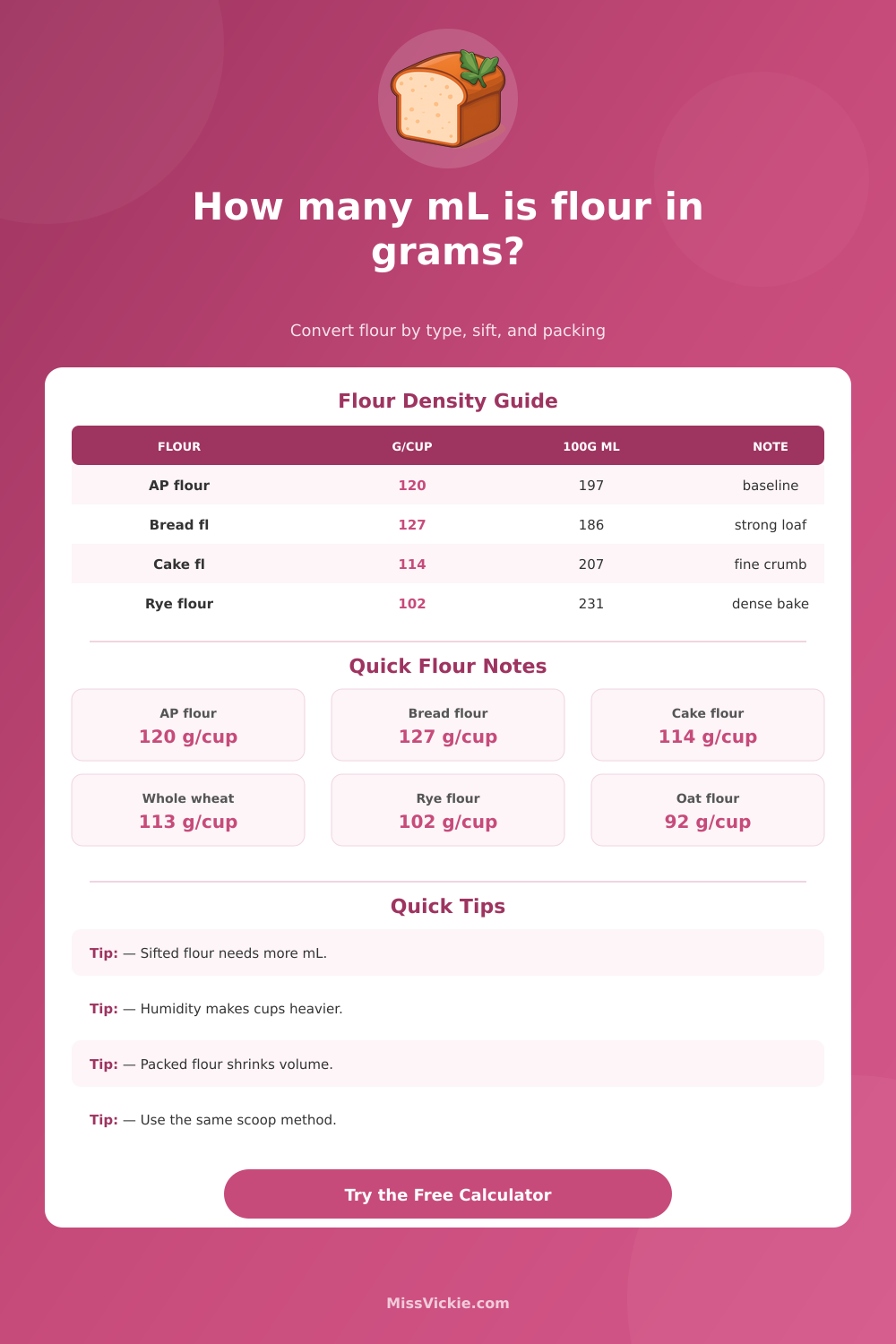
These are practical cup weights used by the converter. The exact volume depends on how the flour is scooped, sifted, settled, and packed.
| Flour type | Approx g/cup | Approx mL per 100 g | Use note |
|---|---|---|---|
| All-purpose flour | 120 | 197 | Balanced baseline for many batters. |
| Bread flour | 127 | 186 | Stronger gluten and slightly heavier cups. |
| Cake flour | 114 | 207 | Finer, lighter, and more aerated. |
| Pastry flour | 110 | 215 | Great for tender crusts and biscuits. |
| Whole wheat flour | 113 | 210 | Bran adds texture and bulk. |
| Self-raising flour | 121 | 196 | AP base with lifting agents blended in. |
| Rye flour | 102 | 232 | Dense grain with lower cup weight. |
| Oat flour | 92 | 258 | Very light and absorbent for small bakes. |
Use this table to understand how the scooping style changes the weight of one cup of flour before the grams to milliliters conversion is applied.
| Measure state | Density shift | Texture effect | Best for |
|---|---|---|---|
| Loose aerated scoop | -7% | Fluffier cup | Soft pastry |
| Standard level cup | Baseline | Normal kitchen fill | Everyday baking |
| Freshly sifted flour | -10% | Air trapped between grains | Layer cakes |
| Lightly packed fill | +8% | Smaller air gaps | Heavier doughs |
These examples are calculated from the same density model, so you can cross-check the converter with quick kitchen-friendly reference points.
| Flour type | 50 g | 100 g | 250 g |
|---|---|---|---|
| All-purpose flour | 99 mL | 197 mL | 493 mL |
| Bread flour | 93 mL | 186 mL | 464 mL |
| Cake flour | 104 mL | 207 mL | 517 mL |
| Whole wheat flour | 105 mL | 210 mL | 524 mL |
This table bridges dry measuring spoons and cups so the calculator can show a rough spoon count along with the main mL answer.
| Dry measure | mL volume | Flour feel | Practical use |
|---|---|---|---|
| 1 teaspoon | 5 mL | Tiny sample | Seasoning test |
| 1 tablespoon | 15 mL | Small spoon | Cookie mix adjust |
| 1/4 cup | 59 mL | Quarter cup | Quick batch math |
| 1 cup | 237 mL | Full cup | Recipe baseline |
Different measuring habits change the final mL estimate. These cards explain which flour handling style gives the most consistent conversion.
Best when the flour is first fluffed, then lightly spooned into the cup without pressing.
Most recipe books assume this method, so the cup weight stays close to the default density.
Useful for sponge cakes and delicate bakes where a lighter cup weight makes sense.
Better for doughs that naturally settle or for users who tap the cup while filling it.
These summary cards show how the density changes after every adjustment. They help you confirm the calculator before you copy the result into a recipe.
Starting grams per cup from the selected flour type.
After style, humidity, storage, sift, and pressure changes.
How many grams fit into one milliliter of the chosen flour.
Rounded output in milliliters for easy kitchen reading.
Input mass from the grams field.
Converted from adjusted cup density.
Approximate tablespoon count for quick scaling.
Flour densities is an important concept to understand in a world of baking. Flour can have different volumens depending on how the flour are handled and stored. For instance, flour that you measure with an liquid measuring jug or measuring cup will have a different volume in milliliters or cups then flour that is measured with a scale, which measure the weight of flour in grams.
The weight of flour and the volume of flour do not have a permanent relationship. Flour contain pockets of air within its structure. If you pack the flour down, it will weigh more within a smaller volume.
Why Flour Volume and Weight Are Different
If the flour is sifted, it will weigh less within a larger volume of flour. Several factor impact the density of flour. For instance, humidity has an ability to impact the density of flour.
Flour will absorb moisture from the air, which will make the flour denser. Additionally, the temperature and in what conditions the flour is stored will impact its density. Flour that is stored for long periods of time will tend to settle in the bag and become more denser.
Finally, the type of flour will impact the density of that flour. Bread flour is more dense than cake flour due to the protein content in the flour. Additionally, rye flour and oat flour will have different densities than flour that is use for baking most baked goods.
Because flour density change based off the way in which flour is handled, the volume of flour (measured in milliliters) will also change. Thus, you cant assume that flour will always weigh the same amount of gram. Density figures can help to convert grams of flour to milliliters of flour.
If you know the density of the flour that you are using, you can calculate how many milliliters of flour will be needed for your recipe if the flour requirement are given in grams. For instance, if a recipe state that 300 grams of flour is needed, knowing the density of that flour will allow you to calculate the number of milliliters of flour that is required to be use in the recipe. Additionally, the environment in which you are baking will impact the density of the flour.
If the kitchen in which you are baking is humid, the flour will be denser so you will need a larger volume of flour to weigh the same number of grams of flour. In a dry kitchen, flour will be less dense so you will need to use a smaller volume of flour to weigh the same grams of flour. Bakers can ensure consistency in the baking process by accounting for the variables discuss in this description of flour density.
For instance, many bakers use kitchen scale to measure the flour that they use in their recipes. This is because the scale will measure the weight of the flour in grams, which dont change based upon how the flour is packed into the measuring cup or how the humidity level in the environment impact the flour. Thus, if a chef must use a liquid measuring jug to measure flour, they must use the same amount of flour and use the same method of measuring that flour.
Additionally, chefs can test the density of the flour that they use by weighing out one cup of flour on a kitchen scale. By noting the weight of one cup of flour, that baker can use that measurement to make volume measurement of that same flour in the future.