MissVickie oven conversion studio
Fahrenheit to Gas Mark Converter
Start from Fahrenheit, Celsius, or gas mark, then shape a realistic oven target with oven type, altitude, pan depth, rack position, and pan material. This is built for actual baking outcomes, not only textbook conversion math.
Real Oven Scenario Presets
Nine kitchen-ready starting points. Each preset fills inputs for a practical scenario so you can convert quickly and still keep context.
Input Panel
Inputs cover temperature plus core oven variables: unit source, oven type, altitude, pan depth, pan material, rack position, and recipe band.
Results
Calculation Breakdown
Conversion Comparison Grid
A quick side-by-side to compare raw conversion versus adjusted kitchen target.
Your starting temperature and source unit.
Pure temperature math before oven context.
After oven, rack, pan, and altitude effects.
Rounded to a practical dial setting.
Reference Table 1: Gas Mark Master
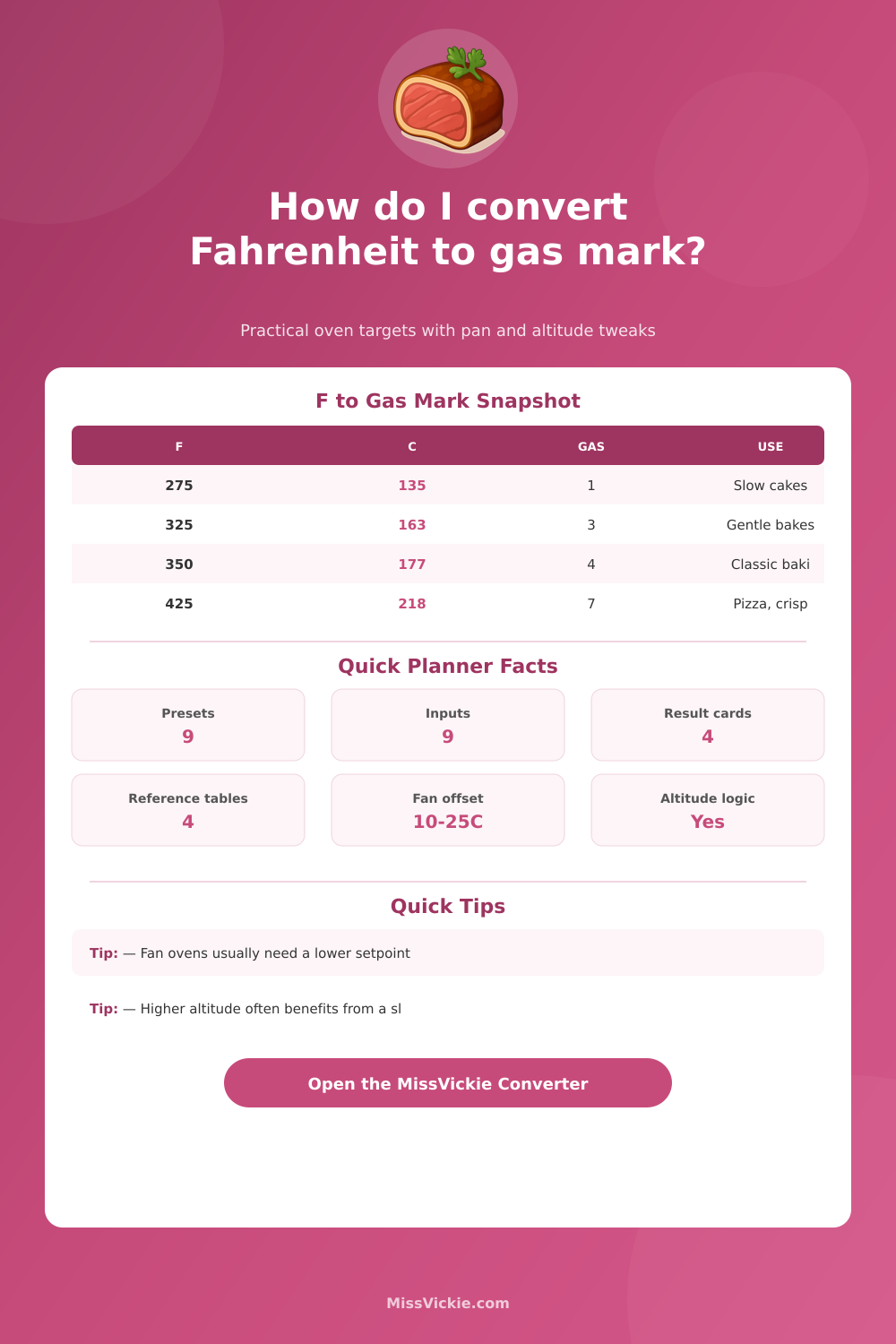
| Gas Mark | Celsius | Fahrenheit | Typical Kitchen Use |
|---|---|---|---|
| 1/4 | 107C | 225F | Very low drying and gentle holding. |
| 1/2 | 121C | 250F | Custard set, slow meringue drying start. |
| 1 | 135C | 275F | Fruit cake and long slow bakes. |
| 2 | 149C | 300F | Cheesecake and low moisture baking. |
| 3 | 163C | 325F | Gentle cookies and even crumb cakes. |
| 4 | 177C | 350F | General baking standard target. |
| 5 | 191C | 375F | Pies, tray bakes, roasted vegetables. |
| 6 | 204C | 400F | Bread spring and stronger browning. |
| 7 | 218C | 425F | Pizza, crisp roast skins, quick bakes. |
| 8 | 232C | 450F | High heat pastry puff and rapid roast finish. |
| 9 | 246C | 475F | Maximum domestic oven blast. |
Reference Table 2: Fan Reduction Guide
| Conventional C | Typical Fan C | Conventional F | Typical Fan F | When to Prefer This Shift |
|---|---|---|---|---|
| 140C | 120-125C | 284F | 248-257F | Meringue, custard, and slow set bakes. |
| 160C | 140-145C | 320F | 284-293F | Cheesecake, loaf cakes, and moist batters. |
| 180C | 160-165C | 356F | 320-329F | General cakes and balanced cookie trays. |
| 200C | 180-185C | 392F | 356-365F | Pastry shells and medium roasts. |
| 220C | 200-205C | 428F | 392-401F | Bread bloom and stronger crust color. |
| 240C | 220-225C | 464F | 428-437F | Pizza steel and intense top heat finish. |
Reference Table 3: Baking Bands and Use Cases
| Band | Range C | Range F | Approx Gas Mark | Common Results |
|---|---|---|---|---|
| Low and slow | 120-155C | 250-311F | 1/2 to 2 | Even set, delicate texture, minimal cracking. |
| Moderate bake | 160-185C | 320-365F | 3 to 4 | Most cakes, cookies, and everyday trays. |
| Hot roast | 190-220C | 374-428F | 5 to 7 | Roasting and robust browning with faster finish. |
| Very hot blast | 225-250C | 437-482F | 8 to 9 | Pizza, fast crust set, high evaporation. |
Reference Table 4: Pan Material Heat Response
| Material | Heat Behavior | Suggested Temp Bias | Time Effect | Practical Note |
|---|---|---|---|---|
| Light aluminum | Balanced conduction | 0C | Baseline | Best neutral reference for recipe testing. |
| Dark non-stick steel | Absorbs more radiant heat | -5C | -2% to -4% | Can brown edges early; watch color soon. |
| Glass or ceramic | Slower to heat, then retains | -5C | +3% to +6% | Protects center but may extend finish time. |
| Cast iron | High thermal mass | +5C preheat-based | -1% to -3% | Excellent for crust when fully preheated. |
| Baking stone/steel | Fast floor energy transfer | +10C for deck style | -4% to -8% | Ideal for pizza and rustic bread bottoms. |
Two Practical Tips
When converting an oven temperature from Fahrenheit to gas mark, there are a few variables to consider. Oven temperature may not always be the same throughout different appliance. Furthermore, the Fahrenheit scale are used in many recipes to denote the temperature of the oven in which the dishes should be cooked.
However, gas marks is a system of nine step used in Britain to denote the heat of the oven. Understanding how the oven conduct heat is half the battle of understanding how to adjust the temperature correctly. Heat can travel in three different way in the oven: convection, radiation and conduction.
Fahrenheit to Gas Mark and Oven Tips
Each of these method may occur in an oven of a specific type. The type of oven in which the food are cooked can change the variables of heat conduction within that oven. For instance, conventional electric oven use heating elements at the top and the bottom of the oven.
However, if the oven door is opened, the conventional oven can take a while to regain its heat. Fan-assisted ovens use a fan that heats the food more efficient than conventional electric ovens. However, the increased efficiency mean that you must decrease the temperature of the food by 10 to 25 degrees Celsius.
Gas oven use natural gas flame to heat the food. Because gas ovens tend to add more moisture to the food, you must increase the temperature of the food to ensure that the crust of item like bread does not become too moist. Another variable to consider is the position of the racks within the oven.
Food should be placed on the middle rack of the oven to allow the heat to be distributed even around the food. If the food is to be cooked on the top rack, it will be exposed to heat from the heating element at the top of the oven. Additionally, if the item is on the rack at the top of the oven, it can be at risk of burning the top of the food.
Finally, if the food is placed on the rack at the bottom of the oven, the heat will rise from the floor of the oven. Finally, the bottom rack is used for items such as pizza that need to be cooked on the bottom of the pan. Additionally, the material of the pan that the food is cooked in can change how the ovens heat can affect the food.
Aluminum pans are known to even distribute the heat to the food that is within the pan. Therefore, aluminum pans are most often use in cooking recipes. However, dark steel pans will absorb more radiation from the heat of the oven than light aluminum pans.
Thus, 5 degrees Celsius must be decreased from the set temperature for food cooked in dark steel pans. Similarly, glass and ceramic pan will absorb the heat more slow than metal pans. Thus, food cooked in glass or ceramic pans will require longer cooking time.
Finally, the mass of the pan itself also affect the cooking time. For instance, cast iron pans have a large mass of iron, so you must preheat them in the oven before cooking. Additionally, because of the properties of the metal, the crusts of food like cornbread can be strong when cooked in a cast iron pan.
Another variable to consider is the altitude at which the oven is used. At high altitude, the air is thinner. Therefore, the boiling point of water is lower at high altitudes.
Because the boiling point is lower, the moisture in foods will be lost at a faster rate. Thus, an increase in the temperature at which the oven is set will help compensate for the loss of moisture by the food. However, cooking times must also be closely monitor at high altitudes.
The temperatures of the oven can be grouped into a few category. Low temperatures between 120 and 155 degrees Celsius are used for cooking delicate item like cheesecake that should not crack during cooking. Items that require moderate cooking temperature between 160 and 185 degrees Celsius may include cakes and cookies.
High temperature around 220 degrees Celsius are used for roasting vegetables. Finally, very high temperature above 225 degrees Celsius are used in making pizza because the high temperatures create the steam needed to allow the dough of the pizza to puff. An oven thermometer is a device that can measure the actual temperature within the oven.
Many ovens are not accurate in the temperature setting that are set for the oven. Thus, using an oven thermometer will allow the cook to adjust the recipes according to the ovens actual heat. If the oven is inaccurate, the cook can adjust the temperature settings for the recipes according to the ovens inaccuracy.
Another tool that should of been used in the kitchen is an oven thermometer to ensure that the oven reaches the correct temperature. Fan-assisted ovens will reduce the baking time of items by 5 to 10 percent because the food will be heated more efficient. Finally, the oven should always be preheated to the set temperature because if it is not preheated, the cooking time for the food will increase by 10 to 20 percent to allow the food to reach the required cooking temperature.