MissVickie Coconut Flour Lab
Coconut Flour Converter with Hydration Planning
Convert coconut flour across kitchen units, resize servings, and predict liquid plus egg support so batters stay workable instead of suddenly dry.
Preset Baking Scenarios
Choose a scenario to auto-fill realistic starter values. Every preset is tuned for a different texture target.
Converter Inputs
This panel combines unit conversion and batter planning. Use all fields for a full recommendation or keep defaults for a quick unit swap.
Brands vary; this controls cup-based conversions.
Used to check binder support against flour mass.
Water, milk, cream, juice, or puree total.
Two Practical Tips Before You Mix
Tip Box 1: Avoid sudden dryness
Coconut flour keeps drinking moisture after stirring. Mix, pause for a short rest, then check texture before adding extra flour. This one step prevents dense muffins and stiff pancake batter.
Tip Box 2: Balance binder and liquid
If your recipe uses less egg support, increase liquids slowly in small pours. If it uses more eggs, hold back liquid until the batter settles, then fine tune with tablespoons.
Reference Tables
These tables are designed for quick checks while scaling. They are not fixed laws, but strong kitchen starting points.
| Table 1: Coconut Flour Unit Weights | |||
|---|---|---|---|
| Unit | Volume ml | Approx grams | Approx ounces |
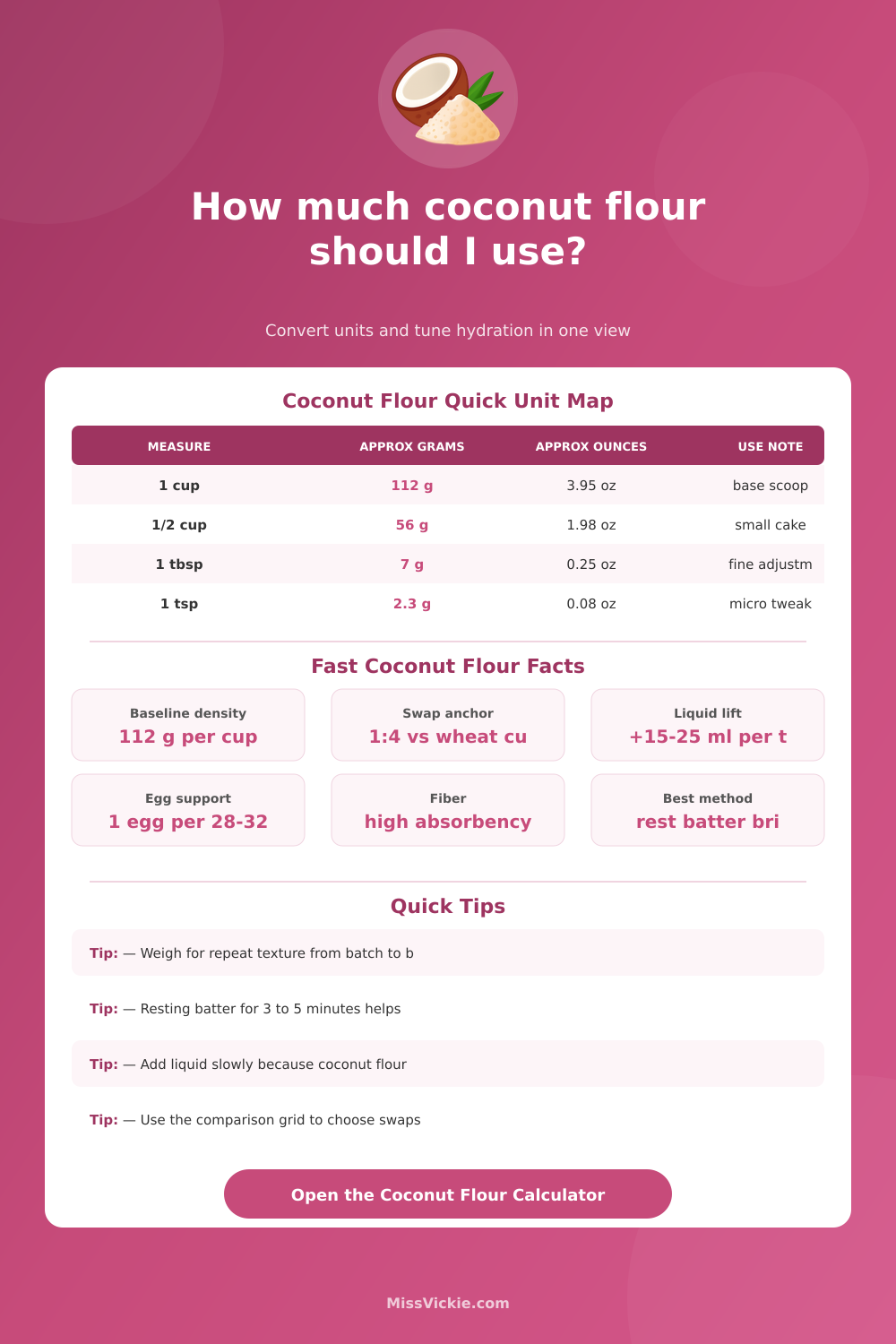
| 1 cup | 236.6 ml | 112 g | 3.95 oz |
| 3/4 cup | 177.4 ml | 84 g | 2.96 oz |
| 2/3 cup | 157.7 ml | 74.7 g | 2.63 oz |
| 1/2 cup | 118.3 ml | 56 g | 1.98 oz |
| 1/3 cup | 78.9 ml | 37.3 g | 1.32 oz |
| 1/4 cup | 59.1 ml | 28 g | 0.99 oz |
| 1 tbsp | 14.8 ml | 7 g | 0.25 oz |
| 1 tsp | 4.9 ml | 2.3 g | 0.08 oz |
| Table 2: Coconut to Wheat Swap Guide | |||
|---|---|---|---|
| Original wheat flour | Coconut flour | Liquid increase | Egg support |
| 1 cup wheat | 1/4 cup coconut | +60 to +90 ml | +1 egg usually |
| 2 cups wheat | 1/2 cup coconut | +120 to +180 ml | +2 eggs likely |
| 3 cups wheat | 3/4 cup coconut | +180 to +260 ml | +2 to +3 eggs |
| 4 cups wheat | 1 cup coconut | +240 to +350 ml | +3 to +4 eggs |
| Cookie style dough | use 22-30% of wheat by weight | moderate lift | binder focus |
| Cake style batter | use 24-28% of wheat by volume | higher lift | egg and yogurt help |
| Flatbread style | use 25-33% of wheat by volume | adjust by rest | egg white useful |
| Table 3: Texture Targets and Hydration Pattern | |||
|---|---|---|---|
| Texture target | Fluid per 28 g flour | Rest window | Outcome signal |
| Pourable batter | 52 to 64 ml | 2-3 min | ribbon falls smoothly |
| Spoonable batter | 46 to 56 ml | 3-5 min | mound relaxes slowly |
| Shapeable dough | 36 to 46 ml | 5-6 min | holds edge when scooped |
| Firm bar mix | 30 to 38 ml | 6-8 min | presses into pan cleanly |
| High-fiber variant | add 6-12 ml extra | add 1-2 min | crumb softens overnight |
| Low sugar variant | add 4-8 ml extra | steady rest | less spread in oven |
| Table 4: Egg and Binder Support Window | |||
|---|---|---|---|
| Coconut flour grams | Egg range | Binder backup | Comment |
| 20-30 g | 1 egg | none or 1 tsp flax | works for thin batters |
| 31-50 g | 1-2 eggs | 1 tsp psyllium optional | good for muffins |
| 51-75 g | 2-3 eggs | 1-2 tsp flax or chia | good for quick breads |
| 76-100 g | 3-4 eggs | 2 tsp psyllium likely | watch center set |
| 101-130 g | 4-5 eggs | 2-3 tsp mixed binder | use staged liquid |
| 130 g plus | 5+ eggs | binder strongly advised | split into two pans |
Flour Comparison Grid
When you are deciding between coconut flour and alternatives, compare absorbency and structure behavior instead of just grams.
Coconut Flour
Very high absorbency and strong moisture draw. Best for recipes built around eggs or blended binders.
Fiber-richLow carb styleHigh hydration demandAlmond Flour
Lower absorbency than coconut with a richer feel. Often gives tender crumb and more spread in cookies.
Nutty profileModerate hydrationHigher fat contentAll-Purpose Flour
Predictable gluten network and classic rise for most household recipes. Usually easiest for first-pass baking.
Gluten structureLower egg demandStandard baselineOat Flour
Soft flavor with medium absorbency. Works well when blended with starches or protein ingredients for lift.
Gentle tasteModerate fiberBlend-friendlyComparison note: the converter output is calibrated for coconut flour behavior, so alternative flours should be tested in small trial batches first.
How to Use This Coconut Flour Converter
Start with the amount and unit you currently have, then choose your target unit. If you know your brand packs heavier or lighter than average, update the density field so cup-based values stay accurate for your pantry.
Next, set original and target servings. The calculator scales coconut flour mass first, then applies environment and texture factors. This helps maintain useful consistency when you move from a family batch to a party batch.
Hydration guidance is estimated from coconut flour mass, rest time, texture target, and humidity. The result card named Hydration Support shows suggested additional liquid, while the breakdown explains each multiplier so you can decide whether to follow it fully or partially.
The Wheat Flour Equivalent card is there for planning and communication. It does not imply a one-click substitution in every recipe. Instead, it gives a quick frame for how much traditional flour structure your coconut flour amount roughly represents.
For the most repeatable bakes, weigh ingredients, rest batter briefly, and use one test muffin or pancake first. A tiny pilot cook can save a full tray from over-thick batter and gives you a clean opportunity to tune liquid by tablespoons.
Coconut flour are made from dried coconut meat. Coconut flour contains a very high amount of fiber. Because of the high amount of fiber that coconut flour contains, coconut flour absorb alot of moisture when mixed with liquids.
Coconut flour can absorbs as much liquid as four cup of wheat flour. If you use coconut flour in your baking recipes, you must use more liquid than if you were to use wheat flour instead. If you use too many coconut flour and not enough liquid, the baked goods will be dry and crumbly.
Tips for Baking with Coconut Flour
Coconut flour doesnt contain gluten, so binder need to be added to help coconut flour recipes set. Eggs can be used as a binder in these recipes. A scale should be used to measure the coconut flour that will be used in your recipe.
This is because different brands of coconut flour can have different density. If you weigh the coconut flour that will be used in your recipe, you can ensure that you use the correct amount. The humidity in the kitchen in which you prepare the recipe may also change how much liquid the coconut flour absorbs.
If the kitchen is dry, the coconut flour will absorb more of the liquid. If it is humid in the kitchen, the coconut flour will absorb less of the liquid. After you have mixed all of the ingredients into the batter for your baked good, you should allow the batter to rest for three to five minutes.
The fiber in the coconut flour needs to absorb the liquid in this period. If you do not allow the batter to rest, the baked goods may have an inconsistently texture. Because eggs contain the liquid and structure needed to set with coconut flour, you must monitor the amount of eggs use in the recipe.
If you use too many eggs, the baked goods may be dense, as they will contain too much of the eggs structure. The same is true for using too few eggs; the baked goods may crumble and fall apart. Coconut flour should not be used in a one-to-one ratio with wheat flour.
You should use much less coconut flour because of the way it absorbs liquid. For example, you should use one quarter of the amount of coconut flour instead of the amount of wheat flour that would be needed. Additionally, the recipe should also increase the amount of liquid and the amount of eggs.
To make baked goods that have a softer texture, blend coconut flour with almond flour or oat flour. Almond flour will add fat to the recipe, while oat flour will make the texture of the baked goods more gentler. Finally, before you bake your recipe using coconut flour, test a small portion of the batter.
Bake a single muffin to test the batter. If the muffin is too dry, add liquid to the remaining batter. If the muffin is too wet, add more coconut flour to the remaining batter.
By testing a small amount of the batter, you can ensure that the batch of baked goods that you bake will be success. Following these guidelines will help you to manage the moisture absorption of coconut flour in your recipes.