🍳 MissVickie kitchen math
Kitchen Unit Converter
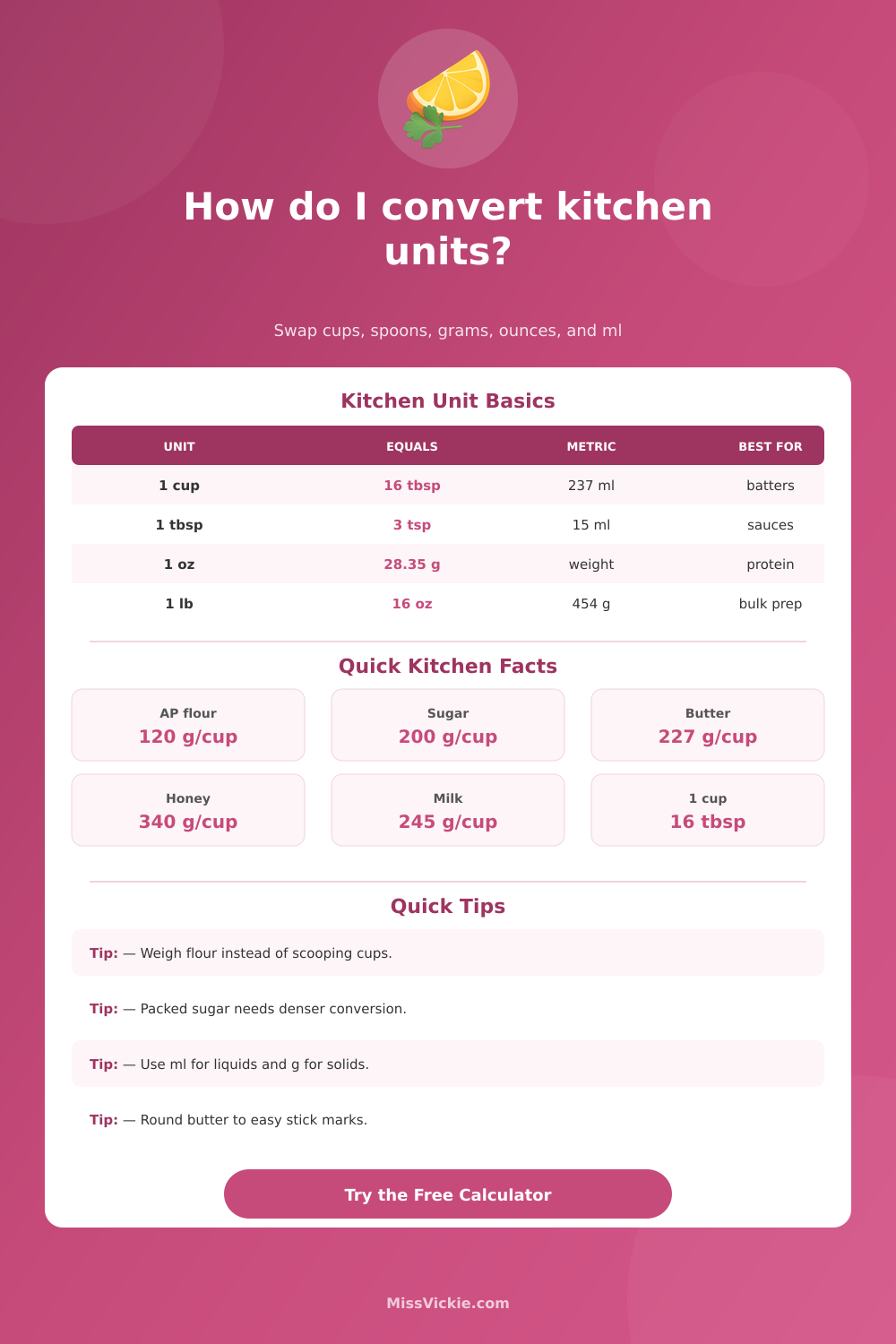
Convert kitchen volume and weight units for flour, sugar, butter, honey, milk, oats, rice, and cocoa, then scale the same ingredient for bigger dinners, batch baking, and meal prep.
Each preset fills a practical ingredient, unit pair, batch size, and measuring context, then runs the conversion automatically.
These fixed conversions help for liquids and same-family measuring when you are not bridging to ingredient weight.
| Kitchen Unit | Tablespoons | Teaspoons | Metric Equivalent |
|---|---|---|---|
| 1 cup | 16 tbsp | 48 tsp | 236.6 ml |
| 3/4 cup | 12 tbsp | 36 tsp | 177.4 ml |
| 1/2 cup | 8 tbsp | 24 tsp | 118.3 ml |
| 1/4 cup | 4 tbsp | 12 tsp | 59.1 ml |
| 1 tbsp | 1 tbsp | 3 tsp | 14.8 ml |
| 1 tsp | 0.33 tbsp | 1 tsp | 4.9 ml |
Use this table for meats, cheese, grains, and any ingredient you can place directly on a kitchen scale.
| Weight Unit | Ounces | Grams | Typical Use |
|---|---|---|---|
| 1 ounce | 1 oz | 28.35 g | Cheese, nuts, chocolate |
| 4 ounces | 4 oz | 113.4 g | Single protein serving |
| 8 ounces | 8 oz | 226.8 g | One cup butter by weight |
| 1 pound | 16 oz | 453.6 g | Bulk prep and meat packs |
| 500 grams | 17.64 oz | 500 g | Standard flour bag target |
| 1 kilogram | 35.27 oz | 1000 g | Large batch cooking |
These are standard cup weights used when you convert between volume and weight for common pantry ingredients.
| Ingredient | 1 Cup Weight | 1 Tbsp Weight | Best Measuring Method |
|---|---|---|---|
| All-purpose flour | 120 g | 7.5 g | Weigh for dough and cookies |
| Bread flour | 127 g | 7.9 g | Weigh for yeast dough |
| Granulated sugar | 200 g | 12.5 g | Cups or scale both work |
| Brown sugar | 220 g | 13.8 g | Pack consistently or weigh |
| Butter | 227 g | 14.2 g | Scale or stick markings |
| Honey | 340 g | 21.3 g | Weigh to avoid sticky loss |
| Whole milk | 245 g | 15.3 g | Use ml for clean liquid math |
| Rolled oats | 90 g | 5.6 g | Weigh for bars and granola |
This table gives quick planning numbers when you need to stretch one ingredient across a larger meal or baking run.
| Scenario | Base Amount | Scaled Amount | Good Output Unit |
|---|---|---|---|
| Cookies 24 to 48 | 2 cups flour | 480 g flour | grams |
| Pancakes 4 to 12 | 1.5 cups milk | 1065 ml milk | milliliters |
| Rice 6 to 20 | 1 cup rice | 567 g rice | grams |
| Granola 8 to 20 | 0.33 cup honey | 286 g honey | grams |
| Frosting 12 to 24 | 1 cup butter | 1.05 lb butter | pounds |
| Brownies 16 to 24 | 0.75 cup cocoa | 96 g cocoa | grams |
Pick the unit family that matches the ingredient and the level of precision you need.
Best for quick batter assembly when the ingredient is forgiving and the recipe already uses cup measures.
Best for flour, dough, and sticky ingredients because scale-based math avoids density guesswork.
Helpful when butter wrappers, grocery packages, or protein portions are marked in ounces.
Strong choice for milk, broth, and sauces since liquids convert neatly without ingredient density shifts.
These four quick cards update from the active ingredient profile so you can compare density and macro traits while converting.
When cooking a recipe, it is often necessity to change the number of serving that the recipe will produce. Recipes are often written to produce enough food for eight person, but it is often necessary to produce food for twelve people. In order to produce enough food for twelve people, the cook will have to increase the amount of each ingredient that should be used in the recipe.
Such an adjustment of the recipe are known as “scaling” the recipe. Recipes often use different measurement systems. For instance, recipes may ask to measure ingredients by volume (such as cups and spoons), or the cook may have to weigh the ingredients (such as grams and ounce).
How to Scale a Recipe Using Weight
Measurements of volume can include both solid ingredients and liquids. For solid ingredient, volume measurements can be made with measuring cups, but the solid ingredient may not remain consistent in its weight if it is scooped directly from a container or if it is spooned into the measuring cup. For example, scooping flour directly from a bag will pack the flour into the measuring cup; packed flour will weigh more than the same amount of loose flour.
Conversely, spooning flour into the measuring cup will allow the flour to remain loose; loose flour will weigh less than packed flour. Because the weight of the ingredient change based on how it is scooped from its container, volume measurements are not always precise. Additionally, volume measurements for liquids may also change if the ingredient changes in some way; for example, liquids will change in volume if the ingredient melt (such as if someone melts butter).
Thus, using volume measurements can lead to mistakes in the recipe. Weight measurements are more precise than volume measurements. For instance, a scale will measure the weight of brown sugar whether the brown sugar is packed into the container or whether the brown sugar is loosely packed into the container.
Many cooks prefers to use grams for weight measurements because they allow for high precision in the kitchen. Ounces are another unit of weight that can be use in recipes, but grams are more common in scaling recipes for larger batch of food. In order to scale a recipe, it is necessary to change the ingredients from volume measurements to weight measurements.
To change the volume measurements into weight measurements, the cook must know the density of the ingredient. Density is the weight of an ingredient divided by the volume of that ingredient. For instance, the density of honey is 340 grams per cup of honey, but the density of flour is much less than 340 grams per cup of flour.
Using the incorrect density in converting cups of ingredient to grams of that ingredient will make the recipe incorrect. When scaling a recipe to provide food for a larger number of people, it is often necessary to provide a “buffer” for the amount of ingredients that will be lost while cooking the recipe. For instance, food can stick to the side of measuring bowls.
Additionally, food can stick to the spoons used to measure the ingredients. Thus, if the recipe is to be scaled to provide food for twelve people instead of eight people, it may be necessary to provide a small buffer of two percent or five percent of the total amount of ingredients for the recipe. Providing a buffer for the ingredients will ensure that there is enough of each ingredient to make the recipe.
Digital tools can help cooks to scale a recipe. For instance, digital tools can calculate the density of each ingredient that is necessary to scale the recipe. Additionally, these digital tools can round the numbers that are calculated to make the amount of each ingredient easier to measure.
For instance, if the calculated amount of an ingredient is 2.347 cups, it may be more practical for cooks to have a digital tool that rounds that number to 2.375 cups, which is easier to measure with measuring cups and measuring spoon. Additionally, digital tools can provide measurements in both grams and ounces so that the cooks have the flexibility to use the measuring tool that is available in the kitchen. It is also necessary for cooks to be aware of the quirkiness of the ingredients.
For instance, rolled oats can be crushed, which causes crushed oats to only weigh 90 grams per cup of rolled oats. Additionally, ingredients like cocoa powder are often sifted before use, which can cause the sifted cocoa powder to weigh 85 grams per cup of cocoa powder. Thus, not all ingredients is the same in weight when compared to volume measurements, and cooks must treat each ingredient as a unique ingredient.
In order to avoid mistakes in cooking, cooks should use specific methods for measuring each ingredient. For instance, cooks should avoid scooping flour directly from the bag; instead, cooks should measure flour by weight with a scale. Additionally, when using scale measurements and density calculations for each ingredient, cooks will reduce the number of mistakes in the cooking process.
Thus, using weight measurements and performing calculations of the density of each ingredient will ensure that cooks’ scaled recipes are success. They should of used more weight measurements to avoid errors. Actually, its better to be precise with the weight of the food.
Useing a scale is more moddern and helps you avoid mistakes. You’re gonna need alot of accuracy when scaling recipes. It isnt easy when your working with small measurements.
If you dont use weight, you might recieve the wrong amount of flour. One should of checked the density first. Youll find that density is very important.
When you’re scaling, dont forget the buffer. The recipes size depends on the ingredients. It is a luxurios feeling when the food turns out perfect.
The cooks skill shows in the final result. This is based off the density of the ingredient. Most people dont realize how much a small error can change teh recipe.
Making sure the measurements is correct is vital. It is better to use grams than volume. When the cook prepares the food, he will find the results amazing.
This process is more easy than it looks. People often dont realize the importance of scale. If you want to be a good cook, you should learns these methods.
Weight measurements is more reliable than volume measurements. The cook must be careful with the flour. It is a common mistake.
You can use a scale to be more accurate. The scale helps the cook to measure more precise. The cook should of been more careful.
Measurements is key to success.