🍲 Recipe scaling calculator
Double Recipe Converter
Scale a single ingredient, full batch yield, serving count, pan recommendation, and bake-time adjustment for cakes, breads, soups, casseroles, cookies, sauces, and pancake batter.
Choose a scaling method, enter the ingredient amount from the original recipe, and the calculator will convert both the ingredient and the finished batch using real culinary reference data.
1x
--
Original amount
1.5x
--
Small increase
2x
--
Classic doubling
3x
--
Party batch
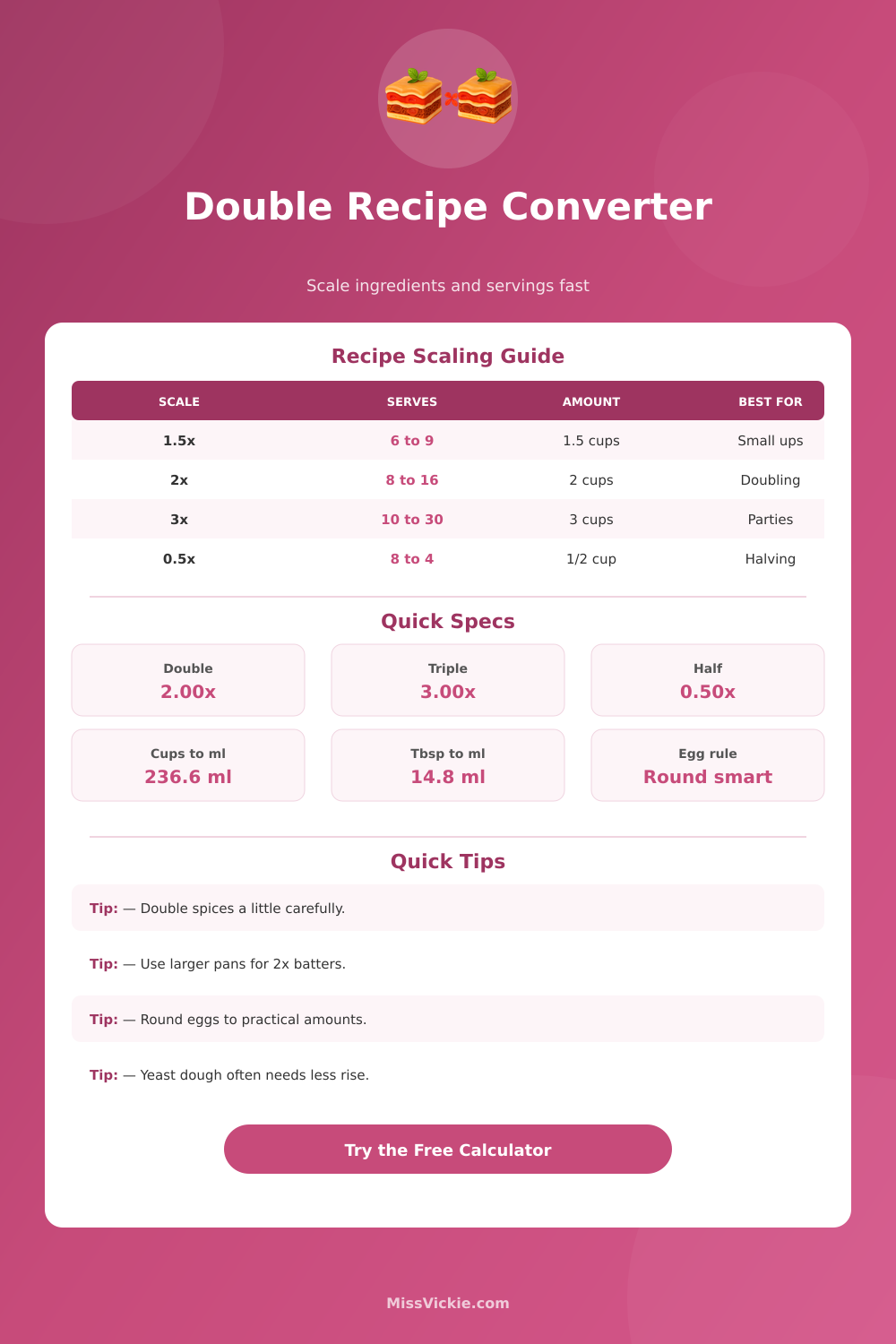
| Method | Multiplier | 8 Servings Becomes | Best Use |
|---|---|---|---|
| Half Batch | 0.50x | 4 servings | Test bakes and small households |
| One and a Half | 1.50x | 12 servings | Brunches and light gatherings |
| Double Batch | 2.00x | 16 servings | Most family parties and meal prep |
| Triple Batch | 3.00x | 24 servings | Potlucks and buffet trays |
| Ingredient Unit | Metric Equivalent | Practical Kitchen Note | Best For |
|---|---|---|---|
| 1 cup | 236.6 ml | Round to 240 ml when needed | Batters, soups, sauces |
| 1 tablespoon | 14.8 ml | 3 tsp makes 1 tbsp | Oil, vanilla, spices |
| 1 teaspoon | 4.9 ml | Use fractional spoons for precision | Salt, yeast, baking powder |
| 1 ounce | 28.3 g | Prefer grams for baking accuracy | Chocolate, butter, cheese |
| Recipe Type | Typical Yield/Serving | Time Change at 2x | Scaling Note |
|---|---|---|---|
| Cake or Cupcakes | 120 g | 8% to 12% | Use deeper pans or split batter |
| Cookie Dough | 45 g | 4% to 8% | Keep tray spacing consistent |
| Yeast Bread | 95 g | 5% to 10% | Do not double yeast exactly |
| Soup or Chili | 360 g | 12% to 18% | Use wider pots for faster heating |
| Original Pan | Usually Works for 2x | Volume Guide | Best Move |
|---|---|---|---|
| 8-inch round | 9x13 pan | About 2x batter | Level batter depth before baking |
| 8x8 square | 9x13 pan | Close to 2x area | Watch center doneness early |
| Loaf pan | 2 loaf pans | Split volume evenly | Better than one oversized loaf |
| 12-muffin tin | 24-cup batch | Two trays or two rounds | Bake in separate pans for lift |
Scaling a recipe means changing the quantity of the ingredient to accommodate for cooking for more people. Scaling a recipe requires more than simply multiplying each ingredient by the same number. While many people thinks that scaling a recipe is as simple as performing the math to determine the new quantity of each ingredient that is required, scaling a recipe also requires adjusting for the effect that scaling has upon the volume and cooking time of the recipe.
Additionally, if a recipe is scaled incorrectly, the texture or the flavor of the food may be affect. Liquids are the easiest to scale because liquids follow linear math. Thus, if an ingredient is a liquid, doubling the amount of that ingredient would require the use of twice as much of that liquid ingredient.
How to Change a Recipe for More People
However, solid ingredients does not always scale in the same way. For instance, flour may pack differently within larger amounts of a container, and leaveners like baking powder may provide too much lift if the cook doubles the amount of baking powder. Additionally, spices may taste too strongly if doubled.
Therefore, it is common for recipes to use only 1.5 times the amount of spices call for in the original recipe, and for cooks to taste the food during the cooking process to ensure that the flavor is to taste. The type of recipe that is to be scaled may indicate how the recipe should be scaled. For instance, pancake batter is a recipe that is easy to scale.
Pancake batter is thin, and it spreads easy, so doubling pancake batter does not create any issue with the even cooking of the pancakes. Yeast bread is a recipe that can be more difficult to scale. Bread contains the microbe that set off the rising of the bread.
Thus, less yeast should be used in a doubled recipe than would be calculated by simple mathematical scaling of the recipe. Casseroles may require a change in pan choice when the cook doubles the recipe. Casseroles require a certain depth of pan to properly cook the food in the center of the casserole; a deeper pan could result in undercooked food in the center of the casserole.
Finally, soups are a recipe that is easier to scale when using a wider pot to cook the pot. Pan choice is another important variable in scaling a recipe. For example, if a cake recipe is to be doubled, using one large pan may result in a cake that takes longer to cook than the original recipe.
Instead, using two identical pans for the doubled recipe will allow for the same cooking time as the original recipe. It is important to choose a pan that allows for even cooking of the food. If the depth of the food to be cooked is doubled, the food will steam instead of properly cook; if the food is too shallow in the pan, the edge may burn.
Another common practice is rounding the quantities of ingredients. For instance, decimals can be used in cooking to ensure accuracy in recipes that require precision in the amount of each ingredient. Rounding to the nearest whole ingredient or quarter ingredient may be used by other cook.
Rounding to the nearest quarter ingredient allows cooks to prepare the food more quickly than rounding to the nearest whole ingredient. Finally, eggs are another ingredient that is difficult to round; cooks may have to either round up to the next whole egg or round down to the previous whole egg. The recipe can be measured in imperial or metric measurement.
Metric measurements are often more accurate when scaling recipes. For example, using grams to measure an ingredient will provide more accurate results than using cups of that ingredient. The use of weights will ensure that a doubled recipe tastes the same as the original recipe.
Imperial measurements are based off volume; cups, tablespoons, and other unit of volume may be used. However, inaccuracies in these measurements can lead to incorrect results. Thus, using weights is a more accurate method that can be used to scale a recipe.
Time must also be adjusted when scaling a recipe. More food takes more time to cook. If the depth of the food in the pan is doubled, it will take more time for the heat to reach the center of the food.
Thus, more time should be allowed to cook the food. In cooking food of this type, it is important to ensure that the center of the food reaches the proper cooking temperature; this can be accomplished with a thermometer or a toothpick. Some common mistakes when scaling recipes include using too much salt and not changing the size of the pan.
If the cook doubles the amount of salt without tasting the food first, the food may end up too salty. Additionally, if the pan size is not changed when doubling the recipe, the food may either overflow from the pan or not cook to the center of the food. By following these step and adjusting for the pans, ingredients, and cooking times, cooks can successfully scale a recipe to produce food that will feed more person.