🍰 Baking conversions for real recipes
Baking Measurement Converter
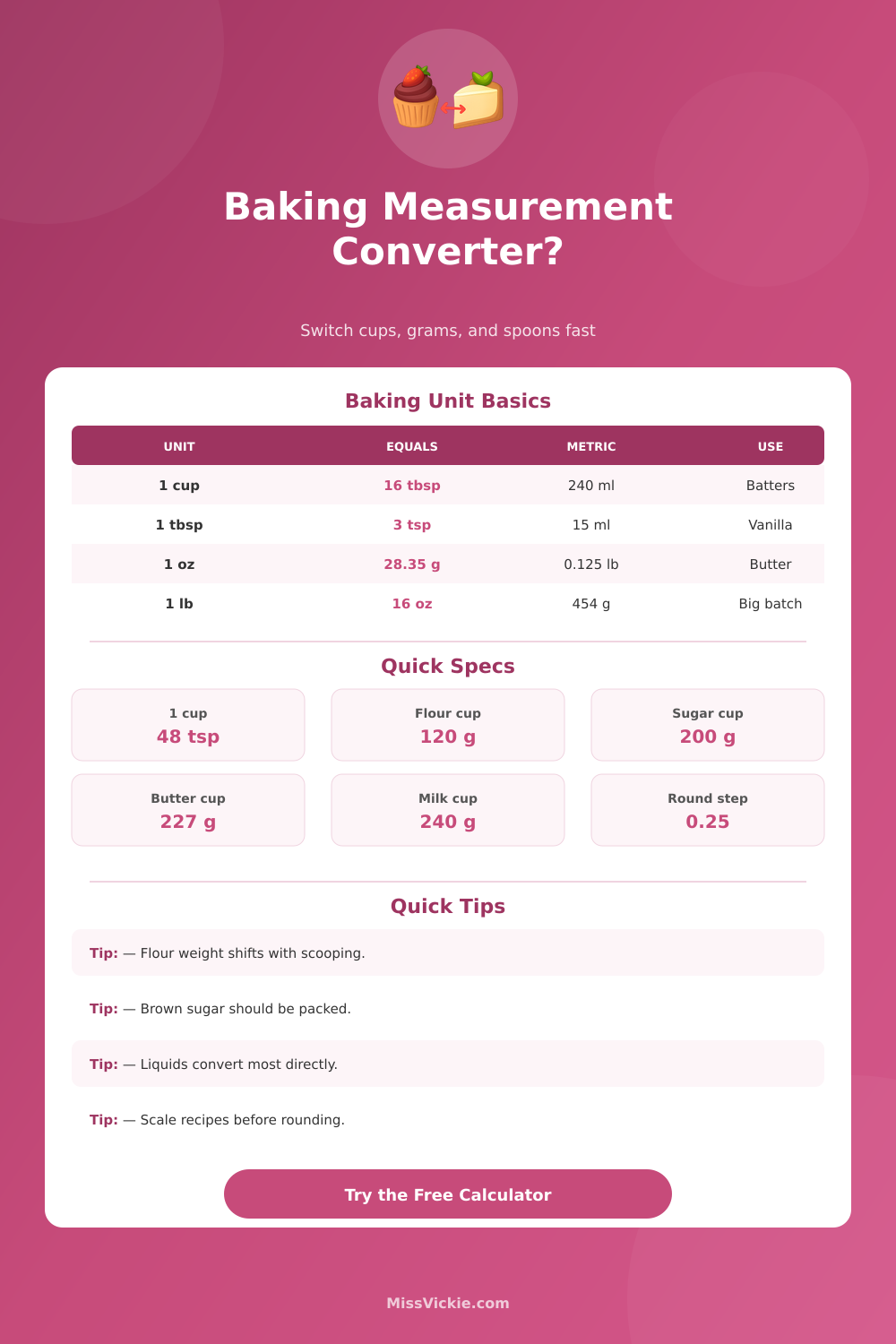
Convert cups, tablespoons, teaspoons, ounces, grams, and milliliters for flour, sugars, cocoa, butter, and liquids with packing adjustments and recipe scaling.
Cup weights vary by ingredient and fill method. This converter uses common U.S. baking references, then applies your packing style and scaling choices before rounding.
All-Purpose Flour
120 g
Best for cookies, muffins, and everyday batters.
Granulated Sugar
200 g
Stable for syrups, cakes, and standard sweet doughs.
Butter
227 g
Equals 2 sticks, useful for bars and frostings.
Milk or Water
240 g
Liquids stay closest to direct ml and gram swaps.
| Kitchen Unit | Teaspoons | Metric | Common Baking Use |
|---|---|---|---|
| 1 teaspoon | 1 tsp | 4.93 ml | Salt, baking powder, extracts |
| 1 tablespoon | 3 tsp | 14.79 ml | Vanilla, oil, cocoa additions |
| 1 fluid ounce | 6 tsp | 29.57 ml | Liquids and syrup measures |
| 1 cup | 48 tsp | 236.59 ml | Flour, sugar, milk, mix-ins |
| 1 pint | 96 tsp | 473.18 ml | Cream, fruit, larger batters |
| 1 quart | 192 tsp | 946.35 ml | Large prep and batch baking |
| Weight Unit | Grams | Imperial Match | Best Use |
|---|---|---|---|
| 1 gram | 1 g | 0.035 oz | Yeast, salt, precision baking |
| 1 ounce | 28.35 g | 0.0625 lb | Chocolate, butter, cream cheese |
| 4 ounces | 113.4 g | 0.25 lb | Half block butter or chocolate |
| 8 ounces | 226.8 g | 0.5 lb | One cup butter by weight |
| 1 pound | 453.59 g | 16 oz | Big doughs and production prep |
| Ingredient | Base Cup Weight | Style Notes | Best Conversion Cue |
|---|---|---|---|
| All-Purpose Flour | 120 g per cup | Spooned and leveled baseline | Scooped cups run heavier |
| Bread Flour | 130 g per cup | Higher protein, slightly denser | Useful for yeast dough math |
| Cake Flour | 115 g per cup | Lighter texture, softer crumb | Sifted cups weigh less |
| Granulated Sugar | 200 g per cup | Fairly stable between scoops | Weight scales cleanly |
| Brown Sugar | 220 g per cup | Packed measurement standard | Loose fill drops weight fast |
| Butter | 227 g per cup | Two U.S. sticks per cup | Great for sticks and ounces |
| Milk or Water | 240 g per cup | Near direct metric swap | 1 ml is about 1 g |
| Honey | 340 g per cup | Dense syrup with little air | Convert by weight when scaling |
| Recipe Need | Base Amount | Scaled Total | Helpful Output |
|---|---|---|---|
| Cookie dough | 2 cups flour | 3 cups at 1.5x | 360 g flour |
| Brownie pan | 0.75 cup cocoa | 1.5 cups doubled | 128 g cocoa |
| Buttercream | 1 cup butter | 2 cups doubled | 4 sticks butter |
| Quick bread | 1.25 cups sugar | 0.94 cup at 0.75x | 188 g sugar |
| Pancake mix | 1.5 cups milk | 4.5 cups for 3x | 1064 ml milk |
Baking require precise measurements because precise measurements will ensure that the chemical ratio are correct in the recipe. If you use incorrect measurements in your recipe, your baked goods will sink in the middle or spread to far on the baking tray. One reason that measurements may become incorrect is with the measurement of the amount of flour in an cup.
If you use a cup of flour scooped from the bag of flour, it will weigh more than a cup of flour spooned into the cup. Many recipes uses volume measurements to describe the amount of ingredients needed. Many others use weight measurements for the same purpose.
Weigh ingredients for better baking
Volume measurements are less accuratly because the density of ingredients can change. You must press brown sugar into the cup to enable the baked goods to contain the moisture that is necessary for the texture. You have to sift powdered sugar to allow the sugar to remain light and not clump together in the recipe.
For liquids like milk, 1 milliliter of milk weigh approximately 1 gram. Dry ingredients such as flour and sugar can have different densities when the dry ingredients are packed into the same amount of space. All-purpose flour can weigh differently when measured in different ways.
If you spoon all-purpose flour into the cup, one cup of flour will weigh 120 grams. If you scoop all-purpose flour into the cup from the flour bag, one cup will weigh 140 grams. The extra weight of the flour will make the baked goods tough.
The recipe has to account for the weight of the flour for the texture of the product to remain the same. Cocoa powder has a low density when measured, so it will clump together in the recipe. The measured amount of cocoa powder will change the density of the final product.
To scale a recipe, you have to change the amount of ingredients needed to make more or less of the same food. The proportion of the ingredients must remain the same. If you round the measurements of ingredients too early in the recipe, this will change the proportions of the ingredients and ruin the recipe.
First, convert the recipe to weight measurements. Then scale the amount of each ingredient needed before rounding the measurements to make it easier to measure the ingredients by hand. There are volume units that will allow you to bridge the gap between the different sizes of measurements.
For instance, 1 tablespoon is the same than 3 teaspoons. 16 tablespoons make up 1 cup. 1 cup is the same as 237 milliliters.
For the weight of ingredients that are more dense, 1 ounce is the same as 28 grams. 1 pound is the same as 454 grams. Weight measurements of ingredients are more accurate because the weight of ingredients wont change when they are packed into a cup.
Common mistakes in the kitchen can happen due to the way that ingredients are measured. If you scoop flour from the bag without spooning it into the cup first, you will add too much flour to your recipe. This will make your pancakes (or other baked good) more heavy to eat.
If you dont pack the brown sugar into the cup correctly, the brown sugar will not provide enough moisture to the batter. Using a kitchen scale to weigh the ingredients will help to avoid these mistakes. A kitchen scale will measure the ingredients mass.
It will not matter how tight you pack the ingredient into the cup. Environmental factor can play a big part in how the ingredients will behave in the recipe. For instance, if you live in an area that is at a high altitude from sea level, the flour will behave differently in your recipe.
If the environment that you live in is humid, the powder ingredients will pack more tightly into the measuring cup. These factors will change the density of ingredients in the recipe. In these cases, you should of adjusted the measurements of the ingredients according to the environment in which you are cooking.
Additionally, make sure that the tools that you use to measure your ingredients are accurate. Using a digital kitchen scale will ensure that you can measure each ingredient and have it be the same every time.