🍛 Curry portion planning
How Much Curry Per Person
Estimate finished curry volume, per-person portions, ladle counts, protein needs, and rice pairings for family dinners, buffets, curry bars, potlucks, and larger events.
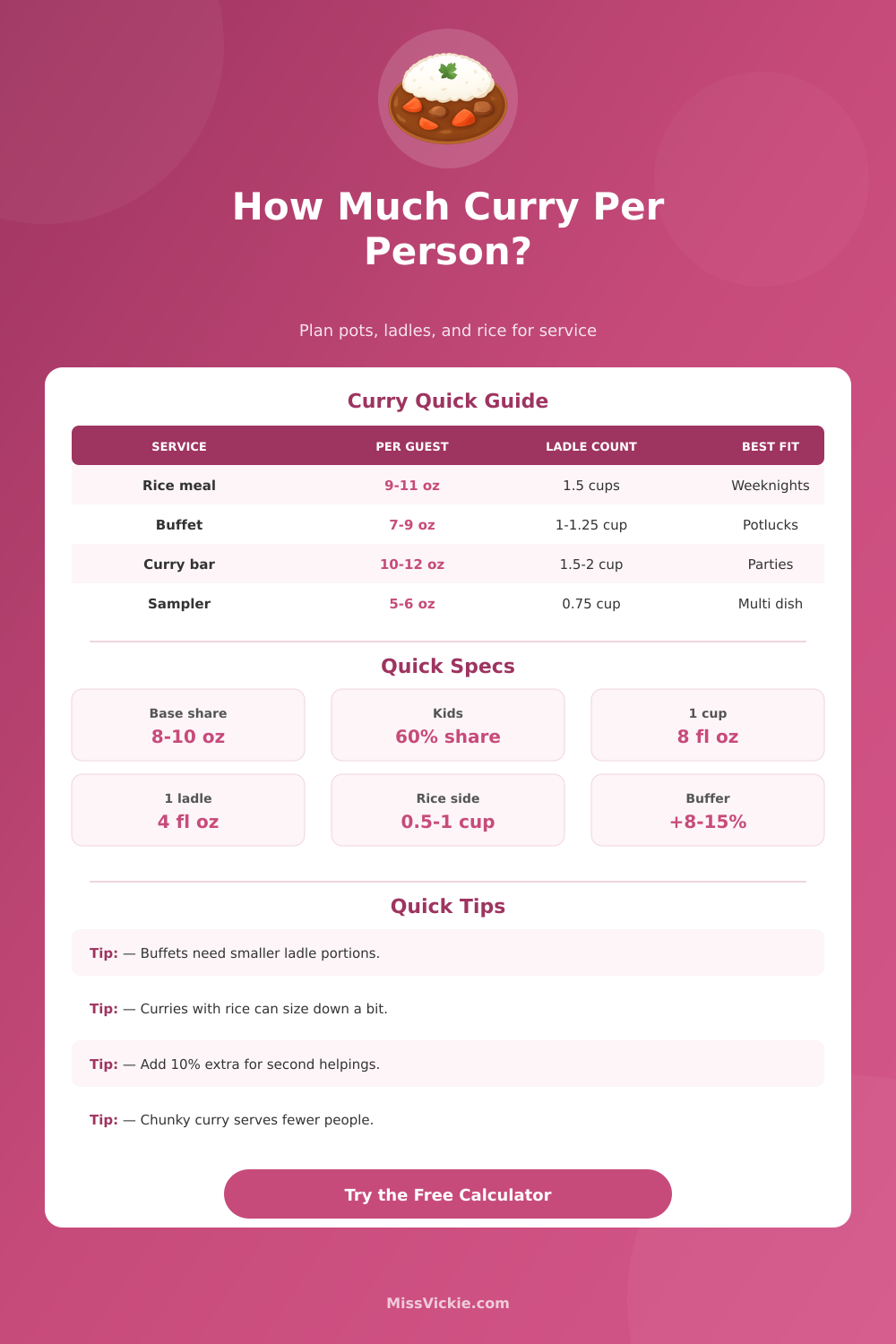
Main-course curry with rice usually lands near 8 to 10 ounces finished per adult. Buffets and sampler spreads run smaller, while curry-bar service and low-side meals need more.
5 to 6 oz
Best when curry is one option among several mains or trays.
7 to 9 oz
Works for self-serve pans with rice, salad, and appetizers.
9 to 10 oz
Standard plated dinner portion with a moderate scoop of rice.
10 to 12 oz
Plan larger portions when curry is the headline item.
| Service Style | Adult Portion | Kid Portion | Best Use |
|---|---|---|---|
| Main Curry with Rice | 8.5 to 9.5 oz | 5 to 6 oz | Weeknight dinners and family service |
| Curry with Naan or Roti | 9 to 10.5 oz | 5.5 to 6.5 oz | When bread replaces part of the rice |
| Buffet Line | 7 to 8.5 oz | 4 to 5 oz | Self-serve trays with multiple sides |
| Curry Bar or Station | 10 to 11.5 oz | 6 to 7 oz | Fewer sides and repeat trips expected |
| Sampler with Other Mains | 5 to 6 oz | 3 to 4 oz | Tasting spreads and combo menus |
| Party Pan Service | 8 to 9 oz | 5 to 5.5 oz | Casual gatherings and drop-in service |
| Curry Type | Protein or Main per Adult | Yield Factor | Notes |
|---|---|---|---|
| Chicken Curry | 4.2 oz cooked | 1.00x | Balanced sauce-to-meat ratio for most menus |
| Beef Curry | 4.6 oz cooked | 1.04x | Heavier pieces and rich gravy raise portions |
| Lamb Curry | 4.8 oz cooked | 1.06x | Richer curry that is usually served a bit fuller |
| Shrimp Curry | 4.0 oz cooked | 0.97x | Lighter protein, but sauce often stretches well |
| Vegetable Curry | 5.0 oz vegetables | 0.95x | Bulk comes from vegetables, potatoes, and sauce |
| Chickpea Curry | 4.8 oz cooked | 0.93x | Dense and filling, often needs less volume |
| Lentil Dal Curry | 4.6 oz cooked | 0.91x | Very filling and easy to stretch for crowds |
| Paneer Curry | 4.4 oz paneer | 0.98x | Rich cubes with moderate sauce coverage |
| Guests | Buffet Curry | Rice Dinner | Curry Bar |
|---|---|---|---|
| 8 | 3.8 to 4.5 lb | 4.5 to 5 lb | 5 to 6 lb |
| 16 | 7.5 to 9 lb | 9 to 10 lb | 10 to 12 lb |
| 25 | 12 to 14 lb | 14 to 16 lb | 16 to 19 lb |
| 40 | 19 to 23 lb | 23 to 26 lb | 26 to 31 lb |
| Measure | Volume | Finished Curry Weight | Planning Note |
|---|---|---|---|
| 1 ladle | 4 fl oz | About 4.4 oz | Useful for buffet and catering service |
| 1 cup | 8 fl oz | About 8.8 oz | Close to a standard plated portion |
| Half hotel pan | 6 qt filled | About 13.2 lb | Roughly 22 to 24 rice-dinner portions |
| Full hotel pan | 12 qt filled | About 26.4 lb | Roughly 44 to 48 rice-dinner portions |
| Rice side | 0.75 cup | About 5.5 oz cooked | Common partner portion for one curry serving |
When calculating an amount of curry that is needed for a group of individuals, there are several different factor that must be considered. The first of these factors is the style in which the curry is to be served. If the cook serves the curry to individuals who have small appetite, or who are serving dish alongside the curry, then fewer portion of curry will be needed.
However, if the curry is to be served in a buffet-style, the portion of curry will need to be different then if the curry were to be served in a curry bar. In each case, though, the standard portion size for curry is eight to ten ounce of finished curry per adult to serve alongside rice. This portion size is enough for an adult to eat and enough to coat the rice without making the rice too wetly.
How Much Curry to Make for a Group
A meal that includes other sides to the curry, like yogurt or pickles, may require less curry than a meal that includes only curry and rice. A buffet style may require different portions than a curry bar, though; individuals take smaller portions of food at the beginning of a buffet but tend to take larger portions of food after the middle of a buffet. Therefore, if the cook serves the curry as a curry bar, larger portion will be needed because guests will be expected to take large portions of the curry themselfs.
In addition to the concept of appetite, the number of children that will be eating the curry will change the amount of curry that is needed. Children tend to eat about sixty percent of the portion of curry that are consumed by an adult. The appetite levels of the individuals that will be served the curry may also change the amount of curry that is needed.
For instance, a group of individuals that are having a casual summer gathering may have different appetite than a group of individuals that is attending an event that includes high levels of physical activity. Additionally, the types of sides that are served with the curry will also alter the portion size of the curry that are served. For instance, if curries are served with additional vegetable or salads, fewer portions of curry will be needed.
Conversely, if sides of rice or naan bread are served with the curry, the portions of curry may be adjusted accordingly. The type of curry that is to be prepared will also influence the amount of curry that need to be prepared. Chicken curries are easy to portion because the protein will balance with the sauce.
Lamb and beef curries, though, may require more weight of curry to be prepared because the pieces of meat are larger than the portions of curry. Vegetable and lentil curries may also require different portions because these ingredients tend to fill the individuals up more than the other type of curries. Additionally, the thickness of the curry sauce also plays an important role in determining how many individual can be served.
Thin sauces will allow for the sauce to flow easy over the rice, while thick sauces will adhere to the plate. Thus, a curry that is thin will serve more individual than a thick curry sauce. A four-ounce ladle is the standard tool for serving curry to an adult at a buffet.
A cup, though, is the standard tool for serving curry as part of a dinner that is plated for each individual. Hotel pans can also be used to prepare curry for large group of people. A half-pan can prepare enough curry for twenty portions of rice, and a full pan can prepare enough curry for forty portion of rice.
Additionally, it is recommended that an extra ten to fifteen percent of curry is prepared in case some of the guest would like seconds. By preparing an extra ten to fifteen percent of curry, the curry chef will ensure that there is enough curry for all of the guest and that there is no shortage of curry. For protein, four ounces of cooked meat is provided for each adult.
For rice, half a cup to one cup of cooked rice is provided for each person. Less rice is needed for children. If the curry restaurant is planning a curry bar for thirty people, then there will be larger scoops of curry for these individuals and fewer side dish will be provided.
For a tasting event, though, the portions of each curry will be smaller. The concept of scaling the food for each number of guests is linear. For instance, for eight guests, four pounds of food may be needed to prepare a rice dinner.
However, the amount of food may need to be doubled for a buffet style meal. For forty guests at a buffet, though, the chef may need to prepare more than twenty pound of food. Additionally, rice will multiply when cooked.
For eight guests, six cups of rice can be prepared. This rice quantity can also be scaled according to the number of guests. Thus, by understanding how the different variables relate to the amount of curry that should of been prepared, the curry chef will be able to prepare the correct amount of curry for any event.