🥯 Bagel crowd planning
How Many Bagels Per Person
Plan bagel counts, per-person shares, dozens to order, total baked weight, and cream cheese tubs for office breakfasts, brunch buffets, sandwich bars, kids tables, and hotel spreads.
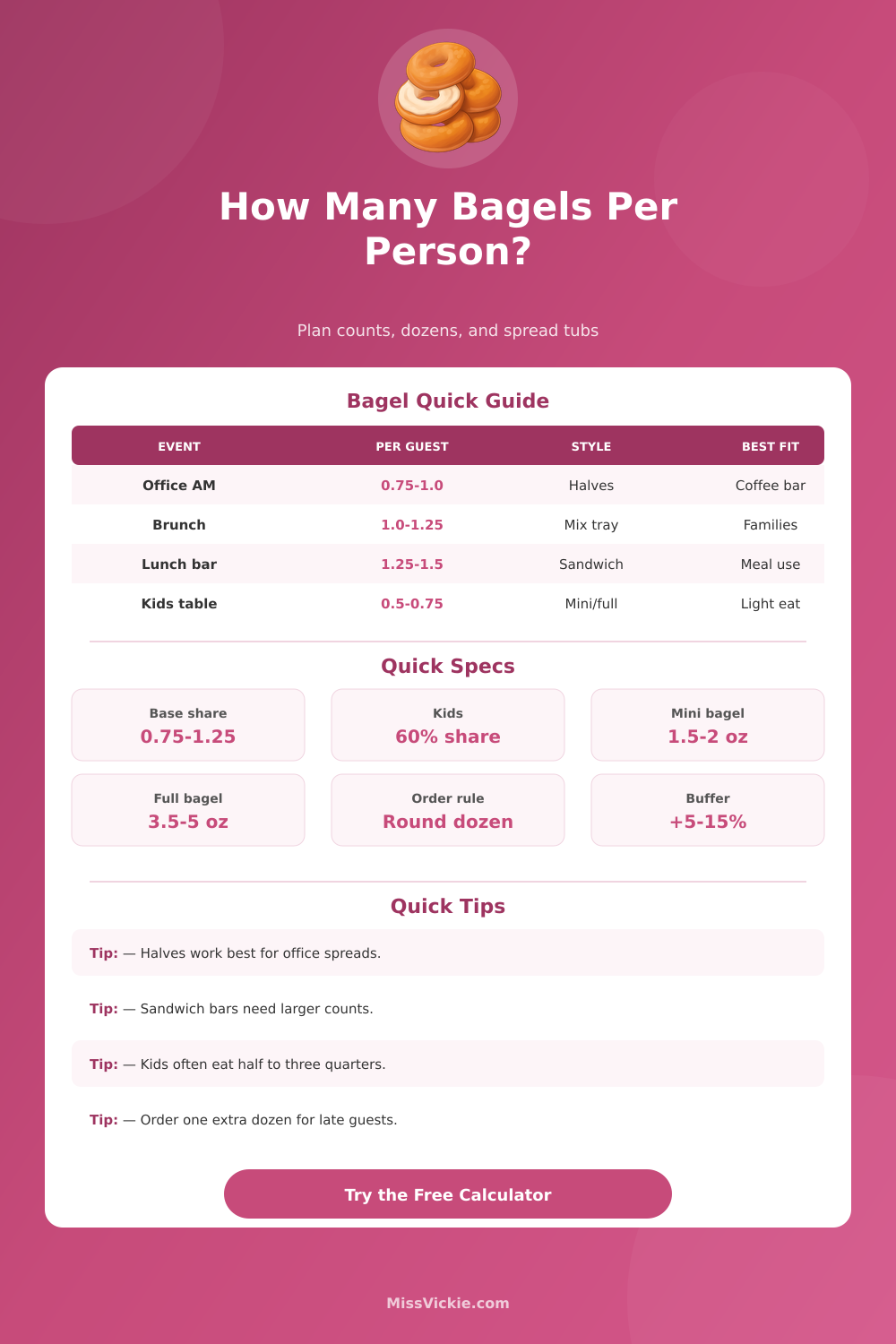
Most breakfast spreads average 0.75 to 1.0 bagel per guest. Sandwich bars, long meetings, and lighter menus often need 1.25 or more per person.
Office Tray
0.75-1.0
Halved bagels move fastest with coffee and fruit nearby.
Brunch Buffet
1.0-1.25
Mixed flavors and cream cheese tubs support steady grazing.
Sandwich Bar
1.25-1.5
Filled bagels become the meal, so counts climb quickly.
Kids Table
0.5-0.75
Mini or quartered bagels limit waste and simplify serving.
| Event | Adult Portion | Kid Portion | Best Use |
|---|---|---|---|
| Office Breakfast | 0.8 to 1.0 bagel | 0.5 to 0.6 bagel | Coffee service, fruit, yogurt cups |
| Brunch Buffet | 1.0 to 1.25 bagels | 0.6 to 0.8 bagel | Buffet with eggs, fruit, pastries |
| Sandwich Lunch Bar | 1.25 to 1.5 bagels | 0.8 to 1.0 bagel | Bagels used as the main entree |
| Kids Table | 0.75 bagel | 0.5 bagel | Quartered or mini bagels with simple spreads |
| Bagel Type | Average Weight | Calories Each | Best Fit |
|---|---|---|---|
| Mini | 1.8 oz / 51 g | 120 | Kids trays, tasting boards, meetings |
| Plain Standard | 3.5 oz / 99 g | 265 | Balanced default for most bagel bars |
| Everything | 4.0 oz / 113 g | 290 | Popular mixed trays and savory spreads |
| Asiago | 4.3 oz / 122 g | 320 | Heavier brunches and rich toppings |
| Guests | Light Spread | Standard Buffet | Meal-Level Bar |
|---|---|---|---|
| 8 | 6 to 7 bagels | 8 to 10 bagels | 10 to 12 bagels |
| 16 | 12 to 14 bagels | 16 to 20 bagels | 22 to 24 bagels |
| 24 | 18 to 20 bagels | 24 to 30 bagels | 32 to 36 bagels |
| 40 | 30 to 34 bagels | 40 to 48 bagels | 52 to 60 bagels |
| Spread Setup | Bagels Per 8 oz Tub | Typical Portion | Planning Note |
|---|---|---|---|
| Butter and Jam | 18 to 20 halves | 0.4 oz each | Use less when fruit and pastries are present |
| Classic Cream Cheese | 8 to 10 full bagels | 0.8 oz each | Most common breakfast baseline |
| Loaded Toppings | 6 to 8 full bagels | 1.1 oz each | Lox, capers, tomato, and cucumber increase use |
| Meal Fillings | 5 to 6 sandwiches | 1.4 oz each | Filled bagels act like entree sandwiches |
When planning a bagel service for a group, it is essential to calculate the number of bagels you need to ensure that each person in the group have enough food. Planning a bagel service require you to consider the headcount of the groups, the appetite of the group, and the type of event you are throwing. If you do not consider the appetite of the group when planning the bagel service for them, you run the risk of either not having enough bagel for each person in the group or providing to many bagels such that there are left overs.
The type of event you are having will dictate how many bagel each person in the group will consume. For instance, if the group will hold the bagel service after a long night of work, each person may only eat half of bagel. However, if the event is a brunch, each person may consume a whole bagels.
How Many Bagels to Order for a Group
Additionally, if the group include children, you will have to adjust your calculation of the number of bagels the group will consume. In this case, calculate the number of children as sixty percent of an adult’s portion of bagel. If you serve bagel halves, the group will consume the bagels more quick than if you serve whole bagels.
People will likely require more time to slice the whole bagels into halves. Lastly, if you serve mini bagel or quartered bagels, there will be less food waste from the group. This is especially beneficial if the group includes young children who cannot eat large portion of whole bagels.
If you serve bagels in sandwich, you will need to provide more bagels because a bagel sandwich constitute a full meal for each person. If you serve plain bagels, more people will likely consume the bagels because there are no toppings to avoid. Savory bagels such as everything and sesame bagels will likely be eaten quick by the group.
However, the group may consume sweet bagels such as cinnamon raisin bagels more slow. Additionally, heavier bagels like asiago bagels may be consumed in smaller portion by each individual because these bagels contain more fillings than plain bagels. To prepare the bagels, you will need to provide spreads for the bagels.
The rule of thumb is to provide one tub of cream cheese for every eight to ten bagels. If bagel toppings such as lox and caper are included in the spread packages, people will consume more cream cheese. This is because when individuals add toppings to there bagels, they use more cream cheese.
Additionally, you can provide both butter and jam as spread option for the bagels. To ensure the group has enough food to eat, you should provide a buffer of bagels for them. A bagel buffer is an extra portion of bagels that is provided for latecomers to the event or for those who would like to eat more than one bagel.
Provide an extra five to fifteen percent of bagels as a buffer for the group. Finally, always round the total number of bagels that you calculate for the group to the nearest dozen. This is because bagels is typically sold by the dozen at the bakery.
To avoid mistake when planning a bagel service for a group, you should follow the following steps. First, do not order too many different flavors of bagels for the group. This may result in many bagels that are not consume by the group.
Second, do not underestimate the appetite of the group. If you underestimate the appetite, there will be no bagels left for the group. Third, if you are providing bagels for a large group of people, calculate the total weight of the bagels to ensure that the delivery service can deliver the order to the group.
By following these steps, you can ensure that the bagel service you provide for the group will meet their need.