🍰 Dessert portion planning
How Much Dessert Per Person
Estimate total dessert, per-person portions, piece counts, tray batches, and plated servings for birthdays, showers, weddings, buffets, office parties, and holiday dinners.
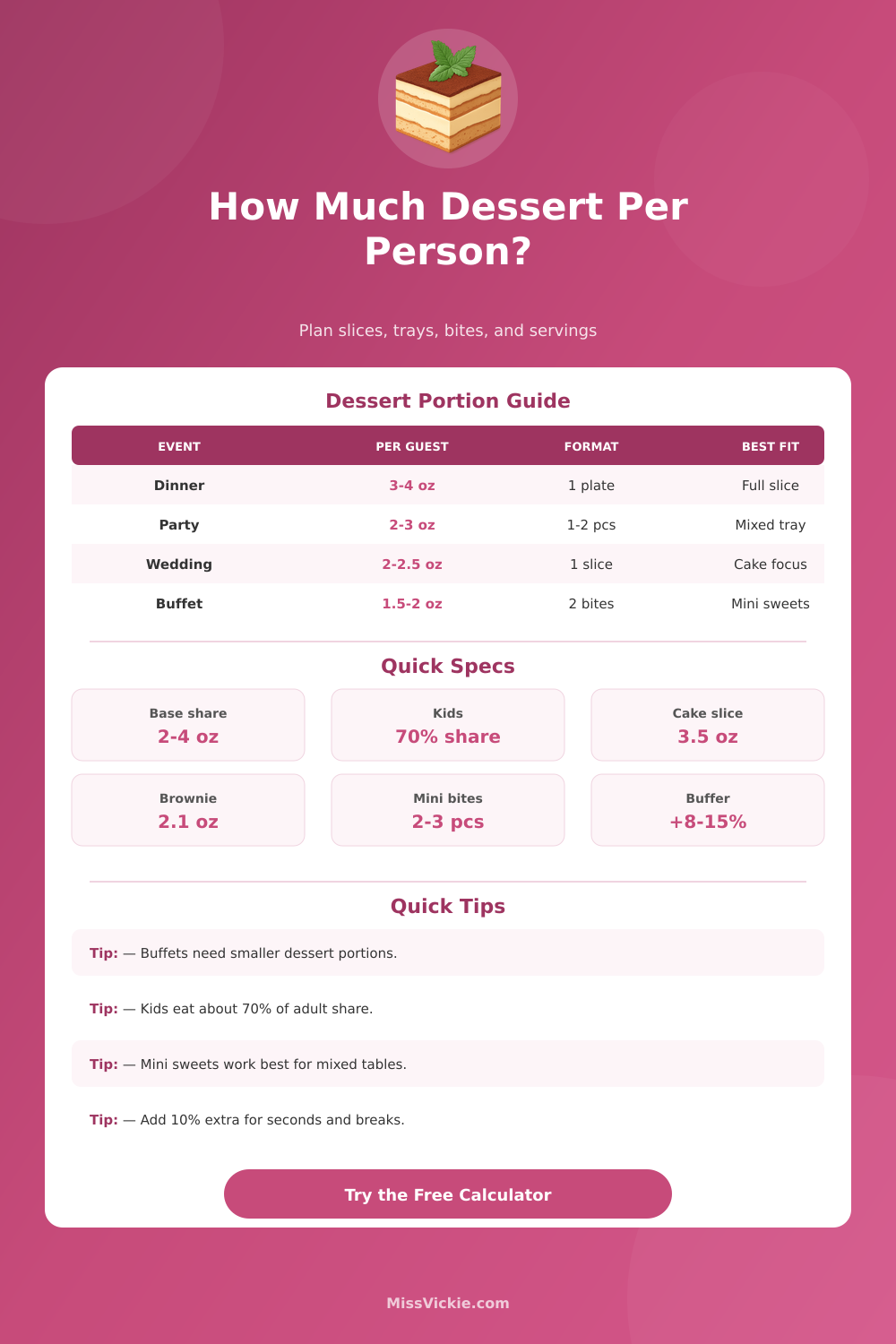
Most plated desserts land near 3 to 4 ounces per guest, while dessert buffets and mixed sweet tables work better around 1.5 to 2.5 ounces per person.
Plated
3 to 4 oz
Best for one featured dessert after a seated meal.
Buffet
2 to 3 oz
Works when guests can sample more than one sweet.
Mini Sweets
2 to 3 pcs
Ideal for showers, receptions, and walk-up tables.
Coffee Table
2 to 2.5 oz
Smaller portions pair well with coffee or tea service.
| Event | Adult Portion | Kid Portion | Best Fit |
|---|---|---|---|
| Plated Dinner | 3.2 to 3.8 oz | 2.2 to 2.7 oz | One full dessert after a meal |
| Birthday Party | 2.8 to 3.4 oz | 2.0 to 2.4 oz | Cake slice with drinks and snacks |
| Wedding Reception | 2.2 to 2.7 oz | 1.6 to 1.9 oz | Wedding cake with another sweet option |
| Dessert Buffet | 1.7 to 2.4 oz | 1.2 to 1.7 oz | Mini tasting portions and variety |
| Dessert Type | Serving Weight | Typical Yield | Best Service |
|---|---|---|---|
| Layer Cake | 3.5 oz slice | 12 slices per cake | Birthdays and plated dinners |
| Cheesecake | 4.0 oz slice | 14 slices per cake | Upscale dessert tables |
| Brownie Tray | 2.1 oz square | 24 squares per tray | Buffets and office parties |
| Cookies | 1.3 oz cookie | 36 cookies per batch | Grab and go tables |
| Guests | Featured Dessert | Mixed Dessert Table | Mini Sweets Table |
|---|---|---|---|
| 10 | 32 to 36 oz | 24 to 28 oz | 20 to 24 bites |
| 25 | 80 to 92 oz | 58 to 70 oz | 50 to 65 bites |
| 40 | 128 to 144 oz | 94 to 110 oz | 80 to 104 bites |
| 75 | 240 to 270 oz | 176 to 205 oz | 150 to 195 bites |
| Dessert | Base Factor | Tray or Batch Weight | Notes |
|---|---|---|---|
| Layer Cake | 1.00x | 42 oz cake | Classic full slice dessert |
| Cheesecake | 1.10x | 56 oz cake | Rich dessert, smaller slice works |
| Cupcakes | 0.95x | 42 oz per 24 | Easy one each planning |
| Fruit Crisp | 1.05x | 48 oz pan | Spoon portions for buffets |
When planning a dessert for a group of people, it is essential to calculate the portion sizes for the desserts. Calculating the portion sizes of the desserts are necessary because incorrect portion sizes will either fail to provide dessert for the guest or provide excess dessert that remains uneaten by the guests. If there is to little dessert for the guests, the guests will desire more dessert.
However, if you provide too much dessert for the guests, it is likely that the dessert will be left over. The type of event that will take place will dictate how much dessert to provide for each guest. For example, if the cook is to plate and serve the dessert following a heavy meal, the portion size should be smaller for each guest since the heavy meal will fill each guest.
How Much Dessert to Serve Each Guest
If the meal is heavy, the appetite for dessert will be smaller. In the case of a dessert buffet, the portion sizes need to be calculate differently. With a buffet dessert style, portions should be smaller to allow each guest to sample at multiple dessert without becoming overly full.
The age of the guests will play a role in determining the amount of dessert to provide for each guest. Younger guests will require less dessert then the adults. The younger children will eat approximately seventy percent of the amount of dessert that an adult will consume.
Additionally, the guests may all have a high sweet preference. Thus, the guests that have a high sweet preference will eat more of the dessert than those with a low sweet preference. The type of dessert that will be provided will also play a role in the calculation of the dessert portions.
If the dessert is a layer cake, the dessert is dense, and it can be sliced into large portions to provide for a large gathering of guests. Brownies and cookies is also a dense dessert and will stay satisfied with smaller portions. Cheesecake is rich in flavor and calories, so the portions of cheesecake need to be smaller.
Fruit crisps are a lighter dessert and are appropriate for the dessert to be provided after the meal. The type of meal that will be consumed prior to the dessert will also impact the amount of dessert that each guest will consume. If the meal that is consumed prior to dessert is a light meal, such as a salad, the guests will eat more of the dessert.
If the meal consumed before dessert is a heavy meal like roast meat, the guests will eat less of the dessert because their stomachs will be full. If the dessert is the main meal of the event, then there will need to be extra dessert provided. It is essential to provide a buffer dessert portion when serving dessert to the guests.
A percent buffer of around ten percent is good for the portion of dessert to provide because this will accommodate for those who would like to eat more dessert, or those who will skip the main meal to eat more dessert. By providing a buffer dessert portion, you wont find yourself in a position of having to purchase more dessert after the event, and you will also be able to control the amount of dessert that is left over after the guests have finished eating. The dessert service style will also determine the portion sizes of the dessert.
For example, plated dessert portions work well with providing three to four ounce of dessert for each guest. For a dessert buffet, two to three ounce of dessert will be provided for each guest. Mini sweet assortments work well when the guests are mingling and socializing at the event.
In this case, two to three small portions of dessert can be provided for each guest. The number of guests will play a role in the amount of dessert to be prepared. If there are ten guests, it is possible to calculate the amount of ounces of cake needed to provide each guest with a portion.
With seventy-five guests, the dessert weight will need to be calculated in pounds instead of ounces. If the baker will prepare the desserts in trays, it is also necessary to know the yield of each tray of dessert. This will allow the host to calculate the number of pans of dessert to be baked.
By considering the type of meal to be served, the type of dessert, and the service style for the dessert, the host can calculate the portion sizes of the dessert to each guest.