🍴 Heavy Hors d’Oeuvres Per Person Calculator
Plan the perfect party spread — get accurate piece counts for any event type and guest count
2 Hours
3 Hours
1–1.5 Hrs
4+ Hours
Hour Added
Crowd Adj.
Types Ideal
Alternatives
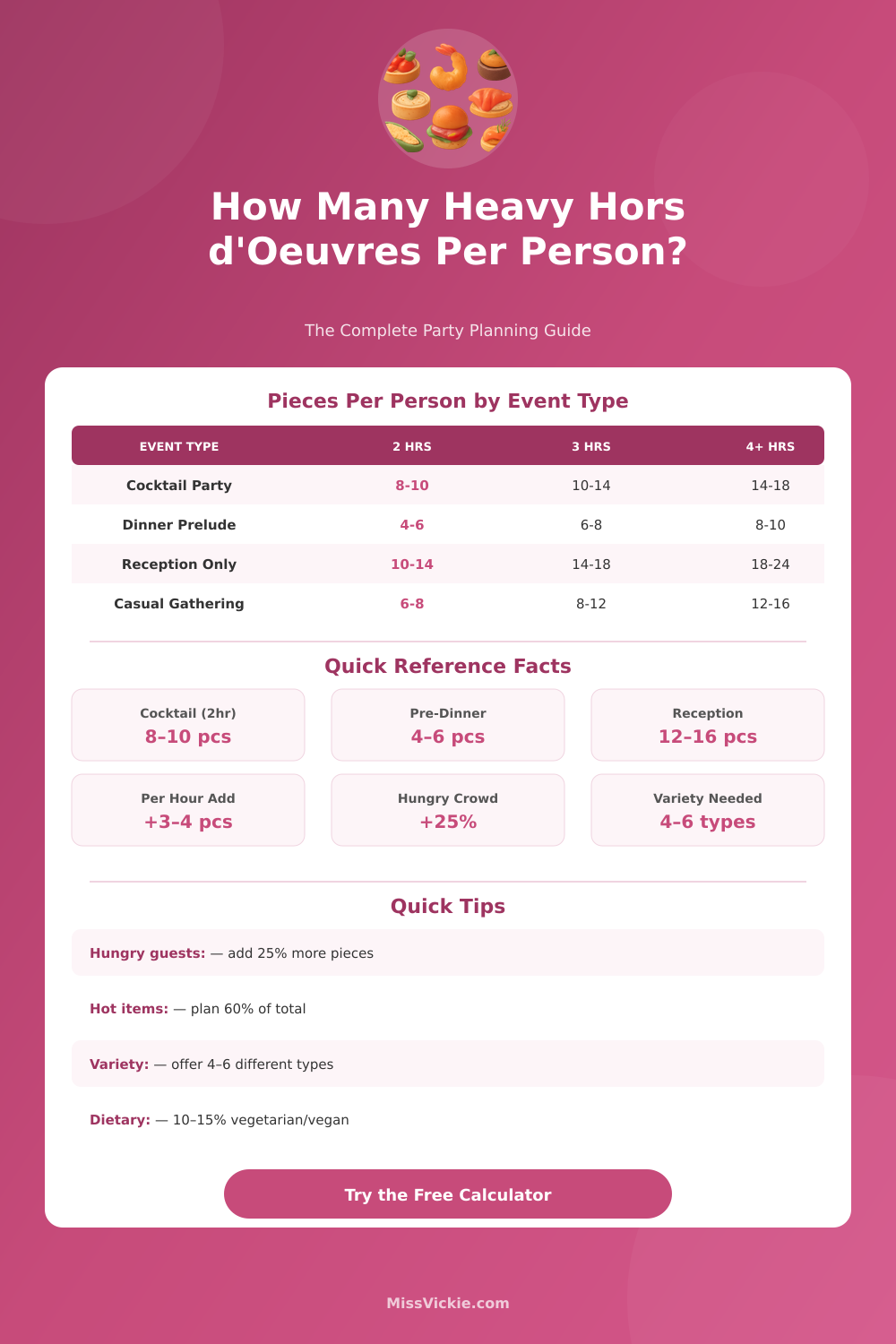
| Event Type | 1–1.5 hrs | 2 hrs | 3 hrs | 4+ hrs |
|---|---|---|---|---|
| Cocktail Party | 5–7 | 8–10 | 11–14 | 15–18 |
| Wedding Reception | 6–8 | 10–12 | 14–16 | 18–22 |
| Pre-Dinner Appetizers | 4–6 | 5–7 | 7–9 | N/A |
| Casual Gathering | 5–7 | 7–9 | 9–12 | 13–16 |
| Open House | 4–6 | 8–10 | 12–15 | 16–20 |
| Corporate Event | 5–7 | 7–9 | 10–12 | 13–16 |
| Holiday Party | 6–8 | 9–11 | 12–15 | 16–20 |
| Appetite Level | Multiplier | When to Use | Example Scenario |
|---|---|---|---|
| Light | × 0.80 | Post-meal snacking, diet-conscious | After-dinner gathering |
| Medium (Standard) | × 1.00 | Typical mixed crowd | Standard cocktail party |
| Hungry | × 1.25 | No other food served, late event | Cocktails replacing dinner |
| Guest Count | Varieties Recommended | Pieces Per Variety | Planning Note |
|---|---|---|---|
| Under 15 | 3–4 | 4–5 per guest | Intimate; fewer types fine |
| 15–30 | 4–5 | 2–4 per guest | Balanced assortment works |
| 31–60 | 5–6 | 2–3 per guest | Good variety expected |
| 61–100 | 6–8 | 2 per guest | Mix hot/cold/dietary |
| 100+ | 8–10+ | 1–2 per guest | Station-style service ideal |
| Split Ratio | Hot Pieces (per 10 total) | Cold Pieces (per 10 total) | Best For |
|---|---|---|---|
| All Hot | 10 | 0 | Winter events, comfort food focus |
| 70% Hot / 30% Cold | 7 | 3 | Cold weather, heartier crowd |
| 60% Hot / 40% Cold | 6 | 4 | Most events (recommended default) |
| 50% Hot / 50% Cold | 5 | 5 | Balanced, mild weather events |
| 30% Hot / 70% Cold | 3 | 7 | Summer parties, outdoor events |
| All Cold | 0 | 10 | Outdoor summer, limited kitchen access |
Heavy hors d’oeuvres contain a significant amount of calories, proteins, and carbohydrate. Since heavy hors d’oeuvres has more nutrients than light hors d’oeuvres, a person will feel full after eating fewer pieces of heavy hors d’oeuvres. In order to plan for the number of heavy hors d’oeuvres that will be needed for an event, one must plan for the number of pieces of heavy hors d’oeuvres that will be prepare.
If one does not plan for the quantity of heavy hors d’oeuvres that will be prepared, then either money will be waste due to the presence of leftover heavy hors d’oeuvres, or there will not be enough food to eat for all of the guests that show up to the event. The number of heavy hors d’oeuvres that must be provided to the guests at an event will depend upon the type of event that is to occur and the length of that event. For example, if the type of event that is to be held is a cocktail party (where no dinner will be served), then the host will have to provide more heavy hors d’oeuvres than if the type of event is a pre dinner reception.
How Many Heavy Hors d’Oeuvres to Serve at an Event
Additionally, the longer that the event is to last, the more heavy hors d’oeuvres that will be needed, since the appetites of guest will increase with the increase in the length of the event. The appetite levels of the guests will impact the number of heavy hors d’oeuvres that are consume at the event. For example, some guests may be light eaters, indicating that they will consume fewer pieces of heavy hors d’oeuvres than others that are known to be hungry eaters.
Additionally, the type of event that is to be held will impact the appetite level of the guests, as well. For example, guests may arrive at an event that is to have heavy hors d’oeuvres after having consume a heavy meal for lunch. In this case, the appetite levels of the guests may be lower than if the guests were to arrive at the event while they is hungry.
The number of guests that will attend the event will impact the number of varieties of heavy hors d’oeuvres that should be provided. For instance, if the number of guests that will come to an event is a small number (fewer than fifteen guests), then three or four variety of heavy hors d’oeuvres should be provided. In contrast, if the number of guests that will come to an event is a large number (more than sixty guests), six or more varieties of heavy hors d’oeuvres should be prepared.
The reason for providing more varieties of heavy hors d’oeuvres for a large number of guests is to provide varieties for those who are picky eater, as well as to avoid having any of the varieties of hors d’oeuvres dissapear too quick during the event. Another factor that must be considered before preparing heavy hors d’oeuvres for an event is the balance that will be created between the number of hot varieties and the number of cold varieties of heavy hors d’oeuvres. Hot varieties of heavy hors d’oeuvres (such as bacon wrapped dates) are among the most popular of the hors d’oeuvres varieties, and typically account for sixty percent of the total number of pieces of hors d’oeuvres that is prepared.
Cold varieties of hors d’oeuvres are also necessary, however, because they do not have to be reheated while the guests are at the event. If the event is to occur outdoors during the summer, more cold varieties of heavy hors d’oeuvres should be prepared. Additionally, ten to fifteen percent of the guests may have dietary needs (such as being vegan or having gluten-free diets), so heavy hors d’oeuvres that meet these requirements should be prepared.
The type of event that is to be held will impact the number of heavy hors d’oeuvres that must be prepared. For example, an open house may have guests that arrive at different times, which may impact the need to prepare heavy hors d’oeuvres for only seventy percent of the guests that are to attend the event. Additionally, it is recommended that ten to twenty percent of the amount of food that is prepared is made into a buffer for the hors d’oeuvres that are to be prepared.
Such a buffer acts as a protective amount of food that is prepared in case some of the hors d’oeuvres are spill or if the guests consume more of the hors d’oeuvres than was expected. The method in which the hors d’oeuvres are to be served will also impact the amount of food that will be consumed by the guests. For example, if the servers bring the hors d’oeuvres to the guests on passed trays, the guests will consume twenty to thirty percent more of the hors d’oeuvres than they would have consumed if they were to be served on a buffet style table.
Therefore, if this method of service is chosen, extra hors d’oeuvres should be prepared. Additionally, if alcohol will be served at the event, the guests will consume more of the hors d’oeuvres due to the effect of alcohol on the bodies. Another factor to consider in preparing heavy hors d’oeuvres is the variety and cost of the hors d’oeuvres that are to be prepared.
Four to six varieties of heavy hors d’oeuvres is the ideal number to prepare, as providing only one variety of hors d’oeuvres may lead some guest to consume too much of that hors d’oeuvre. Additionally, the cost of the hors d’oeuvres may differ depending on whether the hors d’oeuvres are hot or cold. Hot hors d’oeuvres will cost more due to the labor that is required to prepare them.
By calculating the number of pieces of hors d’oeuvres that should be prepared for each guest, and by considering each of these factors, it is possible to ensure that there will be enough hors d’oeuvres to provide each guest with an enjoyable evening.