🍖 Pork Chops Per Person Calculator
Calculate exactly how many pork chops you need for any group size
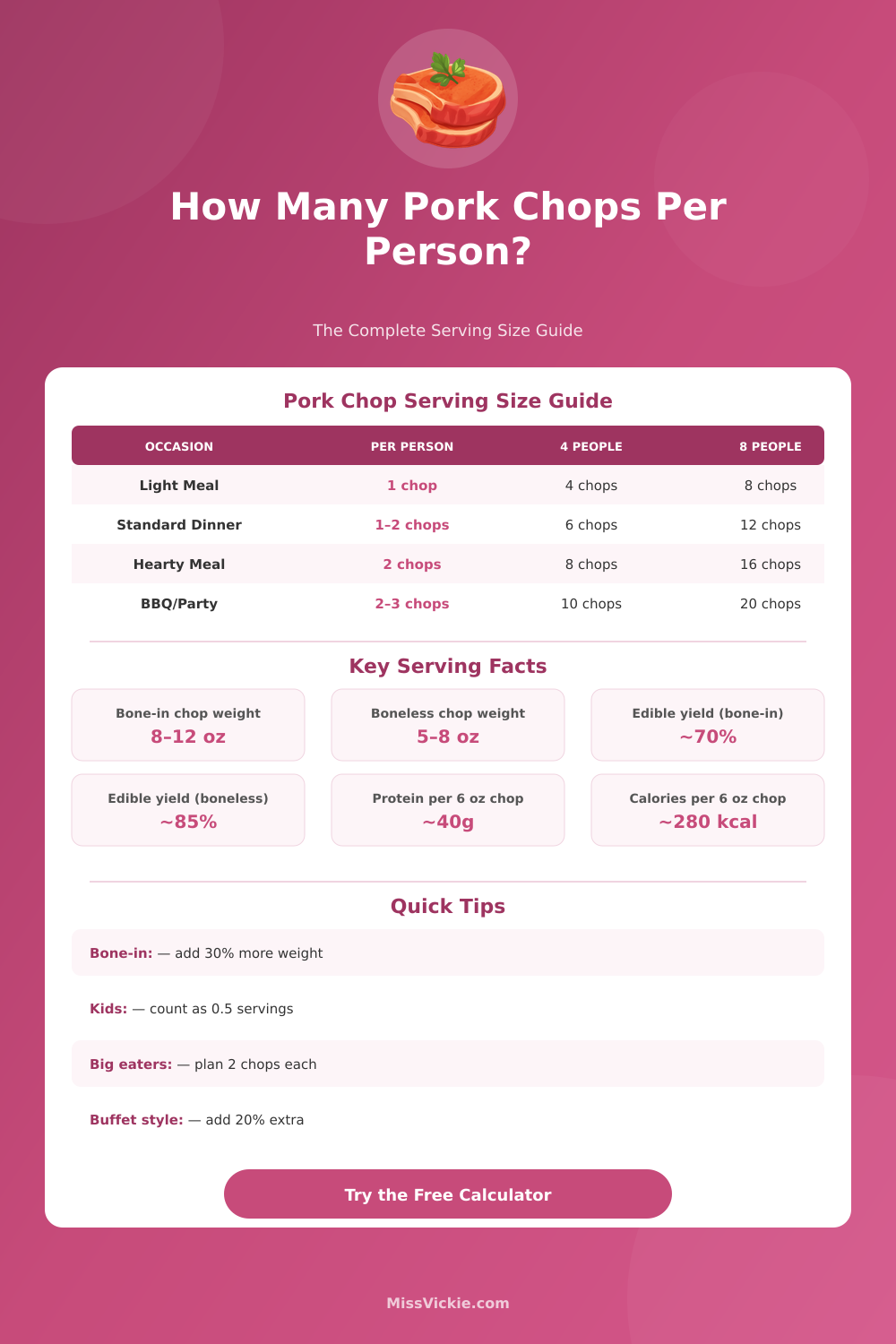
| Occasion | Chops Per Person | Raw Weight/Person | Notes |
|---|---|---|---|
| Light Lunch | 1 thin chop | 3–5 oz (85–140g) | Served with heavy sides |
| Standard Dinner | 1–2 chops | 6–10 oz (170–280g) | Most common serving |
| Hearty Meal | 2 chops | 10–16 oz (280–450g) | Big appetites / athletes |
| BBQ / Cookout | 2–3 chops | 12–20 oz (340–570g) | Outdoor eating — people eat more |
| Kids (under 12) | 0.5–1 chop | 3–5 oz (85–140g) | Half adult portion |
| Buffet Style | 1.5 chops avg | 8–12 oz (225–340g) | Add 20% extra for variety |
| Type | Raw Weight | Edible Yield | Cooked Weight |
|---|---|---|---|
| Thin-Cut Boneless | 3–5 oz (85–140g) | ~85% | 2.5–4 oz (70–113g) |
| Standard Boneless | 5–8 oz (140–225g) | ~85% | 4–6.5 oz (113–184g) |
| Standard Bone-In | 8–12 oz (225–340g) | ~70% | 5.5–8.5 oz (156–241g) |
| Thick-Cut Bone-In | 12–16 oz (340–450g) | ~70% | 8.5–11 oz (241–312g) |
| Double-Cut Bone-In | 16–24 oz (450–680g) | ~65% | 10–15 oz (283–425g) |
| Group Size | Light (1 chop) | Standard (1.5) | Hearty (2 chops) |
|---|---|---|---|
| 2 people | 2 chops | 3 chops | 4 chops |
| 4 people | 4 chops | 6 chops | 8 chops |
| 6 people | 6 chops | 9 chops | 12 chops |
| 8 people | 8 chops | 12 chops | 16 chops |
| 10 people | 10 chops | 15 chops | 20 chops |
| 15 people | 15 chops | 23 chops | 30 chops |
| 20 people | 20 chops | 30 chops | 40 chops |
| 30 people | 30 chops | 45 chops | 60 chops |
| 50 people | 50 chops | 75 chops | 100 chops |
When planning an meal that involves pork chop, it is necesary to determine the correct amount of pork chops that must be purchased for the guests. If there isnt enough pork chops to go around, some of the guests will go without eating pork chop. If there are too many pork chop, there will be excessive leftovers.
In order to calculate the amount of pork chops that will be needed for the guests, there is several factors that must be considered, such as the type of pork chop that will be prepared, the thickness of the pork chop, the number of guests that will be attending the meal, and the appetite of the guests. An understanding of the type of pork chops that will be prepared will have an impact on the weight of the pork chops that are needed. Boneless pork chop will contain no bones, whereas bone in pork chops will contain a pork bone.
How Many Pork Chops to Buy per Person
Because pork chops that contain bones have less edible pork than boneless pork chops, you must provide enough bone-in pork chops to provide for all of the guests an amount of pork that is equivalent than the amount of edible meat that would be contained in boneless pork chops. The thickness of the pork chops that is prepared will also impact the weight of the pork chops that need to be purchased. Thick pork chop will weigh more than thin pork chops.
Therefore, if thick pork chops are selected to be prepared, fewer pork chops will be required to be purchased than if thin pork chops are to be prepared. However, more total weight of pork chop will need to be purchased if thick pork chops will be prepared. Finally, the type of event that will be held will impact the number of pork chops that are needed to be prepared.
For a standard meal that is to be prepared for adults only, one pork chop can be provided per adult guest. However, for events such as barbecues, there may be increased appetite for the guests. In this case, between 1.1 and 1.2 pork chop can be provided per guest.
For buffets or holidays, guests have increased appetite due to the length of the meal. In these cases, between 1.3 and 1.6 pork chop can be provided per guest. Additionally, the age of the guests can be considered.
Children typically eat approximately 65 percent of the portion of pork chop that an adult will consume. For guests that have very large appetite, provide an additional 16 percent of pork chops to the amount that is provided for the rest of the guests. When planning the meal, aim for 6 to 10 ounces of raw pork chop per person.
The raw weight of the pork chop will be provided before cooking. Pork chops will lose some of their weight during the cooking process due to the loss of juice and fat from the chops. If side dish are prepared, those side dishes will fill the remaining portion of the guests’ plates.
In this case, you can decrease the amount of pork chops by 4 percent per side dish that is prepared. If there are no side dishes that will be prepared, more pork chops should of be provided to ensure that the guests are feeling full after the meal. Some common mistake should be avoided when planning the meal with pork chops.
One common mistake is to determine the number of pork chops that will be prepared, but not to determine the total weight of the pork chop. For instance, a pork chop that is a rib chop will weigh more than a boneless chop. Therefore, purchasing pork chops based on the number of chops only will result in either underestimating or overestimating the number of chops that will be needed for the guests.
Another mistake would be to provide an estimation of the number of chops that will be needed for the guests based on the number of chops that were prepared for the same guests for previous meals. If the meal that is being prepared for the guests is a buffet, its likely that the guests will have increased appetite for the meal. Finally, 10 to 20 percent more pork chops then the total number that will be needed can be purchased to ensure that there are enough chops for the guests, even if some of the guests eat more than others.