🌭 How Many Hot Dogs Per Person?
Estimate hot dogs, buns, and grill batches by crowd size, kid share, bun style, sides, toppings, and event length so you buy enough without overdoing the tray or cooler today.
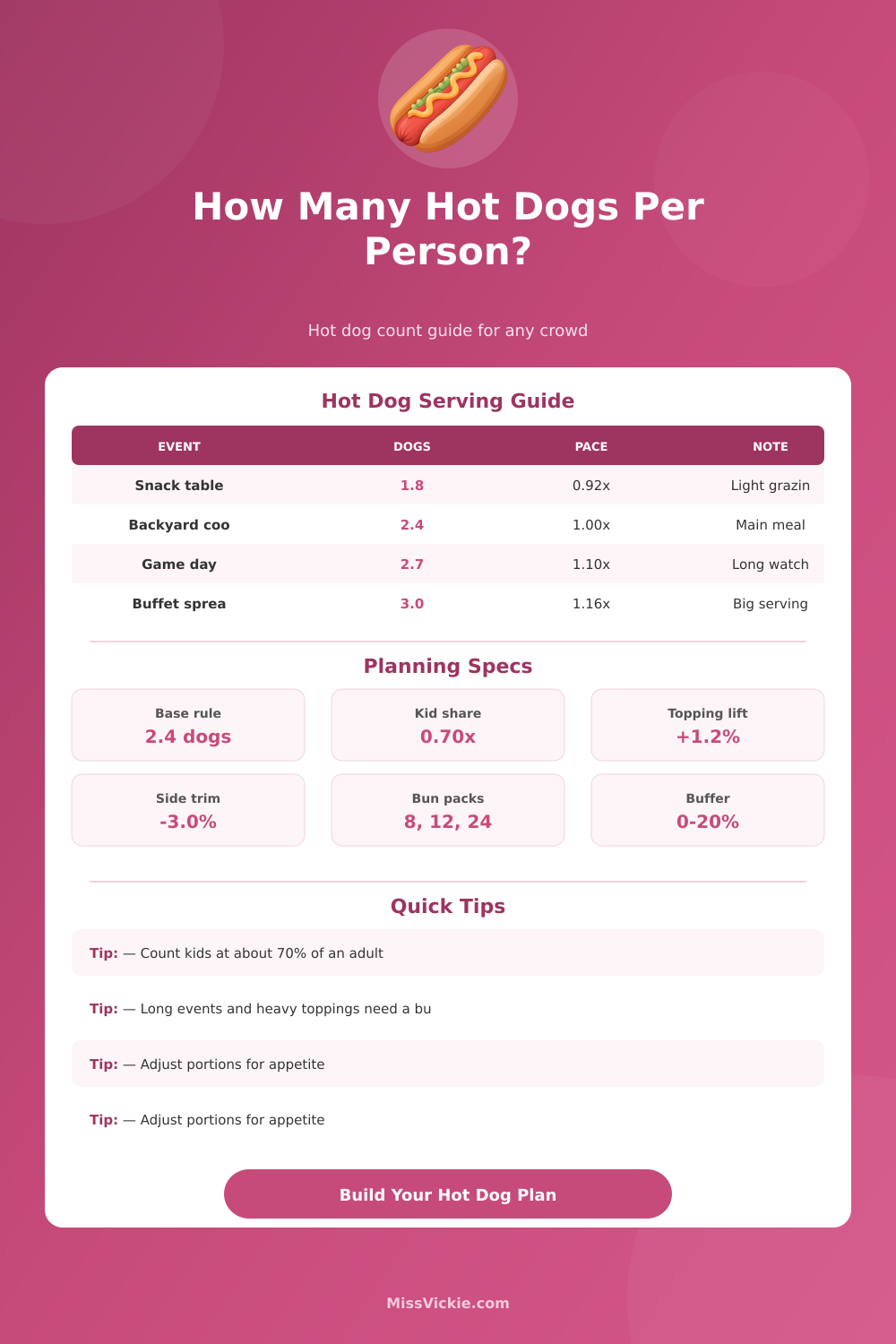
| Event | Dogs | Pace | Note |
|---|---|---|---|
| Snack table | 1.8 | 0.92x | Light grazing |
| Backyard cookout | 2.4 | 1.00x | Main meal |
| Game day | 2.7 | 1.10x | Long watch |
| Buffet spread | 3.0 | 1.16x | Big serving |
| Size | Factor | Oz / Dog | Note |
|---|---|---|---|
| Standard dog | 1.00x | 1.6 | Classic cookout size |
| Jumbo dog | 1.12x | 2.2 | Bigger bite, fewer needed |
| Footlong | 1.22x | 3.1 | Hearty and filling |
| Slider dog | 0.76x | 1.0 | Small and snacky |
| Bun Style | Pack Size | Buy Factor | Note |
|---|---|---|---|
| Standard buns | 8 | 1.00x | Classic grocery pack |
| Bakery buns | 12 | 1.02x | Soft and larger |
| Potato buns | 8 | 1.01x | Rich and sturdy |
| Slider rolls | 24 | 0.90x | Mini roll count |
| Length | Factor | Buffer | Note |
|---|---|---|---|
| 15-45 | 0.94x | 5% | Quick run |
| 45-90 | 1.00x | 8% | Standard pace |
| 90-150 | 1.08x | 10% | Party stretch |
| 150+ | 1.15x | 12% | Long hang |
When planning a cookout, calculating the correct amounts of hot dogs to serve is essential to ensure that there is enough hot dogs for everyone and that there are not to many leftover hot dogs. There are several variable to consider when planning a cookout to calculate the amount of hot dogs needed for the group of people attending the cookout. The first variable to consider is the composition of the crowd attending the cookout.
The composition of the crowd will determine the number of hot dogs that will be consumed during the cookout. You must count the total number of people attending the cookout. Additionally, the number of adults and children must be counted separately.
How Many Hot Dogs to Buy for a Cookout
Children are known to eat less than adults; children eat approximately seventy percent of the amount of hot dogs that an adult will eat. Therefore, if there are many children attending the cookout, few hot dogs will be needed then if the total number of people attending the cookout were all adults. The second variable to consider when calculating the amount of hot dogs needed for the cookout is the type of event that will be host.
The type of event will dictate the rate at which the guests will eat the hot dogs. If the cookout will include food other than hot dogs, guests will eat the hot dogs at a slower rate. However, if the cookout will include hot dogs as the main food for the guests, then the guests will eat the hot dogs at a faster rate.
Additionally, the length of the cookout will impact how many hot dogs the guests will eat. The longer the cookout, the most hot dogs the guests will eat. Therefore, the length of the cookout will also have to be considered when calculating the number of hot dogs needed for the event.
The third variable to consider when hosting a cookout and purchasing hot dogs is the size of the hot dogs that will be served. If you serve hot dogs of the standard size, they are easily grilled for all the guests attending the cookout. However, if jumbo or foot-long hot dogs are selected for the cookout, the guests will eat fewer hot dogs because each hot dog is more fillingly.
Additionally, if sliders are served instead of hot dogs, the guests will eat more hot dogs because each slider contain less hot dog meat. Additionally, enough hot dog buns must be purchased to serve with the hot dogs, as a bun will be provided for each hot dog. The fourth variable to consider when hosting a cookout is the type of toppings and side dishes that will accompany the hot dogs.
If the guests eat the hot dogs with various toppings, such as relish, onions, and sauces, they may eat more hot dogs to enjoy these toppings. However, the side dishes, such as potato salad or coleslaw, may fill the guests up and result in the guests eating fewer hot dogs. Therefore, the number of side dishes that will be served should be considered when purchasing the hot dogs.
Finally, a buffer for the total number of hot dogs that will be purchased should be prepared. A buffer accounts for the possibility that more guests may show up for the cookout than was estimated when planning the cookout. Ten to twenty percent of the total number of hot dogs needed will be purchased as a buffer in case more guests show up.
This buffer will ensure that there is enough hot dogs for all the guests who come to the cookout. Additionally, if there are not enough hot dogs to serve all the guests who show up to the cookout, some hot dogs can be save and used for another cookout. By considering each of these four variable and purchasing hot dogs according to these variables, the cookout host can ensure that there will be enough hot dogs for all the guests and that there will be no hot dogs left over.