
Tuna is an lean fish that contains alot of protein. Because tuna is lean, tuna has a more higher potential to become dry if tuna is cooked for too long. Tuna should be cooked so that it has a crust on the outside of the fish, but the inside of the fish are rare or rare to medium in flavor.
If tuna is overcooked, the tuna will loose it’s moisture, and the texture will begin to become dry and flaky. The protein in tuna can becomes difficult to cook because the protein will tighten up when exposed to the heat of the pan in which the tuna is cooking. In order to cook tuna corectly, the tuna should be dry.
How to Cook Tuna So It Stays Juicy
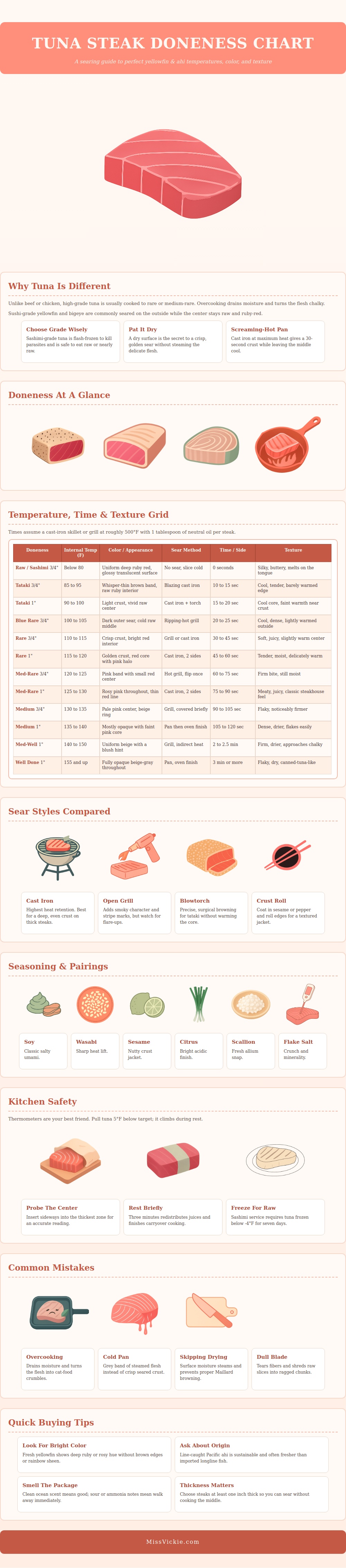
Tuna should be patted with a paper towel for remove the moisture from the fish. A very hot pan, such as a cast-iron pan, should be used to sear the tuna in order to form a crust on the outside of the tuna. A short amount of time should be used to cook the tuna so that the center of the tuna does not become warmed up to the heat of the pan.
Tuna can range in flavor strength depending on the internal temperature of the tuna when it is cooked. Raw tuna will have an internal temperature that is below 80 degrees. Tataki tuna will be seared for a very short time, like 10 second per side.
Blue rare tuna will be between 100 and 105 degrees. Rare tuna will be between 110 and 115 degrees. Medium rare tuna will be between 120 and 125 degrees.
If tuna reaches 130 degrees, it will be firm and dryly. There are different tool that can be used to sear the tuna. A cast iron pan can hold heat very even so that the outside of the tuna will char.
A grill can also be used to sear the tuna, but you should take caution with the fat in the tuna as it may ignite the grills flame. A blowtorch can also be used to sear the tuna. This tool will not heat the inside of the tuna so that it will not cook.
Seasonings will enhance the tunas flavor. However, the tunas natural flavor should be allowed to come through the tuna’s pores. Seasonings that can be used to enhance tuna flavor include soy sauce, wasabi, ginger, sesame seed, lime, and salt.
Lime adds acidity to the tuna. Soy sauce adds saltiness to the tuna. Safety rules must be followed when cooking tuna to avoid food borne illness caused by the parasite that live in tuna.
Raw tuna must be frozen to -4 degrees for a minimum of seven days in order to kill the parasites in the tuna. An instant read thermometer can be used to measure the internal temperature of the tuna. The cook should probe the tuna in the thickest part of the tuna filet.
The tuna should be removed from the heat when it reaches five degrees below the desired internal temperature. This allows for the tuna to continue cooking once it is removed from the heat. Tuna should then be rested for three minute in cover foil to allow the juices to redistribute throughout the tuna.
In order to avoid common mistake in cooking tuna, a few steps can be taken. Use a hot pan to sear the tuna; do not use a cold pan. Do not use wet tuna; it will not brown when cooked.
Use a sharp knife to slice the tuna; this will allow the knife to slice through the protein of the tuna. Buy tuna that is at least one inch in thickness so that the outside can be seared without overcooking the inside of the tuna. Finally, ensure the tuna has a bright red color and smells fresh; tuna that is old will have an unpleasantly odor and flavor.