
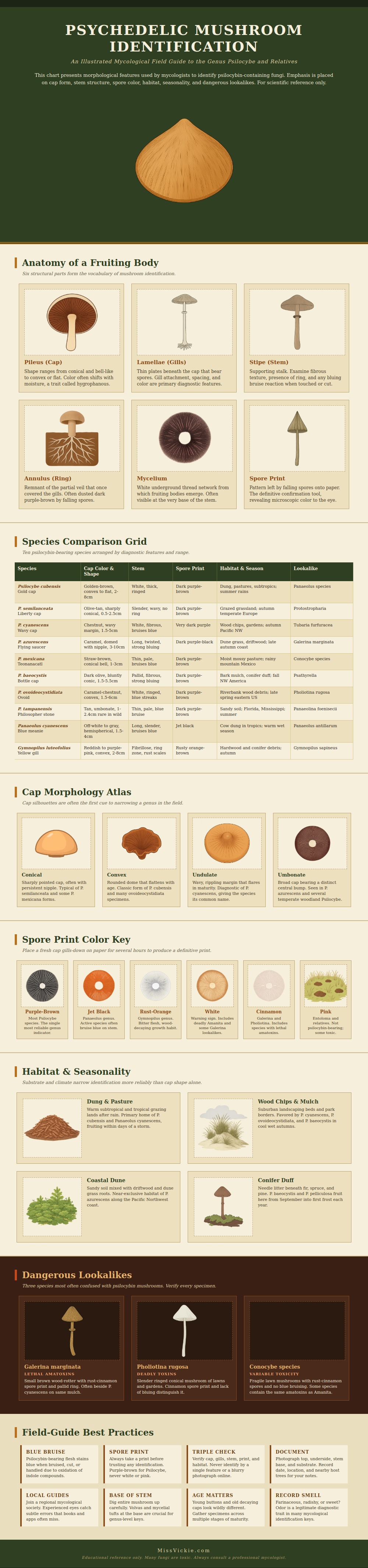
Identifying psychedelic mushrooms can be a critical skill to have, but you have to be careful in how you use this information since identifying the wrong type of mushroom can lead to illness or even death from eating that mushroom. To learn how to identify psychedelic mushrooms correctly, you must learn about mushroom anatomy. Mushrooms contains several different parts that can assist in identifying them.
For instance, mushrooms has caps, gills, stems, and mycelium. Mushrooms caps can vary from being conical when they are young to flat when they have matured. The gills are located underneath the cap and release the mushroom’s spores, which can be used to identify the mushroom.
How to Identify Psychedelic Mushrooms Safely
Mushrooms also have stems and psilocybin causes the blue coloration of their flesh when squeeze. Finally, mushrooms also have mycelium, which is the root system of the mushroom that can tell you more about the type of mushroom. To identify psychedelic mushrooms, you must examine every part of the mushroom.
Many type of mushrooms like psychedelic mushrooms grow in specific habitats. Some psychedelic mushrooms grow in areas with a high amount of animal dung, while others grow on wood chips. Other mushrooms grow in coastal dunes or near riverbanks.
The habitat where mushrooms are found can help with their identification. However, you should not solely rely on the habitat to identify mushrooms. Mushrooms can be found in specific seasons of the year.
Some mushrooms grow in the spring, others grow in the summer, and many mushrooms grow in the autumn during the fall season. Another way to identify psychedelic mushrooms is by performing a spore print on the mushroom. The color of the mushroom’s spores can help identify the type of mushroom it is.
To perform a spore print, you must place the gills of the mushroom on a sheet of paper and leave them to sit overnight. Many psychedelic mushrooms will reveal purple-brown spores. However, some mushrooms will display different colors of spores that indicate that the mushroom is toxic.
For example, jet black spores or rusty orange spores indicate that mushrooms are toxic. If a mushroom displays white spores, it could be a deadly Amanita mushroom. If the mushroom displays cinnamon tan spores, it may be a Galerina mushroom that contains toxins that can damage the mushroom’s liver.
Therefore, by performing a spore print on psychedelic mushrooms, you can identify their species and ensure that you do not consume too much of them. Mushrooms use cap shapes and colors to filter their type. For example, mushrooms with pointed caps are of a more different type than mushrooms with rounded caps.
Additionally, the edges of the caps can also help with indicating specific types of mushrooms. However, as mushrooms grow and age, their caps can change shape. Therefore, you should collect mushrooms of all ages and growing stages.
You should collect younger mushrooms that are still buttons or older, more decayed mushrooms to ensure that all identification trait are seen. Many toxic mushrooms look the same as psychedelic mushrooms. Mushrooms that look alike to psychedelic mushrooms are known as lookalikes.
For example, toxic Galerina marginata mushrooms grow on the same substrate as psychedelic mushrooms, wood chips. However, Galerina marginata mushrooms with rings on their stems grow in lawns. Additionally, the flesh of these mushrooms will be cinnamon-colored instead of purple-brown psychedelic mushrooms.
There are alot of lookalike mushrooms out there that may look similar to psychedelic mushrooms, but you should never assume they are safe to consume. Blue bruising in mushrooms indicates the presence of psilocin, but it does not mean that the mushroom is safe to eat. To identify mushrooms safely, you should create a habit of identifying mushrooms in a specific way.
Always perform a bruise test to see if the flesh of the mushroom turns blue. Always perform a spore print test to identify the color of the mushroom’s spores. Additionally, you can dig near the base of the mushroom where the mycelium or volva can be located.
Take a photograph of the mushroom from many different angle, and keep records of the date and the location where the mushroom was found. However, do not solely rely on the information from mobile applications as they may be incorrect due to blurry photographs of the mushrooms. Instead, use mushroom identification books or mycologists that live in the area to learn more about the mushroom and to identify it correctly.
By following these steps, you will find more greater accuracy in identifying the mushrooms you encounter.