🐔 Broiler Space Calculator
Size floor area, feeder lines, drinker count, and ventilation allowance for broiler houses at every growth stage.
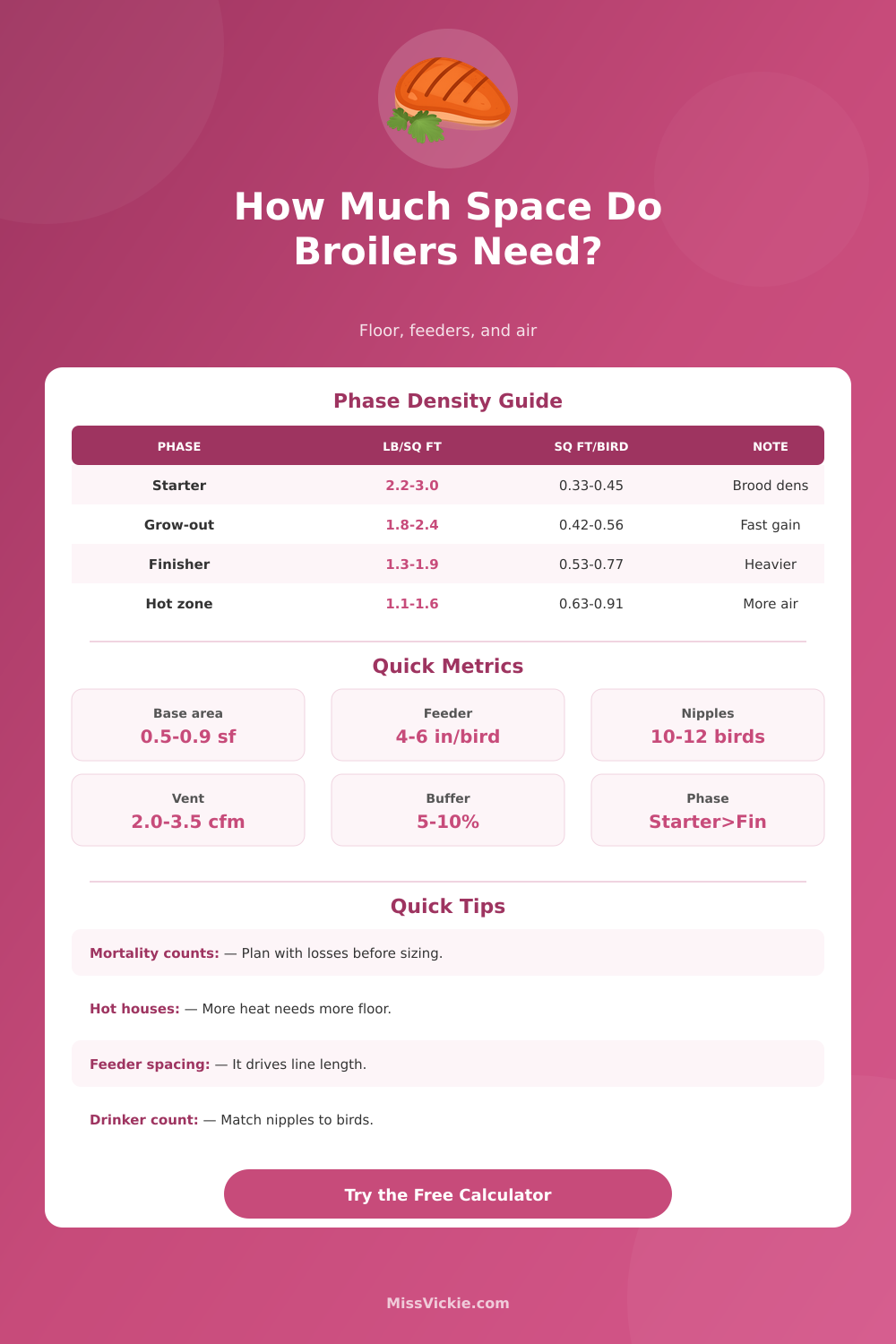
| Phase | lb/sq ft | sq ft/bird | Note |
|---|---|---|---|
| Starter | 2.2-3.0 | 0.33-0.45 | Brood dens |
| Grow-out | 1.8-2.4 | 0.42-0.56 | Fast gain |
| Finisher | 1.3-1.9 | 0.53-0.77 | Heavier |
| Hot zone | 1.1-1.6 | 0.63-0.91 | More air |
| Floor | Factor | Cleaning | Use |
|---|---|---|---|
| Solid Litter | 1.00 | Easy | Common |
| Deep Litter | 0.98 | Good | Warm base |
| Slatted | 0.92 | Fast | Dry zones |
| Wire | 0.88 | Fastest | Small lots |
| Vent Class | Factor | CFM/Bird | Use |
|---|---|---|---|
| Natural | 1.10 | High | Open house |
| Curtain | 1.05 | Mid-high | Seasonal |
| Cross Vent | 1.00 | Mid | Stable |
| Tunnel Vent | 0.92 | Lower | Hot load |
| Target | Spacing | Per 100 | Note |
|---|---|---|---|
| Feeder | 4-6 in | 33-50 ft | Long lines |
| Drinker | 10-12 birds | 8-10 nipples | Even reach |
| Heavy load | 3-4 in | 25-33 ft | More lines |
| Hot house | 9-10 birds | 10-11 nipples | More water |
Space planning for broiler chicken requires careful calculation. Broiler chickens require different amount of space based off their age. Broiler chickens require less space when they are young, but, as their weight increases, they require more floor area.
If there isnt enough floor area for all of the broiler chickens, then the chickens will be crowded. Broiler chickens that are too crowded will experience stress, will not grow even in weight, and will cost more in relation to the feed that they consume. Broiler chickens will go through various growth phase while in their farms.
How to Plan Space, Feeders, Water and Ventilation for Broiler Chickens
For instance, chicks require more tightly spacing brooding areas to retain heat from there environment. However, broiler chickens in the finisher stage will produce more heat and require more space and ventilation to avoid becoming stressed from too much heat. The space that broiler chickens require is related to their live weight.
Broiler chickens that are not given enough space to move will pile upon one another, which can lead to increased mortality rate. To develop a space plan for broiler chickens, determine the total number of broiler chickens that will be raised and the target weight that each broiler chicken will reach. In addition to calculating the space required for the total weight of the broiler chickens, calculate space allowance for mortality rates.
Five to ten percent of the total area can be allowed for mortality rates to ensure that the final weight of the broiler chickens does not exceed the total area of the broiler chicken house. Use these two calculations to develop a total area for the broiler chickens. Additionally, determine the number of feeders and drinker that are required in the broiler chicken house.
Provide feeders at a rate of four to six inches of feeder space per broiler chicken. One drinker nipple should be provided for every ten to twelve broiler chickens. If not provide, the broiler chickens will fight for access to feed and water.
Ventilation for the broiler chickens house is required to provide appropriate air and temperature for the broiler chickens. Ventilation in relation to the area of the broiler chickens house should be scaled according to the climate in which the broiler chickens will be raised and the type of house that are to be used for the broiler chickens. In hot climate, fewer broiler chickens will be raised and tunnel ventilation will be used.
Fewer broiler chickens will live in hot climates because the heat will cause the broiler chickens to not consume as much than feed. In the cold climates, more broiler chickens will be allowed to increase the amount of heat that is given back to the houses. Common mistake to avoid in space planning for broiler chickens are failing to account for the shifts in the growth phases of the broiler chickens.
Broiler chickens of the same density will peck at one another if raised in the same area during both the starter and grow-out phase. Additionally, you must plan feeder lines by taking the total number of broiler chickens to be raised and multiplying that by the number of inch of feeder space required for each broiler chicken. Finally, the ventilation system should be sized according to the age of the broiler chickens.
Too little ventilation to the broiler chickens will allow their droppings to become wet and dirty. Too much ventilation will lead to increased costs regarding the energy for the broiler chicken house.