🍗 Broiler Feed Calculator
Plan starter, grower, and finisher feed with flock losses and climate stress
| Phase | Age Range | Share | Notes |
|---|---|---|---|
| Starter | 0-14 d | 20-30% | High protein |
| Grower | 15-28 d | 35-50% | Fast lean gain |
| Finisher | 29-49 d | 25-40% | Energy dense |
| Hold / Finish | 45+ d | 0-10% | Batch cleanup |
| Heat Stress | Any age | +5% | More water |
| Cold Stress | Any age | +3% | More energy |
| System | Age | Target Wt | FCR |
|---|---|---|---|
| Backyard | 35-49 d | 4.0-5.5 lb | 1.9-2.3 |
| Small Farm | 35-45 d | 4.5-5.8 lb | 1.7-2.0 |
| Grow-Out | 38-49 d | 5.2-6.2 lb | 1.6-1.8 |
| Fast Line | 35-42 d | 5.0-6.0 lb | 1.55-1.7 |
| Heat Season | Any | 4.8-5.8 lb | +0.08 |
| Cold Season | Any | 4.8-5.8 lb | +0.05 |
| Climate | Factor | Effect | Use |
|---|---|---|---|
| Cool house | 0.97x | Lower intake | Spring flock |
| Normal house | 1.00x | Baseline | Typical barn |
| Warm house | 1.05x | More feed | Summer build |
| Hot house | 1.10x | Stress load | Heat wave |
| Stress house | 1.15x | Peak load | Emergency |
| Loss | Rate | Factor | Notes |
|---|---|---|---|
| Low waste | 2% | 1.02x | Clean feeders |
| Standard | 4% | 1.04x | Typical setup |
| High waste | 8% | 1.08x | Spillage risk |
| Mortality | 3% | 0.97x | Good flock |
| Mortality | 6% | 0.94x | Average flock |
| Mortality | 10% | 0.90x | Weak flock |
To calculate the amount of broiler feed that is required to raise the chicks to market weight, each person involved in the broiler farming operation must perform this calculation. Broiler feed is the largest cost associated with raising broilers to market weight. If the calculation of the amount of broiler feed that is required are not performed correctly, then either feed will be depleted before the broilers reach market weight, or there will be wasted money if too much feed is purchased.
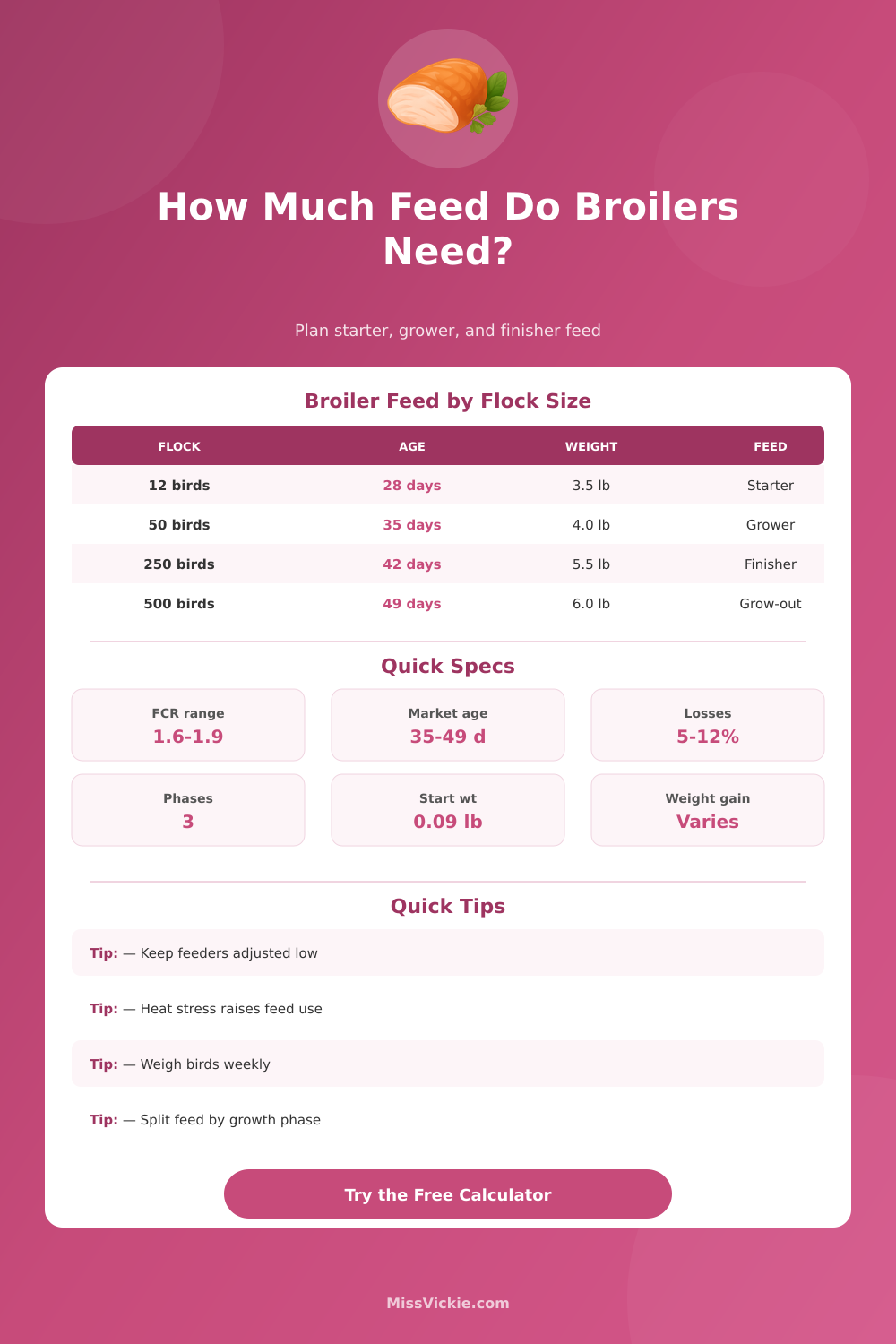
Factors that you must consider when calculating the amount of broiler feed to purchase include the number of broilers to be raised, the growth curve of the broilers, and variables like temperature change and mortality in the flock. Broilers are fed during three different phases, each of which require a different type of feed. During the first phase, called the starter phase, the farmer provides chicks with high-protein feed to start there skeletal frames.
How to Calculate Broiler Feed Needed
Grower feed is provided during the grower phase to promote the development of lean muscle in the broilers. Finally, during the last phase, called the finisher phase, finisher feed is provided to broilers to promote an increase in there final weight. Starter feed accounts for twenty to thirty percent of the total broiler feed that the broilers consume, but finisher feed accounts for a higher portion of the total feed required by the broilers after they reach six week of age.
If the proper type of feed is not provided during each phase, the broilers will stall in there growth, and the feed will be consumed at a more higher cost then it should of been. Another factor that must be considered when calculating the amount of feed that must be purchased is the mortality and wastage in the broiler flock. Mortality refers to the number of broilers that die within the flock.
If broilers die, then there is fewer broilers to be fed. For instance, if the mortality rate within the flock is three percent, there will be fewer broilers to be fed at the end of the broiler raising period. Wastage is the percentage of broiler feed that is lost due to spills in the broiler feeders.
The wastage of feed increases the amount of feed that is required to be purchased for the broilers. If the feeders are set too highly for the broilers, wastage can reach four percent or more of the total feed that is provided. The climate in which the broilers are raised can also impact the broilers feed consumption.
For instance, if broilers are exposed to high temperatures, they will change there feeding patterns. The same can be said for changes in the temperature in which the broilers are raised. The Feed Conversion Ratio, or FCR, is a number that is used to indicate how many pounds of feed is required to produce one pound of broiler meat.
A low FCR indicates that the broilers are efficient converting feed into meat. For small broiler farms, an FCR between 1.9 and 2.3 are common. Professional broiler farms raise there birds to an FCR of 1.6.
A calculation tool can be used to calculate the total tonnage of feed that will be required to raise the broilers to market weight. The tool requires information about the target weight of the broilers, the age of the broilers, and the FCR of the broilers. Because the breed of broiler, the lighting within the broiler barns, and the ventilation within the broiler barns influence the FCR, these factors need to be monitor to maintain a low FCR.
Monitoring the feed intake of the broilers is one of the tasks that all broiler farm owner and managers should perform. All broiler farm owner and managers should monitor the feed intake of the broilers in order to ensure that the broilers are eating as expected of the growth rate of the broilers. The feed intake of broilers should be monitored starting around day twenty of the life of the broilers.
Furthermore, the height of the feeders in which the broilers eat should be adjusted so that the broilers can eat easy and without scattering the feed. Finally, the spilled feed within the broiler feeders should be cleaned up each day, as a failure to do so will rapidly increase the amount of wastage of feed within the broiler barn. Another factor to consider when calculating the amount of broiler feed that is required to raise the chicks to market weight is the amount of water in which the broilers will be drinking.
Broilers will drink twice their body weight in water each day, and the water must be clean in order to maintain the feed efficiency of the broilers. If the water is not clean, the feed conversion ratio will worsen. Another factor to consider when calculating the amount of broiler feed to purchase is the specific breed of broiler that is to be raised.
Broilers of different breeds will have different rates of growth, and different requirements for feed to support there growth rates. For instance, broilers of the fast-growing Cornish cross breed will reach market weight quick, but breeds that grow slower will require a different feeding schedule. Finally, the environmental conditions within which the broilers are raised should be considered in the calculation of the amount of broiler feed to purchase.
When the temperatures within which the broilers are raised rise to 85 degrees or more Fahrenheit, the broilers may experience heat stress. Broilers that experience heat stress will eat less during the day and more at night. Additionally, heat stress will cause the FCR of the broilers to increase.
Proper ventilation within the broiler barn will help to prevent the heat stress of the broilers and maintain there FCR. By monitoring the weights of the broilers, the feed intake of the broilers, and the environment in which they are raised, the broiler farmer can ensure that the amount of broiler feed that will be required can be accurately calculated.