🍚 Rice Cooker Calculator
Balance water, cycle time, and yield for jasmine, sushi, brown, and more
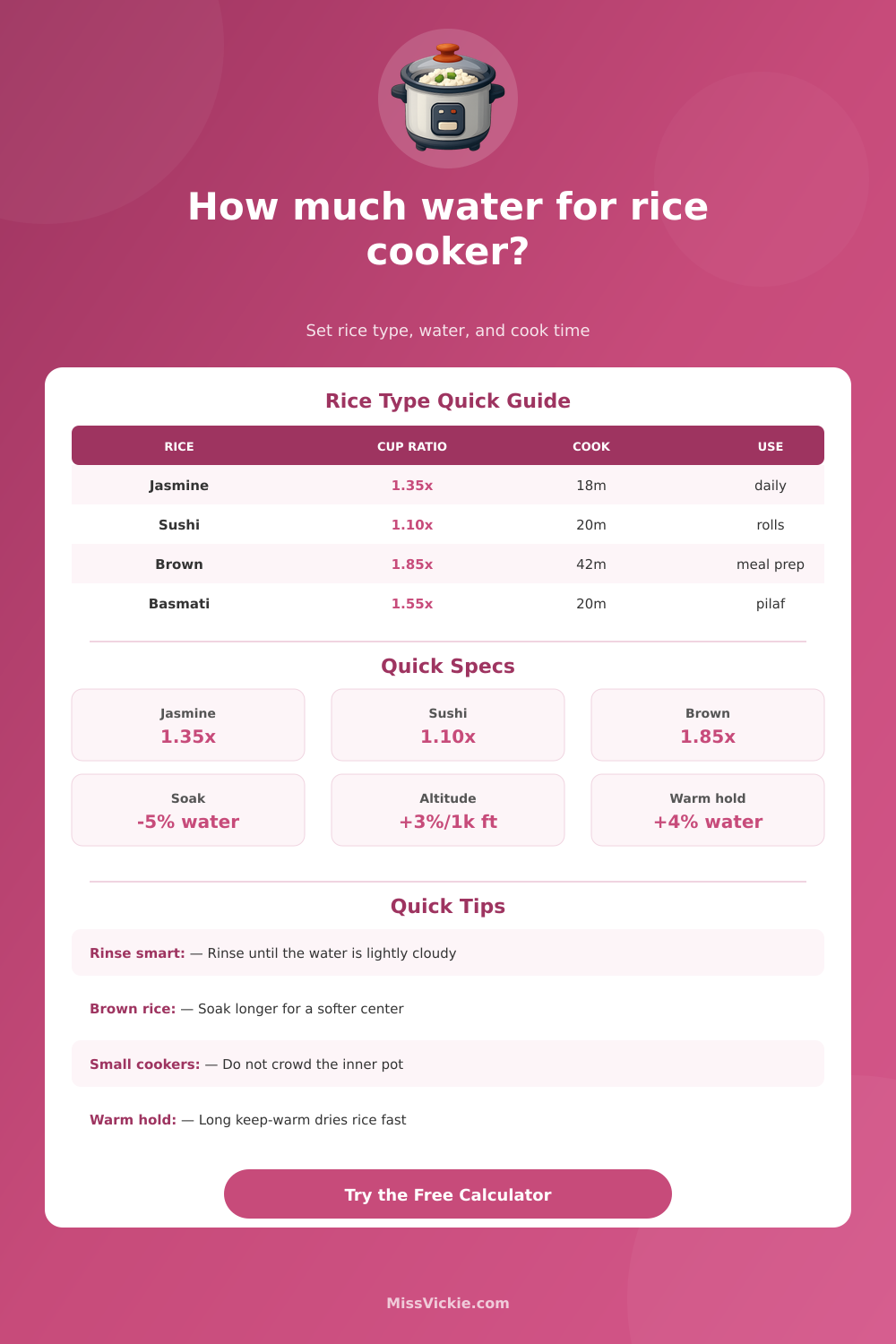
| Rice Type | Water / Cup | Cook Time | Best Use |
|---|---|---|---|
| Jasmine | 1.35 cups | 18-20m | Everyday bowls |
| Sushi | 1.10 cups | 18-22m | Rolls and bowls |
| Brown | 1.85 cups | 40-45m | Meal prep |
| Basmati | 1.55 cups | 18-22m | Pilaf and curry |
| Parboiled | 1.60 cups | 22-25m | Reliable batches |
| Wild blend | 2.20 cups | 45-50m | Hearty mixes |
| Rinse Level | Water Cut | Texture | Note |
|---|---|---|---|
| No rinse | 0% | Full body | Good for sticky rice |
| Light rinse | 1% | Balanced | Small starch drop |
| Standard | 2% | Clean | Most daily batches |
| Thorough | 4% | Loose | Whiter, drier grains |
| Heavy rinse | 5% | Very clean | Best for sushi style |
| Cooker Size | Dry Rice Limit | Cooked Yield | Fit Note |
|---|---|---|---|
| 3-cup mini | 1.5 cups | 4-5 cups | Solo or pair |
| 5.5-cup compact | 3 cups | 8-9 cups | Small family |
| 8-cup standard | 4 cups | 11-12 cups | Most homes |
| 10-cup family | 5 cups | 14-15 cups | Meal prep |
| 12-cup large | 6 cups | 17-18 cups | Party batch |
| Condition | Water Change | Time Change | Reason |
|---|---|---|---|
| Above 2000 ft | +1% / 1000 ft | +2% / 1000 ft | Boils lower |
| Soak 10 min | -3% | -4% | Grain absorbs first |
| Keep-warm 60 min | +2% | +3 min | Edge drying |
| Full cooker | +4% | +10% | Less steam room |
| Sticky target | +3% | +2% | More adhesion |
Rinse, then rest, then cook
Rinsing removes excess surface starch, and a short soak helps the center hydrate more evenly before the cooker switches to the finish phase.
That combination usually gives cleaner grains and fewer wet patches.
Capacity is a real limiter
If the pot is too full, steam circulation drops and the top layer can stay uneven. Leave enough headroom for bubbling and expansion.
A smaller batch often cooks better than an overloaded one.
Cooking rice involves a management of several specific variables. The variables to consider in the cooking of rice include the type of rice that is to be used, the amount of water that will be used in the cooking process, whether you should rinse the rice prior to cooking, the capacity of the vessel in which the rice is to be cooked, and the altitude at which the rice is to be cooked. Because different types of rice has different physical structures, different types of rice require different amount of water to be added to the rice to be cooked and different times to cook the rice.
Jasmine rice is a type of long-grain white rice that absorbs water quick. The ratio of 1.35 part of liquid to 1 part of rice grains is effective for jasmine rice due to the fact that polishers starch on the surface of the grains. It is necessary to lightly rinse the jasmine rice prior to cooking to remove excess starch from the rice grains; this will prevent the rice from becoming too stickily when cooked.
How to Cook Different Kinds of Rice
If jasmine rice is to be sticky when cooked, the rinsing of the rice is to be skipped. Brown rice is different than jasmine rice in that the bran layer of the brown rice is intact. Because of this intact layer of the grain, brown rice require both more water and more time to cook the brown rice than jasmine rice requires.
Approximately 1.85 part of liquid are required for every 1 part of brown rice to be cooked; the cooking time should be 40 minutes or more. Soaking the brown rice for 20 minutes prior to cooking will allow the water to seep into the inner kernel of the brown rice. This soaking process will allow the center of the brown rice to soften before cooking, preventing the brown rice from being too crunchy when serve.
Sushi rice requires a ratio of 1.10 parts of liquid to 1 part of grain. The rice must be rinsed to remove 5% of the starch from the rice grains; this will allow the rice to become adhesive when cooked. The rice should also be soaked in water for a brief period prior to cooking to help achieve a sticky texture from the sushi rice.
Basmati rice is another type of rice that is available for purchase; however, people use basmati rice in cooking for its fluffiness. For basmati rice, the ratio of 1.55 parts of liquid to 1 part of rice grain is used. Basmati rice is a long-grain rice; therefore, when cooked, the rice will remain separate from one another when consume.
Short-grain rice tends to stick to itself when cooked. The capacity of the rice cooker is an important factor in the cooking process. If you use an eight-cup rice cooker, you can cook four dry cups of rice.
This gives enough room for the steam to circulate around the rice. However, if you put six dry cups of rice into an eight-cup rice cooker, then the rice cooker will be 85% full. At 85% of the rice cookers capacity, you will need to add 4% more water to the rice and cook the rice for 10% longer than the recommended time.
This is because if the rice is too small for the rice cooker, it will cook unevenly due to the excessive empty space in the rice cooker. The altitude also play a role in how you cook the rice. The boiling point of water decreases as the altitudinal height increases.
If the rice cooker is located at an altitude of 2,000 feet or higher above sea level, you should add 1% of the amount of water for every 1,000 feet of elevation gain. Additionally, you should increase 2% of the cooking cycle for every 1,000 feet of elevation gain. If the rice is left in the rice cooker in the “keep-warm” setting for too long, the rice will eventually dry out.
Thus, if you plan to eat the rice later, you should add 2% of the amount of water that you use to cook the rice. There are some common mistakes that people make when cooking rice. One of the most common is rinsing brown rice too aggressively.
This can strip the rice of its nutrients, especially if the rice is not soaked prior to cooking. Another mistake is cooking too small of a batch of rice in a very large rice cooker. The large surface area of the rice cooker causes the water to evaporate too quick.
The age of the rice cooker can be another mistake people make. If a rice cooker is too old, the nonstick pots may not distribute the heat as efficient as newer models, and thus, you will have to use more water when cooking the rice. To achieve the best result with your rice cooker, let the rice sit undisturbed in the rice cooker for five minutes after the cooking cycle is complete.
This allows the steam to finish cooking the rice, ensuring that each grain of rice is even. Use a fork to fluff the rice once it is done cooking. Do not use a spoon to fluff the rice as it may mash the grains of rice.
To achieve extra fluffy rice, reduce the amount of water to a ratio of 0.96. To make the rice stickier, increase the amount of water to a ratio of 1.08. Thus, by adjusting the amount of water and the amount of time that the rice is cooked and rinsed, you can control the texture of the rice.