❄ Microwave Defrost Calculator
Estimate safe microwave defrost time by food, weight, thickness, wattage, and low-power staging.
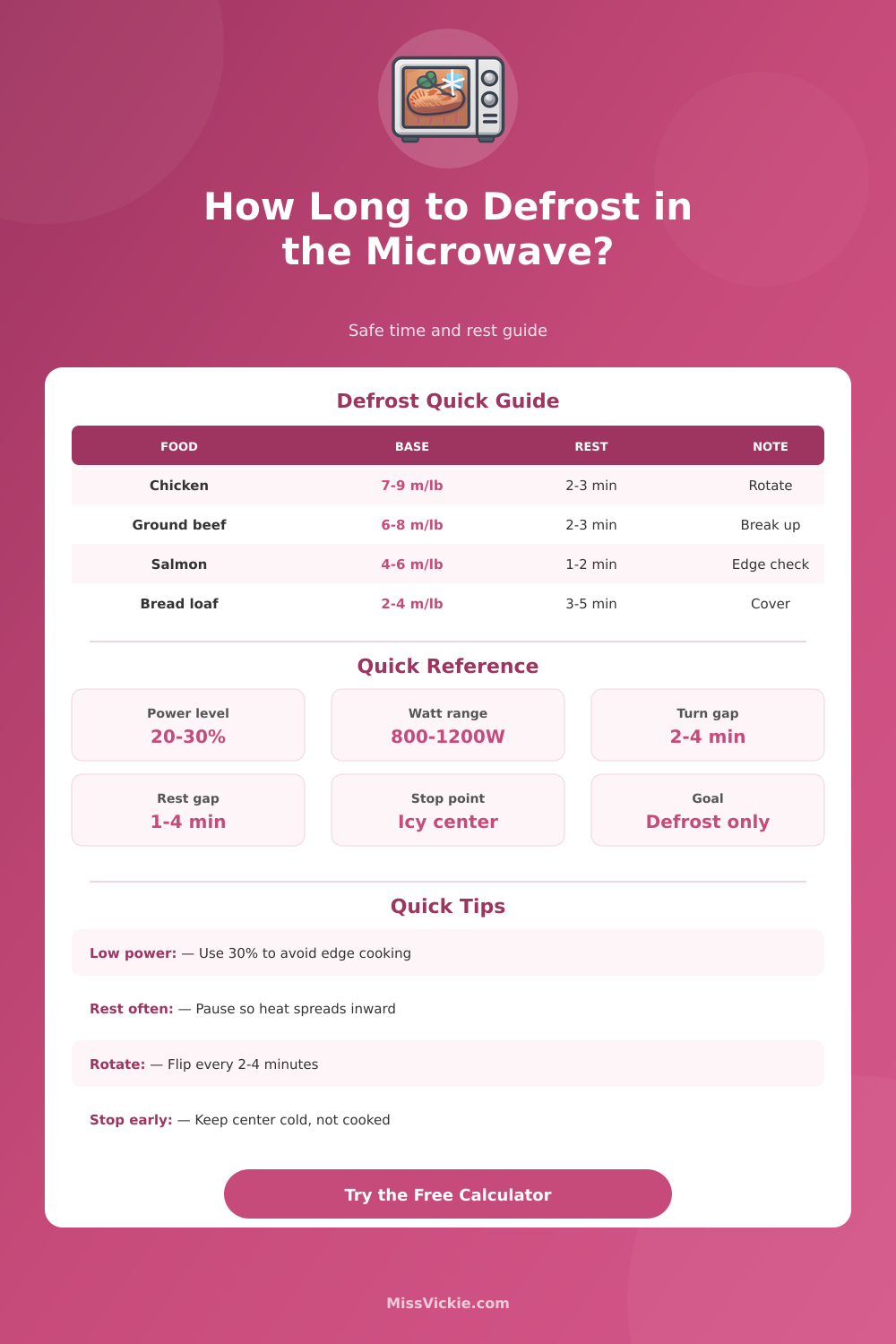
| Food | Base Rate | Ideal Thickness | Safe Rest | Best Defrost Pattern |
|---|---|---|---|---|
| Chicken Breast | 7.8 min/lb | 1.0-1.5 in | 2-3 min | Short bursts, rotate early |
| Ground Beef | 6.9 min/lb | 1.5-2.0 in | 2-3 min | Break apart between cycles |
| Salmon Fillet | 5.0 min/lb | 0.75-1.25 in | 1-2 min | Thin, gentle, icy center |
| Bread Loaf | 3.0 min/lb | 3.5-5.0 in | 3-5 min | Very short bursts, keep covered |
| Frozen Berries | 2.4 min/lb | 0.5-1.0 in | 1-2 min | Loosen, do not warm through |
| Shrimp | 4.4 min/lb | 0.5-1.0 in | 1-2 min | Check fast and often |
| Soup / Stew | 7.2 min/lb | 1.5-3.0 in | 2-4 min | Stir after each interval |
| Casserole | 6.6 min/lb | 1.5-3.0 in | 3-4 min | Defrost edges first |
| Vegetable Mix | 3.9 min/lb | 1.0-1.5 in | 1-2 min | Loose and vented |
| Steak Strips | 5.8 min/lb | 0.75-1.5 in | 1-2 min | Separate pieces early |
| Microwave | 30% Power Factor | Time Change | Best Use |
|---|---|---|---|
| 700W | 1.43x | +43% | Compact or older ovens |
| 800W | 1.25x | +25% | Lower-output countertop ovens |
| 900W | 1.11x | +11% | Average home microwave |
| 1000W | 1.00x | Baseline | Reference point for the calculator |
| 1200W | 0.83x | -17% | High-output and inverter models |
| Thickest Point | Thickness Factor | Turn Interval | Rest Interval |
|---|---|---|---|
| Up to 0.75 in | 0.86x | 1-2 min | 1-2 min |
| 0.76-1.25 in | 1.00x | 2-3 min | 1-2 min |
| 1.26-2.00 in | 1.16x | 2-4 min | 2-3 min |
| 2.01-3.50 in | 1.34x | 3-4 min | 3-4 min |
| Over 3.50 in | 1.55x | 4-5 min | 4-5 min |
| Food | Stage 1 | Stage 2 | Stage 3 | Rest Pattern |
|---|---|---|---|---|
| Chicken Breast | 42% | 35% | 23% | 2-3 min between checks |
| Ground Beef | 45% | 34% | 21% | 2-3 min, break apart early |
| Salmon Fillet | 40% | 36% | 24% | 1-2 min, handle gently |
| Bread Loaf | 50% | 30% | 20% | 3-5 min, keep covered |
| Frozen Berries | 35% | 40% | 25% | 1-2 min, stop at loosened edges |
| Soup / Stew | 46% | 34% | 20% | 2-4 min, stir well |
When frozen food is placed in a microwave, it will eventualy thaw until the food reach a temperature where the frozen part of the food melt, and the food becomes soft. This process of thawing frozen food in a microwave, which makes foods from frozen to thawed, is called microwave defrosting. As mentioned earlier, defrosting frozen foods in a microwave must be done careful to ensure that foods is safe to eat.
One of the main issue with microwaving frozen foods at full power is that the microwave will cook the outside of the food while the inside of the food remain frozen. Using full power on your microwave, or even a high power setting on your microwave, will cook the edges of your food while the center of the food remains cold. Because the edges of the food become hot while the center of the food remains frozen, bacteria can grows in the warm area of the food, and this makes the food unsafe.
How to Safely Defrost Frozen Food in a Microwave
To prevent this from happening, you must use a low power level on your microwave. Using a low power level (20-30%) ensure that the microwave pulses energy to the food so that the heat can move to the center of the food. Using short bursts of microwave energy followed by resting periods also help to evenly thaw the food.
The resting periods allow carryover heat to move from the edges of the food to the center of the food. Without resting periods, the edges of the food would cook before the center of the food become thawed. Food thickness and shape will alter how long this process take.
Thicker foods take longer to thaw than thin foods. The wattage of your microwave will also impact how long it take for your food to thaw. The more higher the wattage, the faster that your food will defrost; the lower the wattage, the longer it will take for your food to thaw.
It is also important to rotate your foods so that they evenly catch microwaves from all sides. Irregularly shaped food will not catch microwaves evenly on its entire surface. Ground beef is another example of this, as you will need to break it apart during this process so that microwaves can access inner layer of meats that are otherwise hidden from microwave energy.
When doing microwave defrosting, you should stop microwaving your foods when they are icy but pliable to stop thawing at just the right point. Defrosting foods in a microwave should only be done for thawing purpose; you dont want to cook your foods. Too much thawing time in the microwave and you run the risk of partially cooking your foods.
When foods are cooked partially, it is difficult to finish cooking on a stove or in an oven. You will be afraid of overdoing certain part of the food while other parts may be underdone. Depending on what type of food you are cooking, different foods needs different amount of time.
Foods like seafood thaw very quickly. You need to keep a close watch on seafood that you put in your microwave. Bread is another important item when it comes to microwave defrosting, as bread can easily become gummy if it is too moist or too hot when you microwave defrost it.
For other type of food, it is best to research how much time it will take to microwave defrost these items on a low power level. By using low power levels, rotating your foods, and allowing for resting periods after microwaves stop cooking, you can ensure that your food will be even thawed and safe to eat!