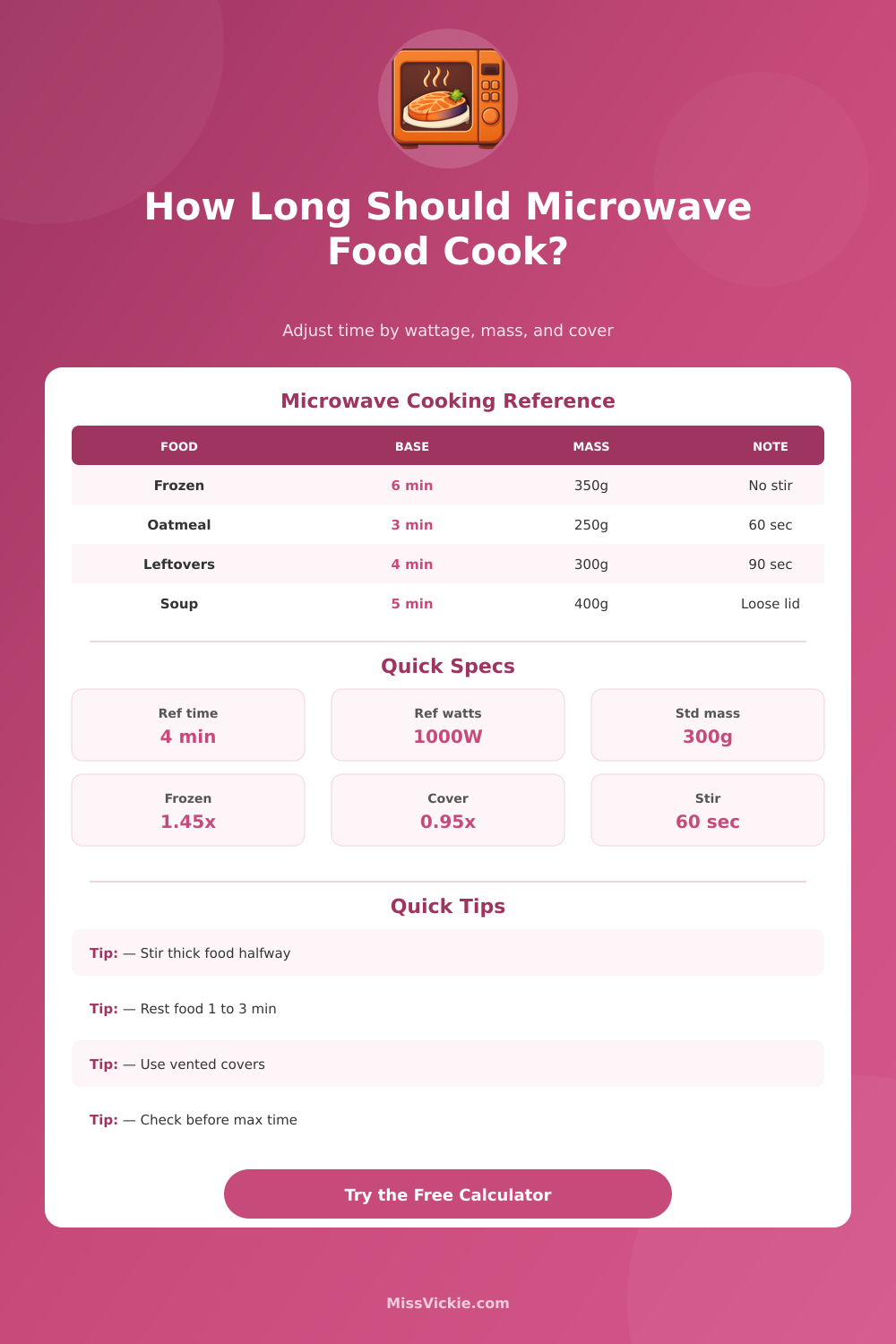
🍳 Microwave Cooking Time Calculator
Dial in time for frozen dinners, oatmeal, leftovers, soups, and more
| Preset | Base Time | Mass | Best Use |
|---|---|---|---|
| Frozen Dinner | 6.0 min | 350g | Tray meal |
| Oatmeal | 2.5 min | 280g | Creamy bowl |
| Leftovers | 3.5 min | 320g | Lunch plate |
| Soup Cup | 4.0 min | 450g | Stir well |
| Rice Bowl | 5.0 min | 300g | Covered bowl |
| Steamed Veg | 2.75 min | 200g | Bright green |
| Pasta Bowl | 4.25 min | 350g | Add a splash |
| Casserole | 7.0 min | 600g | Deep dish |
| Baked Potato | 6.5 min | 250g | Flip once |
| Fish Fillet | 3.75 min | 180g | Loosely cover |
| Microwave | Factor | Time Shift | Common Use |
|---|---|---|---|
| 700W | 1.43x | +43% | Compact unit |
| 800W | 1.25x | +25% | Older home unit |
| 900W | 1.11x | +11% | Mid range |
| 1000W | 1.00x | Base time | Standard ref |
| 1100W | 0.91x | -9% | High power |
| 1200W | 0.83x | -17% | Fast cooking |
| 1500W | 0.67x | -33% | Commercial use |
| Start Temp | Factor | Extra Time | Notes |
|---|---|---|---|
| Frozen | 1.45x | Longest | Break apart first |
| Refrigerated | 1.18x | Moderate | Most leftovers |
| Cool Pantry | 1.08x | Small bump | Stored in cool room |
| Room Temp | 1.00x | Baseline | Freshly plated |
| Warm | 0.88x | Less time | Preheated food |
| Container | Factor | Cover | Factor |
|---|---|---|---|
| Glass Bowl | 1.00x | Uncovered | 1.05x |
| Ceramic Bowl | 1.02x | Loose Lid | 1.00x |
| Plastic Dish | 0.98x | Vented Lid | 0.96x |
| Paper Bowl | 0.97x | Damp Towel | 0.95x |
| Silicone Dish | 0.99x | Microwave Lid | 0.97x |
| Meal Tray | 1.04x | Vented Wrap | 0.94x |
Microwaves can heat an edges of the food and leave the middle of the food cold. However, by understanding an impact of wattage, food masses and moisture, and the power of the microwave, you can greatly improve the heating of food in a microwave. Wattage are one of the first variables to consider when heating food.
The wattage of the microwave will dictate a rate at which the food heats. Most microwave come with various wattage settings. Microwaves with higher wattage will heat the food more faster.
How to Heat Food Evenly in a Microwave
If you use a microwave with high wattage setting, you may want to lower the setting for the food so as to avoid drying out the edges of the food. Another factor to consider is the mass of the food. When using a microwave, the microwaves energy beam have limited penetration power into the food.
The center portion of thicker foods will take longer to heat because the microwaves cannot reach the center of the food as effective as the edges. If the food is in a frozen state, it will take longer to heat the food because the microwave energy must perform an additional step of melting the ice in the food prior to heating it. Another variable that can be adjusted in the microwave heating process is the container.
Containers made of glass will hold the heat of the food better and retain it better than plastic container. Plastic containers tend to release the heat from the food more quickly than glass containers. Additionally, use a cover for the food.
Use a cover for the food to allow the food to steam and cook from all sides of the food. However, use a vent cover or a damp towel over the food so that the food does not become to soggy. Stirring the food in the microwave is another factor that will improve the heating of the food.
Stirring the food during the heating process will allow the heat to be distributed even throughout the food. If you stir the food midway through the heating process, you may be able to reduce the time needed to heat the food. Stirring is also useful to avoid cold spot in thick foods.
Finally, allow the food to sit for a few minutes after the microwave heating cycle is complete. This standing time allow the heat from the food to distribute throughout the food. If you heat the food and dont allow it to sit for a few minutes, the center of the food may remain cold.
Finally, different food require different heating techniques. For example, if you are heating oatmeal, you will have to heat it longer if the oatmeal is cold from the refrigerator than if it is at room temperature. Additionally, stir the oatmeal every minute while heating to avoid clumping of the oatmeal.
For soups, because they are liquid, you may have to check the soup every 45 seconds to ensure that it does not superheat. Thin foods like fish fillets will heat quickly in a microwave so heating time need to be shorter to avoid overcooking the food. Foods like potatoes take longer to heat so there is more time to allow the heat to permeate the food, but you should flip the potatoes halfway through the heating process so that they heat even.
Safety is another consideration when heating food in a microwave. Because the interior of the food may heat unevenly, you want to ensure that the food becomes hot enough to kill any bacteria live in the food. To ensure the food reaches an even temperature, heat the food using a conservative heating time, then heat 15 second burst at the end of the cooking time to ensure the middle of the food is hot enough.
By following these guidelines, the food will be hot and safe to eat. Additionally, by adjusting the variables of the amount of wattage, the mass and type of food, and the stirring of the food, the microwave can become a reliable appliance for heating food.