🍳 Range Hood Calculator
Size CFM, hood width, duct diameter, and noise headroom for a safer kitchen
| Cooktop Type | Base Rule | Common CFM | Notes |
|---|---|---|---|
| Gas range | 100 CFM per 10k BTU | 300-600 | Most residential kitchens |
| Dual fuel | 105 CFM per 10k BTU | 350-700 | Extra reserve helps with ovens and burners |
| Induction | 85 CFM per 10k BTU | 250-500 | Less heat, but steam and odors still matter |
| Commercial gas | 125 CFM per 10k BTU | 800-1,200+ | Heavy capture and code review may apply |
| Wok burner | 120 CFM per 10k BTU | 700-1,000+ | High plume velocity needs stronger pickup |
| Hood Style | Best Width | Capture Factor | Install Note |
|---|---|---|---|
| Wall-mount | Cooktop + 6 in | 1.00x | Best all-around residential choice |
| Island | Cooktop + 12 in | 1.15x | Open sides need more overlap |
| Under-cabinet | Cooktop + 6 in | 1.05x | Check cabinet depth before buying |
| Insert / liner | Custom cabinet | 1.02x | Use with a matching cabinet shell |
| Ceiling mount | Cooktop + 10 in | 1.08x | Works well in modern open spaces |
| Duct Size | Practical CFM | Shape | Use Case |
|---|---|---|---|
| 6 in | Up to 300 | Round | Short runs, compact hoods |
| 7 in | 301-600 | Round | Typical residential sweet spot |
| 8 in | 601-900 | Round | Safer for longer duct paths |
| 10 in | 901-1200 | Round | High-output pro-style systems |
| 12 in | 1200+ | Round | Extra-large or commercial venting |
| Noise Target | Sone Range | Reserve | Buying Hint |
|---|---|---|---|
| Whisper | 4-5 | 18% | Best for open kitchens |
| Quiet | 5-6 | 12% | Good for family cooking |
| Balanced | 6-8 | 0% | Works for everyday use |
| Performance | 8-10 | -8% | Prioritize airflow first |
Capture Matters More Than Raw CFM
A wider hood that overlaps the cooktop by a few inches often performs better than a narrow hood with the same motor rating.
Depth, mounting height, and placement can change real-world results a lot.
Short, Straight, Round Ducts Win
Every extra elbow and every extra foot of duct adds resistance. If you must route around framing, size up the duct when possible.
A smoother vent path also helps the hood sound quieter at normal speeds.
A range hood are an appliance that is used to remove smoke, steam, and grease that is created within the kitchen areas. If the range hood that is installed in the kitchen is too small for that area, the smoke and grease will remain within the kitchen, and the smoke and grease may settles upon the cabinets and other furnitures within the kitchen. In order to ensure that the range hood will correctly perform it’s functions, it is essential to calculate the amount of airflow that is necessary for the kitchen area.
The most common measurement of range hoods is in relation to the units of airflow that the hoods provide, known as CFM (Cubic Feet per Minute). While the manufacturer of the range hood may provide a CFM value for that appliance, the actual CFM of that hood may be less due to the resistance within the ducting of the range hood. For instance, each additional foot of range hood ducting will reduce the efficiency of the range hood by approximately two percent, and each bend within the ducting will reduce the efficiency of the range hood by approximately five percent.
How to Choose the Right Range Hood for Your Kitchen
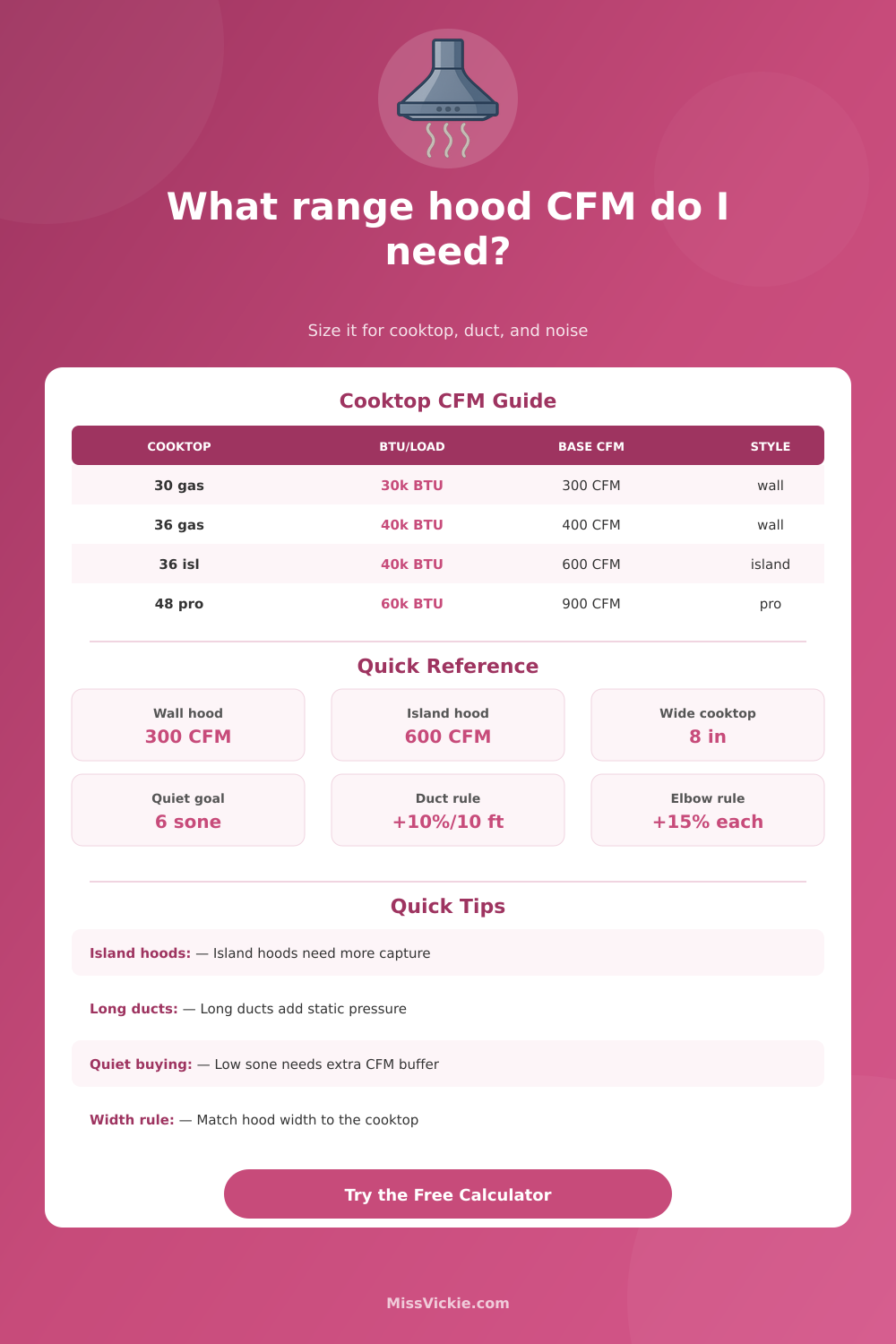
The total BTU (British Thermal Unit) value of the cooktop that you will use in the kitchen will help to determine the amount of CFM that is required of the range hood. For instance, dividing the BTU value of the cooktop by 100 will provide the starting CFM value for that range hood. For example, using an electric range cooktop with a total BTU of 42,000 would result in a starting CFM value of 420 for that range hood.
Additionally, the style of the range hood will influence the amount of CFM that is required. For instance, wall mount canopy range hoods typically require less CFM than island range hoods, as the island range hoods must work to remove smoke from the cooktop that is within the kitchen area, and may require a CFM that is fifteen percent higher than a wall mount range hood. Similarly, under-cabinet range hoods may be required to provide a range hood that allows for better clearance within the kitchen area, but may have a smaller capture zone due to the proximity of the cabinets to the range hood.
Aside from the size and type of cooktop that will be used in the kitchen, the habits of the cook will influence the CFM of that range hood. For instance, if the cook will use the range hood for simmering cooktop settings, a standard CFM may be appropriate for that appliance. However, if the cook will use the range hood to cook foods in a wok or with a high heat gas burner, the cooktop will release more smoke; in this case, eighteen percent more CFM is required to effectively remove the smoke from the kitchen.
Should the range hood be required to be quiet while in operation, it is possible to choose a range hood with a higher CFM than is required to provide adequate functioning of the range hood. For instance, if the CFM of the range hood is set to a lower setting, the range hood will be quieter. The height of the ceiling within the kitchen may also impact the range hood.
For instance, the standard ceiling height is eight feet; however, if the ceiling height is nine feet or more, the smoke from the range hood will travel further distances before the range hood captures it. In this case, three percent more CFM should of been provided for each additional foot of height within the ceiling. Additionally, the ductwork for the range hood will impact its performance; short and straight ducting work better than long and complex ducting systems.
This is due to the fact that shorter and more direct ducting systems require less static pressure to allow the range hood to effectively perform its tasks. The width of the range hood should match that of the cooktop. For instance, if the cooktop measures thirty-six inches in width, the range hood should also be thirty-six inches in width.
However, it is better for the range hood to be three to six inches in width more than the cooktop. For instance, an island range hood should have six inches in width provided for overlap of the hood and cooktops; otherwise, some of the smoke will escape from the range hood. Additionally, if the range hood is too narrow for the cooktop, it will not be able to effectively remove smoke from the cooktop.
Some of the most common mistakes in range hood selection include purchasing a range hood that is too small for the area of the kitchen. For instance, small range hoods will not be able to perform as well as range hoods with greater CFM values when the cooktop is used at high heat. Another common mistake is purchasing a range hood that is too quiet for the needs of the kitchen.
Finally, if the CFM of the range hood is 400 or higher, a make-up air system will be required for that range hood; the make-up air system will allow for fresh air to be supplied into the building. In addition to considering the placement of the range hood, there are additional steps that may be taken to ensure the range hood performs its tasks effectively. For instance, the burners of the cooktop should be placed under the slots of the range hood that are the strongest in their intakes.
The type of filter that is placed within the range hood should also be chosen appropriately; baffle filters will trap more grease than mesh filters if they are used in frying cooktops. The range hood must also be cleaned regularly to avoid the reduction in CFM that may result from the buildup of grease within the filters. Finally, if the range hood is mounted higher than thirty-six inches above the cooktop, the range hood will be less effective in its function; ten percent less CFM will be provided if the range hood is mounted higher than thirty-six inches above the cooktop.
If the range hood is sized and installed correctly, it will effectively remove the steam, smoke, and odors that may exit the cooktops.