🍖 Korean BBQ Calorie Calculator
Estimate calories from meat, rice, sauce, and banchan in one Korean BBQ meal
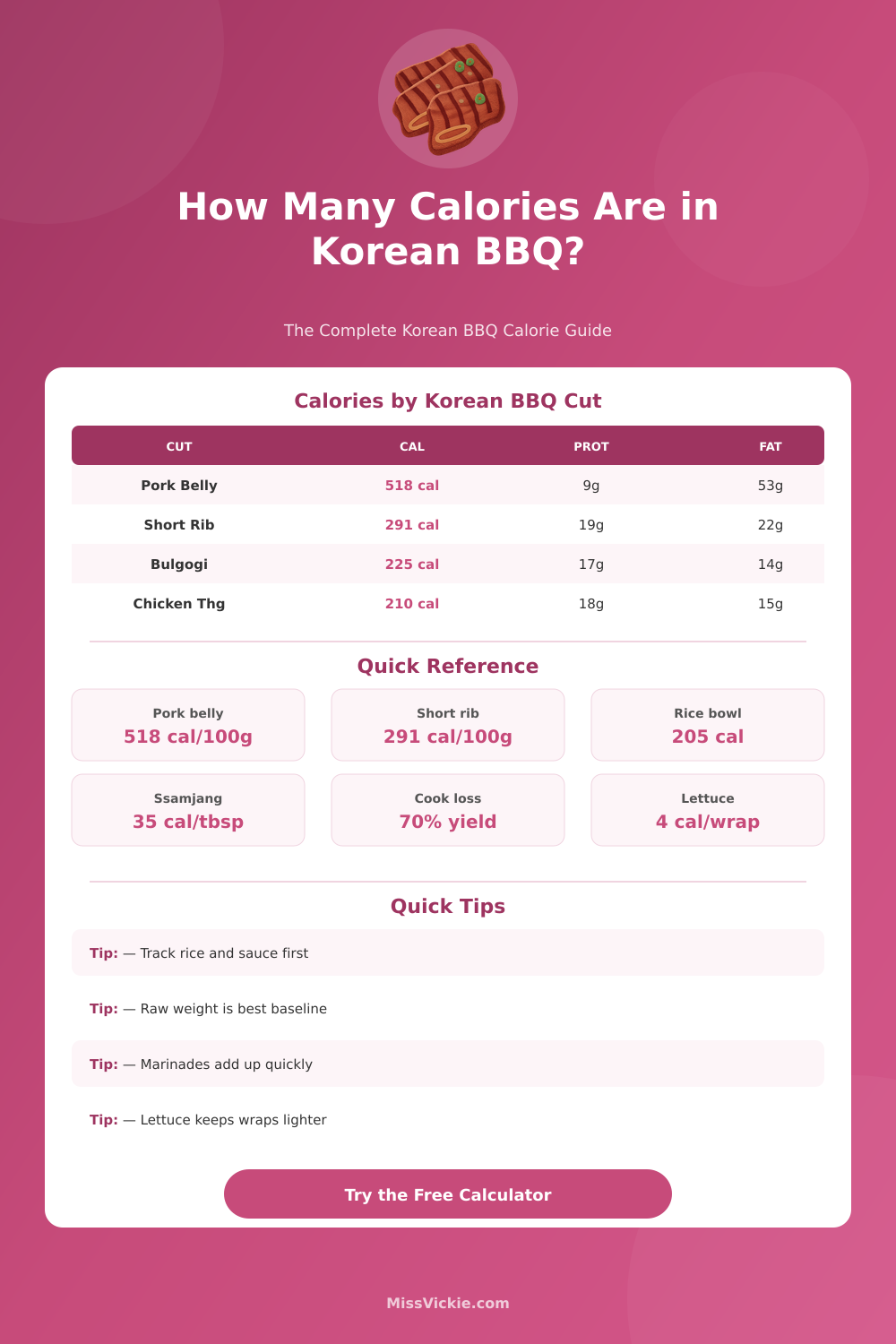
| Cut | Raw 100g | Protein | Fat |
|---|---|---|---|
| Samgyeopsal | 518 cal | 9.3g | 53.0g |
| Galbi | 291 cal | 19.0g | 22.0g |
| Bulgogi | 225 cal | 17.0g | 14.0g |
| Chicken thigh | 210 cal | 18.0g | 15.0g |
| Brisket | 250 cal | 17.0g | 18.0g |
| Pork shoulder | 242 cal | 20.0g | 16.0g |
| Tofu grill | 76 cal | 8.0g | 4.5g |
| Cut | Loss | Yield | 500g Raw |
|---|---|---|---|
| Samgyeopsal | 30% | 70% | 350g cooked |
| Galbi | 22% | 78% | 390g cooked |
| Bulgogi | 20% | 80% | 400g cooked |
| Chicken thigh | 20% | 80% | 400g cooked |
| Brisket | 28% | 72% | 360g cooked |
| Pork shoulder | 25% | 75% | 375g cooked |
| Tofu grill | 5% | 95% | 475g cooked |
| Item | Portion | Calories | Notes |
|---|---|---|---|
| White rice | 1 cup | 205 cal | 158g cooked |
| Brown rice | 1 cup | 215 cal | 195g cooked |
| Ssamjang | 1 tbsp | 35 cal | Rich dip |
| Sesame salt | 1 tbsp | 45 cal | Oil plus salt |
| Kimchi | 1 serving | 15 cal | 1/2 cup |
| Japchae | 1 serving | 160 cal | 1/2 cup |
| Lettuce wrap | 1 wrap | 4 cal | Small leaf |
| Meal Style | Meat | Rice | Total |
|---|---|---|---|
| Light lunch | 250g | 1 cup | ~480 cal |
| Standard dinner | 400g | 2 cups | ~860 cal |
| Feast for 4 | 700g | 4 cups | ~1,620 cal |
| Party platter | 1,000g | 6 cups | ~2,300 cal |
Korean BBQ contain many different types of food. Each of these different types of food contain different amount of calories. Many of the foods that contain high amount of calories include the meat, rice, and sauces that are commonly eaten with Korean BBQ.
Pork belly contain a high amount of fat. Because pork belly contains a high amount of fat, pork belly also contains a high number of calories. Marinated beef, such as bulgogi, often contains sugar in the marinade that coats the beef prior to cooking.
Calories in Korean BBQ and How to Eat Less
Thus, bulgogi contain many calories due to the sugar content of the marinade. Finally, side dish (called banchan) and rice bowls also contain many calories that should be taken into account when counting the calories from a complete Korean BBQ meal. The type of meat that you select will contain the primary factor in the calorie count of your meal.
Pork belly is a meat that is high in fat. Fat contain 9 calories per gram of meat, whereas protein contains 4 calories per gram. Therefore, meats that contain a high amount of protein and low amounts of fat will contain fewer calories than meats that contain a high amount of fat.
For instance, if you select chicken thigh or brisket instead of pork belly, you will have selected a meat that has more protein and less fat. Therefore, you will consume fewer calories from the meal if you choose chicken thigh or brisket over pork belly. The type of marinade used for meats will also alter the number of calories that you consume from that meat.
For instance, bulgogi contains a soy-sugar glaze that add carbohydrates to the meat. Thus, if you weigh the meat prior to marinating it will allow you to account for the calories from the meat alone rather than the entire meal. Aside from the meat, rice and sauce also contain calories.
A cup of cooked white rice contains 200 calories. Rice is a carbohydrate that contains calories. Brown rice also contains calories, although it also contains fiber.
Sauces such as ssamjang and gochujang also contain many calories. Ssamjang contains oil and paste. One spoonful of ssamjang contains 35 calories.
Gochujang also contains sugar. Therefore, gochujang also contains calories. Banchan also contain calories.
For instance, potato salad also contains mayonnaise, which has a high amount of fat and calories. However, side dishes like pickled radish and lettuce wraps contain few calories. Thus, letting wraps are a low-calorie side dish alternative that can contain the meat for Korean BBQ.
The method in which you cook the meat will alter the number of calories in the meal. People often use oil on the grill to prevent the meat from sticking to the grill. Thus, the oil adds to the calories of the meal.
Additionally, meats will lose some of their weight during the cooking process. Pork belly will lose 30% of its weight during the cooking process. Thus, the cooked pork belly will weigh 70% of the raw weight of the pork belly.
Tofu will hold its weight during the cooking process, so tofu is a different type of food than pork belly. You should calculate the calories of the food that you cook based on the raw weight of the food, since the nutrition facts of the food are based on the raw weight of that food. There are several way to use the nutritional data about the ingredients of Korean BBQ.
For example, calculating the number of calories per diner can allow you to determine if you are consuming too many calories from your meal. Determining the amount of protein in your meal will allow you to determine how much protein is in your meal. For instance, if the meat constitutes 50-70% of your meal, you will know that the meat is the dominant food in your meal.
Additionally, if you determine that the sauce contains 10% of your meal, you can use this information to consume less of that sauce in the future. Thus, you can make various tradeoffs to consume fewer calories. For instance, if you trade pork belly for chicken thigh, you will consume fewer calories from your meal.
Many people make mistakes while eating Korean BBQ. For instance, many people will estimate the portion sizes of the meat by looking at the food. This can lead to underestimating the number of calories that they are consuming.
For instance, 100 grams of pork belly contains 500 calories, so eating 100 grams more meat will add 500 calories to the meal. Many people also dont account for the sugar content of the marinades for the meat. Finally, many people who dine at all-you-can-eat restaurants will eat many portions of the meat and banchan because they are encouraged to do so.
However, there are several ways to eat Korean BBQ that will allow you to consume fewer calories from the meal. For instance, you can choose to eat lean brisket or pork shoulder rather than pork belly. Lean cuts of meat will contain less fat and thus fewer calories.
Another way to eat fewer calories is to eat tofu rather than pork. Tofu is a meat alternative that contains less fat than pork. Additionally, you can eat ssam vegetables, such as bean sprouts or spinach.
These vegetables have fewer calories than the other vegetables that may be on the Korean BBQ table. Finally, you can eat brown rice rather than white rice, and you can use less oil on the grill to prepare the meat. Thus, these various choices will allow you to enjoy Korean BBQ while consuming fewer calories from that meal.