
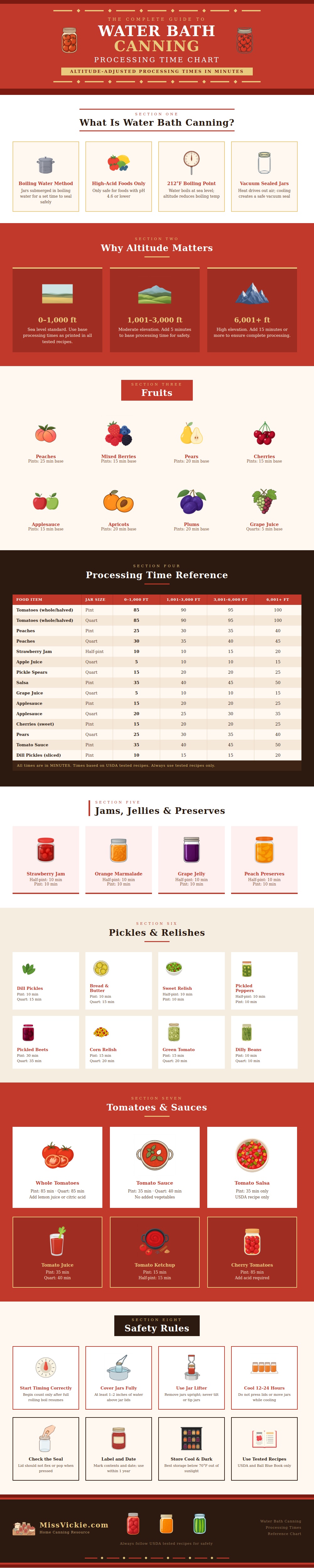
Water bath canning is a method use to preserve foods that are naturaly high in acid. High-acid foods are safe for water bath canning because the acidity in high-acid foods prevent the growth of dangerous bacteria. Because high-acid foods has a low pH, a person dont need to use a pressure canner to make high-acid foods safe.
Instead, a person use a boiling water bath to heat the jars and the food inside the jars. The boiling water bath heats the food to a temperature that destroy microorganisms, and the boiling water bath drive air out of the headspace in the jars. As the jars cool, the lack of air in the headspace create a vacuum seal, and the vacuum seal is necessary for the food to be shelf stable.
How to Do Water Bath Canning Safely
The boiling point of water change based off the altitude where a person lives. If a person live at sea level, the water boils at two hundred and twelve degrees, but the boiling point of water decrease as a person moves to higher altitudes. Because the boiling point of water is lower at higher altitudes, the water isnt as hot at higher altitudes.
Therefore, a person must extend the processing time for the jar if a person is canning at a high altitude. Extending the processing time ensure that the heat penetrate the center of every jar, and extending the processing time ensure that the food is safe to eat. A person should use a reference chart to determine the correct processing times for different food.
The reference chart provide specific instructions because different foods require different amount of heat and time. For example, fruit juices require different processing times than salsa, and salsa require different processing times than jams. A person must match the intensity of the heat to the density and acidity of the specific food, because the density and acidity of the food dictate how much heat are required.
Fruits and jams is common foods for water bath canning because fruits and jams are naturally acidic. Peaches, pears, and berries are fruits that are good candidate for the water bath method. When a person processes fruits and jams, the processing time will change depending on whether a person use pint jars or quart jars.
A person must account for this difference because a larger volume of food take more time to reach the necessary temperature in the center of the jar. Heat transfer is a slow process, so a person must not rush teh heat transfer. Jellies and preserves also require specific temperatures so that the pectin set without the fruit becoming mushy.
Pickles and relishes also use the water bath method, but pickles and relishes often rely on a brine to maintain acidity. A brine is a liquid that help pickles and relishes stay acidic. Whether a person is canning dill spears or pickled peppers, the processing time for pickles and relishes is short, but the processing time must be precisely.
Precision is necessary because precision determine if a pickle is crisp or if a pickle is soft. Tomatoes are also foods that can be canned using a water bath, because tomatoes are botanically fruit and tomatoes are acidic. However, many people try to add onions or peppers to tomatoes, and adding onions or peppers can lower the acidity of the tomatoes.
If the acidity of the tomatoes is too low, the batch of tomatoes will be unsafe. Because of this risk, a person should add lemon juice or citric acid to the tomatoes to ensure the pH remains in the safe zone. Whole or halved tomatoes require more processing time in the boiling water than fruit juice require, because whole or halved tomatoes are denser and require more heat.
Safety is the most important part of the water bath canning process. A person must wait for the water to reach a full, rolling boil before a person start the timer. A person must also ensure that the water cover the jars completely, because the jars must remain submerged throughout the entire processing period.
A person should use a jar lifter to move the jars, and using a jar lifter help a person avoid burns. Additionally, using a jar lifter prevent a person from tilting a jar, and preventing a person from tilting a jar ensure that a person does not break the vacuum seal. After the processing time is finished, the jars must undergo a cooling process.
The jars should sit undisturbed for twelve hours or more during the cooling process. A person should not press on the lids during the cooling process, because pressing on the lids can ruin the seal. A person should wait for the “pop” sound that indicate a successful vacuum seal has formed.
Finally, a person should label the jars with the contents and the date, and labeling the jars help a person organize a pantry.