🍺 Homebrew Calorie Calculator
Estimate calories in your homemade beer by style, ABV, gravity readings, or serving size
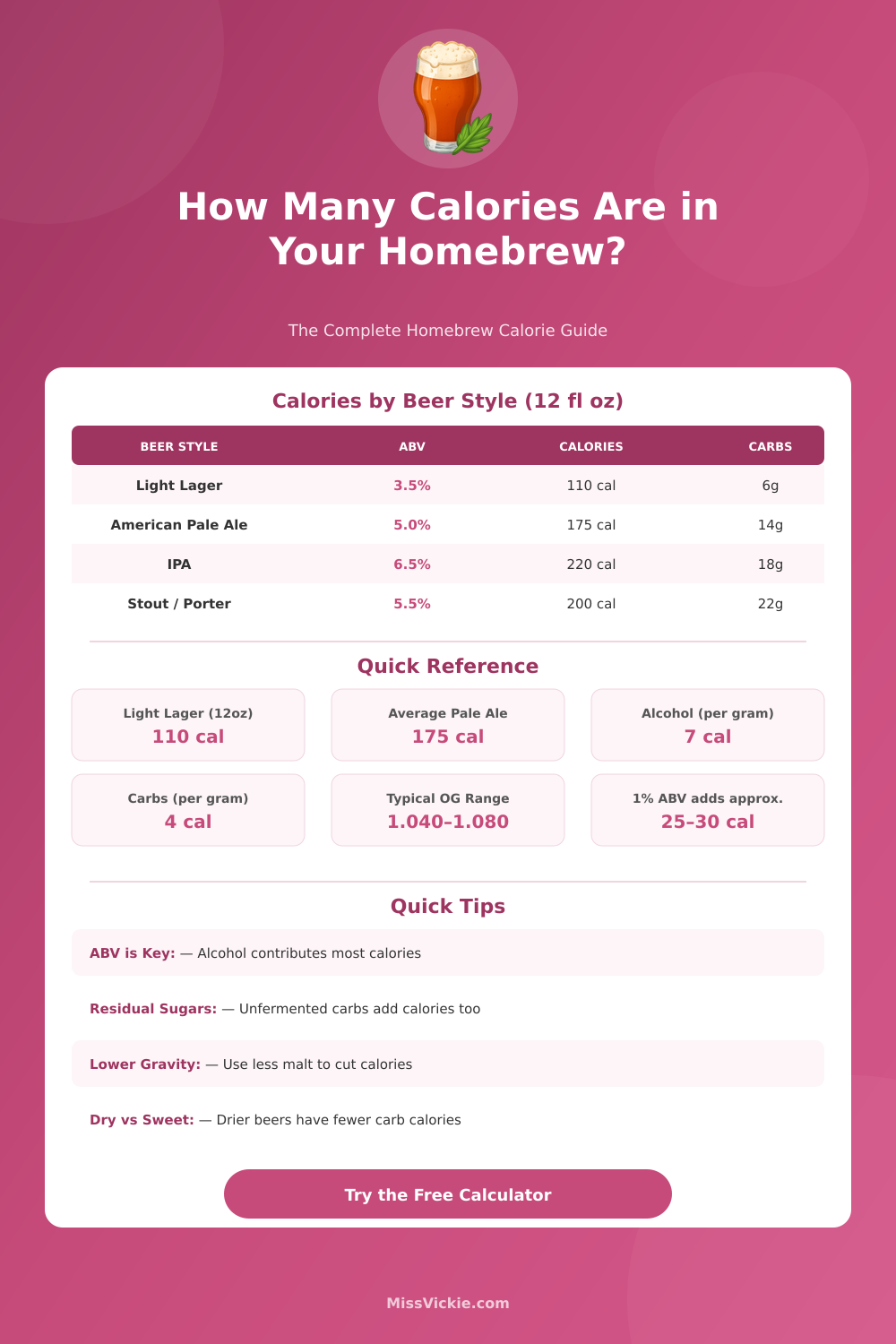
| Beer Style | ABV | 8 fl oz | 12 fl oz | 16 fl oz | Carbs/12oz |
|---|---|---|---|---|---|
| Light Lager | 3.5% | 73 | 110 | 147 | 6g |
| American Pale Ale | 5.0% | 117 | 175 | 233 | 14g |
| IPA | 6.5% | 147 | 220 | 293 | 18g |
| Stout / Porter | 5.5% | 133 | 200 | 267 | 22g |
| Hefeweizen / Wheat | 5.0% | 120 | 180 | 240 | 16g |
| Imperial Stout | 10.0% | 227 | 340 | 453 | 28g |
| Sour / Farmhouse | 4.5% | 110 | 165 | 220 | 12g |
| Amber / Red Ale | 5.2% | 123 | 185 | 247 | 16g |
| Barleywine | 9.0% | 207 | 310 | 413 | 26g |
| Saison / Belgian | 6.0% | 140 | 210 | 280 | 20g |
| Original Gravity | Final Gravity | Est. ABV | Est. Calories |
|---|---|---|---|
| 1.040 | 1.008 | 4.2% | ~130 |
| 1.048 | 1.010 | 5.0% | ~160 |
| 1.052 | 1.012 | 5.2% | ~170 |
| 1.060 | 1.014 | 6.0% | ~195 |
| 1.065 | 1.015 | 6.6% | ~215 |
| 1.080 | 1.018 | 8.1% | ~265 |
| 1.100 | 1.022 | 10.2% | ~335 |
| Beer | ABV | Calories | Carbs |
|---|---|---|---|
| Bud Light (commercial) | 4.2% | 110 | 6.6g |
| Budweiser (commercial) | 5.0% | 145 | 10.6g |
| Homebrew Light Lager | 3.5% | 110 | 6g |
| Homebrew Pale Ale | 5.0% | 175 | 14g |
| Homebrew IPA | 6.5% | 220 | 18g |
| Homebrew Imperial Stout | 10.0% | 340 | 28g |
Homebrew covers the world of making beer, wine, cider and mead at home. This is a hobby that ties brewers, mazers, vintners and cider makers, that all love to create their own drinks. The ideal of the homebrew community is a homebrewer in every neighbourhood and a homebrew club in every community.
The target is to praise and promote the art, science and pleasure of fermentation, while you build expert communities for today’s and future homebrewers
Homebrewing: Making Beer, Wine, Cider and Mead at Home
Home brewing was not federally legal until 1978. That astonishes many folks. Actually it already was allowed before the ban, and even George Washington brewed beer at home.
Things have come a long way since then.
Starting is more simple than you think. Top-rated starter kits for home brewing and recipes make the process accessible. Supplies for home brewing, prime ingredients for beer and wine are widely availabel.
A 2.5-gallon batch for brew-in-a-bag could be a good entry point for all-grain brewing. It maybe is the best size. The standard amount for homebrew recipes is 19 liters or 5 US gallons, because many home brewers like kegging in Cornelius kegs, that hold exactly 19 liters.
Discussion forums form an important part of the hobby. Here you talk about general homebrew topics, all-grain brewing, recipe exchange, as well as wine and mead making. Everything from yeast, grain, kits and more gets discussed.
Brewer’s Friend is a whole homebrew recipe designer with software, calculators, a brew day planner and a journal, for help to make the best beer always. An excellent way is to research forums and recipe sites, then create original recipes based on what sounds good.
Here are many rules about what had to happen. The try-it-and-adjust method works well for many folks.
Cooking with beer is another side worth knowing. Sean Paxton, known as The Homebrew Chef, gives useful tips to use beer in everyday and special recipes. On his website he shares his knowledge and experience about food and beer with the community by means of an original online cookbook, that offers scalable recipes with beer as an ingredient.
He works with pub owners and craft brewers across the country to host exclusive multi-course beer dinners. Homemade beer mustard recipes are a fun start, if you have beer and mustard seeds. A nearby homebrew store is also a great source for barley malts and rare kinds like wheat, rye or spelt.
Some bakers even tried making bread from their homebrew mash, although the bread can turn out too wet, if the method is not adjusted carefully.